Showing posts with label nuts and seeds. Show all posts
11.4.14
Rutabaga Spaghetti with Peas and Pistachios ‒ Lanttuspagetti herneillä ja pistaaseilla
The spring has been early this year, after practically no winter. I saw catkins already in February, caltsfeet flowers in March and right now finding some leftover snow is a matter of some serious search. Yesterday there were, pushing out of the ground, something green which I am almost certain was ground elder. It's definitely the time to get rid of the last root vegetables, berries in the freezer and dried nettles to make room for the fresh stuff.
This pasta dish was something I came up with one night when I came home late and hungry, from the ingredients I happened to have. This time we tried it with a bit more special twist, using a "pasta" famous among so-called paleo eaters and low carbers. By hand, it required some work, but the idea seems so great I'm seriously considering to buy a new kitchen gadget just to make sure I'll prepare this more often from now on.
- 1 large rutabaga (the bigger you can find the easier this gets)
- 2 tbsp canola oil
- 200 g frozen peas
- 1 dl roasted and salted pistachios, peeled
- 1 orange
- black pepper
Peel the rutabaga. Then take your peeler, a cheese slicer or a dedicated kitchen gadget. Try to carve out as long stripes out of the rutabaga as you can. When the whole of the yellow root is spaghettisized, steam the stripes a few minutes to get them half done. (If you prefer your spaghetti a little al dente, you can skip this step.) Then fry them on a pan with oil just enough to get some delicious browning on the edges.
You can finish the spaghetti with any of your favourite pasta sauce, but for this version, simply peel and cut the orange and then add the pieces into the pot, together with peas and pistachios. Stir. The dinner is ready when the peas have fully melted.
Nutritional values / 1387 g:
energy 987 kcal
fat 59 g
protein 35 g
carbohydrates 76 g
fiber 32 g
Tunnisteet:
low carb,
main courses,
nuts and seeds,
pasta,
peas,
rutabaga
26.1.14
Green Lasagna ‒ Vihreä lasagne
This is already the third lasagna recipe in this so-called Finnish-style food blog. None of my lasagnas have been exactly traditional though, and my personal twist is using more Finnish ingredients in the place of those typical to Italian kitchen. So before, I've replaced your average white wheat noodles with something as imaginary as finncrisps and zucchini. In the version at hand I used what I had at hand and ended up doing a green sauce instead of the tomato-based red one. Next time I thought to try making the white sauce too a bit differently, from nuts. That was even better but ended up too dry, especially on the surface, so this final recipe I'm posting now is the third incarnation in the development process. Feel free to substitute the dark green veggies according to availability and season.
- 12 spinach lasagna noodles (or regular full corn noodles)
- 3 dl lupin seeds or lentils
- 200 g cashew nuts
- 150 g frozen spinach
-1.5 dl dry and crunched nettle
- 1 broccoli or 150 g kale
- 1 onion
- 100 g pesto (or a bunch of fresh basil if you're growing a window garden, plus some extra oil and salt)
- 100 g melting soy cheese
- 3 garlic cloves
- 1 tbsp canola oil
- nutmeg
- black pepper
- white pepper
- salt
If possible, put the cashews in water during the previous night so they'll soften up. Soaked nuts are easier to blend with your average kitchen equipment. Use the water as well, so the consistency is on the runny side. Spice with garlic, white pepper, nutmeg and salt.
Chop the onion and sauté it lightly in oil. Add the broccoli and then the frozen spinach too. When the spinach has melted, add the lupins and half a litre of water. Crumble in the nettle, spoon in the pesto and sprinkle with black pepper. When the lupins are done, check the consistency of the sauce. You probably need to add water, but don't make it so runny it doesn't stick on the noodles.
Cover the bottom of an oven casserole with the lupin sauce. Layer with noodles. Cover the noodles with the cashew sauce. Repeat the process three to four times. See that the white layer is the top one. Sprinkle with soy cheese. Bake in the lowest shelve of a a 175°C oven for about 45 minutes. Let the lasagna rest for a moment before cutting so the layers hold together nicer.
Nutritional values / 1556 g:
energy 3263 kcal
fat 201 g
protein 151 g
carbohydrates 219 g
fiber 47 g
Tunnisteet:
broccoli,
Italian,
kale,
lentils,
lupin,
main courses,
nuts and seeds,
oven dishes,
spinach/nettle
18.9.13
Stuffed Black Currant Leaves ‒ Viinimarjanlehtikääryleet
I'm a bit of a fan of making "Finnishized" versions of dishes normally attributed to whole different nations. You take the basic idea of the dish but swap the main ingredients into some local ones. Often the result is closer to the original idea than the hardcore versions that count on finding preserved but hard-to-acquire ingredients in the place of fresh ones.
Last summer I got a packet of grape leaves so we made a large pot of dolmades, a Greek dish where rice is wrapped inside the leaves. They were great though I still don't know what grape leaves really taste like since those were heavily preserved in tartaric acid.
This year I thought I'd localize the recipe. Black currant leaves are very aromatic and currants in general are called "wine berries" or viinimarja in Finnish so I thought they'd work great in this type of a dish. Seems I'm not exactly the first person who's used them this way so I took some model from this recipe which also uses rice as the stuffing. Whenever a recipe calls for rice I usually apply oat but it tastes a bit mild. So this time I thought I'd try processed spelt for a slightly nuttier flavour. Most recipes seem to call for a really long list of spices which to me sounds like they're not sure to what direction they want to take it, so I went with a fairly simple list instead.
- 40 large black currant leaves
- 2 dl pearl spelt
- 0.5 dl pine nuts
- 1 small punch of fresh mint
- 3 garlic cloves
- 2 tbsp rape oil
- cinnamon
- clove
- salt
For the broth
- 1 dl rape oil
- 0.5 dl lemon juice
- 1 dose of stock
- 2 tsp brown sugar
- salt
Cook the spelt in salty water for about 20 minutes. Roast the nuts on a dry pan a bit so they'll get colour on their cheeks. Mince the garlic and the mint. Mix the stuffing ingredients together.
Cook the currant leaves in plenty of water for about five minutes to soften them up. Take two leaves at a time. Cut their stems off and place them on each other so they'll overlap in the middle. Scoop a teaspoonful of the stuffing in the middle. Fold the edges of the leaves on the stuffing and roll them into small cigars. Place each cigar carefully but tightly into a casserole.
Mix the broth ingredients and pour over the casserole. (Add some water too if the amount of liquid doesn't seem enough.) Place in a 150°C oven for about an hour. You can eat them right away, but if you have the patience you can wait a day or two for them to juice up in the fridge. This is also the reason why it's a great idea to make a big portion of them while you're at it.
Nutritional values / 628 g:
energy 2371 kcal
fat 192 g
protein 43 g
carbohydrates 149 g
fiber 30 g
Last summer I got a packet of grape leaves so we made a large pot of dolmades, a Greek dish where rice is wrapped inside the leaves. They were great though I still don't know what grape leaves really taste like since those were heavily preserved in tartaric acid.
This year I thought I'd localize the recipe. Black currant leaves are very aromatic and currants in general are called "wine berries" or viinimarja in Finnish so I thought they'd work great in this type of a dish. Seems I'm not exactly the first person who's used them this way so I took some model from this recipe which also uses rice as the stuffing. Whenever a recipe calls for rice I usually apply oat but it tastes a bit mild. So this time I thought I'd try processed spelt for a slightly nuttier flavour. Most recipes seem to call for a really long list of spices which to me sounds like they're not sure to what direction they want to take it, so I went with a fairly simple list instead.
- 40 large black currant leaves
- 2 dl pearl spelt
- 0.5 dl pine nuts
- 1 small punch of fresh mint
- 3 garlic cloves
- 2 tbsp rape oil
- cinnamon
- clove
- salt
For the broth
- 1 dl rape oil
- 0.5 dl lemon juice
- 1 dose of stock
- 2 tsp brown sugar
- salt
Cook the spelt in salty water for about 20 minutes. Roast the nuts on a dry pan a bit so they'll get colour on their cheeks. Mince the garlic and the mint. Mix the stuffing ingredients together.
Cook the currant leaves in plenty of water for about five minutes to soften them up. Take two leaves at a time. Cut their stems off and place them on each other so they'll overlap in the middle. Scoop a teaspoonful of the stuffing in the middle. Fold the edges of the leaves on the stuffing and roll them into small cigars. Place each cigar carefully but tightly into a casserole.
Mix the broth ingredients and pour over the casserole. (Add some water too if the amount of liquid doesn't seem enough.) Place in a 150°C oven for about an hour. You can eat them right away, but if you have the patience you can wait a day or two for them to juice up in the fridge. This is also the reason why it's a great idea to make a big portion of them while you're at it.
Nutritional values / 628 g:
energy 2371 kcal
fat 192 g
protein 43 g
carbohydrates 149 g
fiber 30 g
Tunnisteet:
black currant,
cold dishes,
Greek,
nuts and seeds,
oven dishes,
sidekicks,
snacks,
spelt,
veganmofo
17.9.13
Kale and Fava Bean Dip ‒ Lehtikaali-härkäpapudippi
I've had this wonderful sounding spinach dip in my bookmarks, waiting for me to do it with fresh nettle. There are some new shoots growing now, but since I have a lot of kale and green fava beans waiting I thought I'd try something similar with them instead. I did add some dry nettle from last year though.
The amounts in the original recipe are in those archaic measures that are a pain to convert into SI-system (I know, you doing the conversions the other way around end up with just as cumbersome fractions). Since this type of dish doesn't really call for specific amounts like, say, cookies would, I just added things with a freehand style. This base I developed would call for more liquid, but I have absolutely no complaints about the taste. It goes best together with rye crisps, corn snacks, veggie sticks or other such stuff with a more flavour and toughness than your average potato chip does.
- 200 g kale
- 200 g soy cheese
- 3 dl cooked fava beans
- 2 dl cashew nuts
- 0.5 dl lemon juice
- 0.5 dl dried nettle
- 0.5 dl nutritional yeast
- 3 garlic cloves
- 1 tbsp rape oil
- 1 tbsp pesto
- salt and pepper
Soak the nuts overnight or boil for about 20 minutes (this "quick-soaking" must be among the best kitchen tips I've heard for a while) to soften them up. Blend all the ingredients together, but save some of the cheese to sprinkle on top.
Bake for 15 minutes in a temperature of 175°C. Serve as a hot dip sauce or use between sandwiches.
Nutritional values / 969 g:
energy 2105 kcal
fat 139 g
protein 94 g
carbohydrates 119 g
fiber 32 g
Tunnisteet:
beans,
cold dishes,
kale,
nuts and seeds,
on the bread,
sauces,
snacks,
spinach/nettle,
veganmofo
22.8.13
Himalayan Balsam Pasta ‒ Jättipalsamipasta
The plant known as policeman's helmet or Himalayan balsam (Impatiens glandulifera) is native to the Himalayas, as the name might suggest for the brightest of us. In recent years however, it's become a real menace in Finland too. It looks pretty, so people have planted it in their gardens but it's managed to spread very effectively, invading the habitat areas of more domestic species with its huge and dense growing stalks. Luckily, unlike most other invasive weeds, this one is completely edible, so we can try to get rid of it by filling our bellies. Before flowering the stem can be used as a vegetable, the flowers themselves look decorative and the seeds make a nice snack. Unless of course, you let the pods explode and scatter their seeds all around up to seven metres. Simple minded people like me could be popping them open for hours in a row just for the fun of it.
This time of the year the stems have already gone a bit woody, but since I wanted to try this idea of filling them which I nicked from Sami Tallberg's Villiyrttikeittokirja (Readme.fi 2010), I wanted to try anyway. I was going to use cashew cheese here but since it had gone bad already while waiting for me to get round to actually doing this, I had to settle for basic store-bought spread. Tallberg describes the taste as peppery, but I got a little disappointed from the plant's lack of flavour, especially considering how aromatic it seems. This pasta might need something with more zest, say celery or extra apple. The seeds were crunchy and nice though, so they can make a nice addition to dishes. Next time I think Imight try roasting them a bit. Collecting them is less work if you wait until they're ready to pop open. Just place a bag around them and poke with your finger.
- 250 g good quality pasta
- 3 Himalayan balsam stems
- 1 dl Himalayan balsam seeds
- 4 small apples (not those watery market varieties but real apples)
- 5 spring onions with their stalks
- 50 g soy-based cream cheese spread
- 0.5 dl white wine
- 2 tbsp rape oil
- 1 tbsp spruce syrup
- 1 garlic clove
- white pepper
- salt
- flowers to decorate
Cook the pasta in well salted water. Chop the onions and sauté them in plenty of oil.Cut the apples in four parts and remove the core. Throw them on the pan as well. When the pasta is done, pour away the water. Then add the onions, the apples, the wine, the syrup and the seeds.
Crush the garlic. Mix it and pepper with the cream. Peel the balsam stems and fill them with the cream. I find this is easiest done with a syringe. If the cream seems too thick for this, add a little bit of oat milk. Cut the stems in pieces.
Arrange the stems on pasta portions. Decorate the plate with some flowers.
(I wasn't able to find any nutritional information for the balsam, so I guess there's no point in counting it for the rest of the dish either. I'll add it here in case the situation should change.)
Tunnisteet:
himalayan balsam,
main courses,
nuts and seeds,
pasta,
summer
21.8.13
Pea Soup from Fresh Peas ‒ Hernekeitto tuoreista herneistä
The weekend was quite inspirational when it comes to food. This is why every food enthusiast should regularly try dishes completely different from their own stables. It helps to remember: oh yes, so many different flavours and mouth feels exist and I too, could try achieving them and learn how to change between worlds so different.
On Saturday I went to my 2-month old godchild's naming ceremony. The proud parents invited both of their families to enjoy oh-so-classic standing stable meal similar to the ones I've eaten in almost every wedding and funeral I've ever taken part of. I had potatoes with brown sauce, bean salad, broccoli gratin, a nettle-filled bread roll and the drink of Louhisaari. And the star of the day got a pretty name too. She became Taru, a name meaning fairytale in Finnish. With a name like that she just must inherit her mum's red hair. After all, daddy already bought her first tank.
On Sunday we went to four pop-up restaurants of the Restaurant Day held all over the city. We got dadaist Russian-inspired pizza with sauerkraut, chili packed inside focaccia in the park, raw sushi and green smoothie from an Alice of Wonderland and vegetable soup with very lovingly combined garnishes together with kombucha in the balcony of a yoga school located in the harmonious surroundings of Pyynikki. All of them were made with care and carried along the very personalities of their makers. This is something I never seem to find from real restaurants. Recently I flipped through an acquaintance's portfolio pictures from cook school and got really depressed on how uninspired and unappetizing their meals looked and sounded. But it's only his first year so perhaps I shouldn't blame the whole field yet. At least they seem to concentrate on something of more substance than disguising the plates as abstract art.
On both days I also dropped by in Chilifest, held in the main square, where some severely badass people compete over the world championship of eating naga morich. We just settled for shopping sauces and spices. No new younglings as impulse buying this time since our window shield is quite full of chili plants already. Perhaps I should try more about incorporating the fiery fruits in traditional Finnish dishes.
Coming back to the "what should I cook today" subject with my head squirming with fresh ideas, I thought that for once, I could try making the classic Thursday soup while the main ingredient is still fresh from the stalk. Interestingly enough, nearly all the recipes I found when trying to google similar ones actually used frozen peas though the name talked about freshness. It's quite alright to make this quick soup for lunch or dinner in wintertime too, but please don't try to deceive me with a badly chosen title.
Unlike in the dried pea version, I pureed most of the peas to achieve a velvety structure and tweaked it more summerish with fresh tasting herbs. The main spice is sage, inspired by the famous Saint-Germain soup. You can also let this cool down before enjoying on a hot day.
- 1 l fresh pea pods (or 400 g frozen peas)
- 5 dl water
- 1 dl oat cream
- 1 small punch of fresh sage
- 2 garlic cloves
- 1 portion of stock
- small piece of horseradish
- mint
- thyme
- salt
Peal the pods and put the peas in a pot together with the water. Add the spices as well. Let the peas summer until they're soft. Puree the whole soup. (I like to use a hand-held blender for this since it still leaves bits and pieces untouched and the structure thus more varying.)
Mix the cream with the rest of the soup. Garnish with herb oil, lightly roasted sunflower seeds and couple of salvia leaves. Especially nice if served with an oven-baked bread.
Nutritional values / 1000 g:
energy 283 kcal
fat 10 g
protein 13 g
carbohydrates 38 g
fiber 13 g
Tunnisteet:
cold dishes,
nuts and seeds,
peas,
soups,
summer
22.6.13
Cherry and Dark Chocolate Ice Cream ‒ Kirsikka-tummasuklaajäätelö
Being a child of warmness and light, I love the way how these nightless nights try their best to compensate the darkness and heaviness of winter. It's no accident that the more north you go the more metalheads there are. It's a bit disturbing sometimes to realise that the Portuguese guy dressed in black and chains, who you just met, is really a representer of a scared and ridiculed marginal group, when you're used to this stuff being completely mainstream. This applies inside Finland too: there are more dedicated metal music listeners in Oulu than there are in Helsinki.
But for me, heavy music is an inseparable part of the light of midsummer too. I've spent most of my adulthood midsummers in a heavy festival Nummirock, held in the middle of nowhere by the village's farmer society, because the atmosphere is the friendliest and most peace-loving I've seen in any mass event, coming from both the audience and the workers, who tend to overlap. So this morning I had to put on some black metal.
The plus side in listening the stuff at your own home is that you can have dark, homemade ice cream while you're at it! This time I tried making the base from nut cream for the first time, but this would work just as well with oat or soy cream. Also, this was the first time I tried my flatmate's ice cream machine instead of making the stuff by hand like I normally do. The plus side was of course that it happened more quickly but on the other hand, the stuff never ended up as cold and thick as I had hoped for. From what I've gathered from different net forums, apparently if you're going to use a machine for the job you should buy a good one, good in this case meaning expensive. But can't whine, all of this disappeared quicklier than you can growl the name.
- 4 dl cashew nuts
- 2 dl water
- 300 g cherries
- 2 dl cherry jam or puré (or 1 dl sugar)
- 100 g dark chocolate
- 4 tbsp cocoa powder
Blend the nuts together with the water. This works easier if you've let them soak for the previous night. Mix in the jam and the chocolate powder. Chop the chocolate. Remove the cherry stones and quarter the cherries. You can add the cherries and the chocolate now or at the very end of the process. Pour the stuff into your ice cream maker and follow its instructions.
Enjoy while listening to this for it's no light treat. Only cold.
Nutritional values / 1076 g:
energy 2503 kcal
fat 144 g
protein 63 g
carbohydrates 236 g
fiber 17 g
Tunnisteet:
cherries,
ice cream,
nuts and seeds,
raw,
sweet
30.4.13
Sun Rolls ‒ Aurinkosämpylät
We've had an exceptionally cold spring this year, but now it finally looks like the snow has withdrawn (at least for a while). To get to enjoy wild veggies quicker, I tried to lure out the Sun from behind those clouds with these rolls I made for a housewarming present.
Rolls like these are usually among the first things Finnish kids learn to bake on their own. Still, I've been looking for the perfect recipe for most of my life. They didn't rise at all, they became too dense, they tasted like sugar buns. Eventually I've come to the conclusion it's not really about the recipe, it's about the touch and some basic rules you need to learn by experience. This is why I tried to include some tips I've found helpful in the recipe, so the instruction part may seem a bit complicated than usual, though it's not really.
- 10-12 dl flour (mostly white wheat flour, but do try experimenting with adding different full corn flours, wheat germ or such for less bun-like results)
- 5 dl water (some use oat milk or such but I wouldn't bother)
- 50 g margarine
- 50 g fresh yeast (I've found dry yeast harder to control)
- 1 tbsp dark syrup
- salt
- 2 carrots
- 1.5 dl sun flower seed
Make sure all the ingredients are room temperature. Dissolve the yeast in water (which doesn't need to be warm). Add the syrup, the salt, part of the flours and the margarine. Keep kneading with your hand while you add flours little by little. Optionally, crate in the carrot and the sunflower seeds too.
Add flour just enough to get the dough to detach from your bowl but see it still sticks to your fingers. Using more flour than you absolutely need just gives you hard buns. Also, if you're using old flours you'll need less than fresh ones. Knead at least ten minutes more to make sure you get long, pretty strings and gets some of that seitan-style structure. Smoothen the surface of the dough, cover with a towel and let it rise until it's doubled its size (should take less than an hour).
With a sharp knife, take fist-size pieces of the dough and carefully roll a bit between your hands. If you wish, decorate by cutting a cross (Sun symbol!) on them and sprinkling some more seeds. Place the rolls on the baking sheet, put the baking sheet in a warm place (like over a sink filled fit hot water if you don't have any better place) and cover again for half an hour. For a bit nicer colour, spray a little water with a spray bottle.
Bake in 225°C for 8-10 minutes. If you let them be a little longer you'll get crunchier surface. When they come out of the oven, instantly cover them with a towel to keep them soft longer. These are at their best on the same day.
Nutritional values / 1505 g:
energy 3426 kcal
fat 97 g
protein 116 g
carbohydrates 525 g
fiber 43 g
Tunnisteet:
bread,
carrot,
nuts and seeds,
snacks,
winter
21.4.13
Raw Buckwheat Porridge ‒ Raaka tattaripuuro
A typical Finnish breakfast to date is still porridge. According to this survey, that's what 40% of Finns eat, while 11% uses cereals. I've always been more on the bread league myself, but sometimes it's nice to get variation.
Raw porridge as an idea sounded like something only a very dedicated hippie would eat but once I managed to ovecome my prejudices this turned out quite yummy indeed. You could use any other grain you wish here, besides buckwheat at least millet, barley and oatmeal seem popular. If you add some dried fruits and berries it becomes surprisingly sweet as well.
- 2 dl barley
- dried berries and/or fruits, rosehips in this case
- nuts and/or seeds, sunflower seeds in this case
- enough water to cover it all
In the evening, put everything in a bowl to soak for the night and cover up with water. In the morning, blend smooth. Serve with berries or jam. (The ones you see in the picture are gooseberries, by the way.)
Nutritional values / 1152 g:
energy 2503 kcal
fat 124 g
protein 68 g
carbohydrates 276 g
fiber 89 g
Tunnisteet:
buckwheat,
gooseberries,
nuts and seeds,
porridge,
raw,
rose,
slow cooking
20.4.13
Greenish Karelian Pies ‒ Vihertävät karjalanpiirakat
I feel people are often way too conservative when it comes to dishes where the whole idea is that you can stuff them with anything at hand. For karelian pies this nearly always means rice porridge. My personal favourite is still a rather classic turnip filling, but this combination has also managed to attract praises. Couple of times I've run out of the filling though there was still crust left, so if you want to play safe increase the amounts in the stuffing part a little.
Basic crust recipe
With a modernized filling:
- 200 g frozen peas
- 2 dl hazelnuts
- 1 lime
- 1 tbsp dark syrup
- white pepper
- salt
If possible, let the nuts soak in water the previous night. Make the crust as usual. Mash the peas and the nuts together. Wash the lime, crate some of the peel and squeeze the juice. Mix with the pea and nut mash together with seasonings.
Stuff the pastries with your filling and continue to heating the oven and wrinkling and as usual.
Nutritional values / 1152 g:
energy 2503 kcal
fat 124 g
protein 68 g
carbohydrates 276 g
fiber 89 g
Basic crust recipe
With a modernized filling:
- 200 g frozen peas
- 2 dl hazelnuts
- 1 lime
- 1 tbsp dark syrup
- white pepper
- salt
If possible, let the nuts soak in water the previous night. Make the crust as usual. Mash the peas and the nuts together. Wash the lime, crate some of the peel and squeeze the juice. Mix with the pea and nut mash together with seasonings.
Stuff the pastries with your filling and continue to heating the oven and wrinkling and as usual.
Nutritional values / 1152 g:
energy 2503 kcal
fat 124 g
protein 68 g
carbohydrates 276 g
fiber 89 g
Tunnisteet:
coffee table,
Karelian,
nuts and seeds,
peas,
rye,
snacks
13.4.13
Lettuce Wraps ‒ Salaattikääröt
I've sometimes thought about ordering tempeh fungus and try if it would work with peas as well. Turns out someone else has thougt about that as well and succeeded. You can now find domestic pea and lupine tempeh from Finnish stores. Apparently, horse bean tempeh is also possible to make. Next time I feel like a chemistry project, this is very likely the way to go. In the meanwhile, I can recommend at least the lupine version. In this case it's made of blue lupins grown in Lapua.
The package was rather small, so I had to come up with a way to incorporate it into a bigger dish without losing the tempeh taste in the mix. So I tried using salad leaves as a wrap like I've seen done in raw food blogs. On paper the combination sounded great and fresh but in practise these started to turn me off quite soon. Perhaps I shoul've used some less bland type of lettuce or collard than an iceberg head. Or maybe I shouln't have used that virgin oil when making the mayo since it tends to have much too strong a flavour. Nevertheless, this combination was clearly missing something. Perhaps this combination was a bad one all in all. Still, I'm going to write it down to hopefully give you guys better ideas.
- 1 lettuce head
- 150 g lupine tempeh
- 2 dl hazel nuts
- 1 dl mayonnaise
- 240 g canned artchoke hearts
- 1 tbsp mustard
- oil for frying
- black pepper
- salt
Blend the mayo with artichoke hearts and mustard. Slice the tempeh and fry lightly, seasoning only with salt and pepper. Crunch the nuts.
Carefully peel the lettuce leaves off. Fill them with a spoonful of artichoke mayonnaise, tempeh pieces and nut crunch. Wrap the edges on each other so the fillings will keep inside. Enjoy fresh.
Nutritional values / 1144 g:
energy 1575 kcal
fat 125 g
protein 52 g
carbohydrates 62 g
fiber 29 g
Tunnisteet:
artichoke,
cold dishes,
collard,
failures,
nuts and seeds,
snacks,
tempeh
15.1.11
Stuffed Holiday Roast with Cranberry Glaze ‒ Täytetty juhlapaisti karpalokuorrutteella
Yule ended last Thursday with Talvennapa, "the navel of the winter". It's said to be the coldest day of the year. The Great Oak is symbolically cut down from covering the Sun so it gets to shine and daytime starts to grow longer again. Most people celebrating the day choose a weekend instead of the "official" day when there's more time to relax.This roast should be a perfect centerpiece for any feast table. I took the inspiration from Vegan Dad's seitan roast and tofu glaze. The latter one especially turned out excellent. The stuffing portions need some adjusting as I got quite a lot of leftovers. But don't worry, you can eat them while waiting for the roast to cook.
- 1 dough for seitan roast
Stuffing:
- 1 dl barley
- 1 dl pine nuts
- 1 dl horse beans
- 1 dl grinded celeriac
- 1 dl frozen cranberries
- 0.5 dl roasted onion
- 1 tablespoon margarine
- 1 tablespoon wheat flour
- green pepper
- salvia
- thyme
- herb salt
Glazing:
- 2 dl frozen cranberries
- 1 dl water
- 0.5 dl dark sugar
- 1 tablespoon vinegar
- cinnamon
- allspice
Roast the nuts if you wish. Cook the barley and the beans. Mix all the stuffing ingredients together. While it's cooling down, prepare the seitan part.
Roll out the seitan dough into a thin rectangle. Spread the stuffing in the centre lengthwise. Make sure it's firm. Roll the seitan tightly so the edges will touch each other. Seal the roast and wrap inside a tin foil. Roast for an hour in 175°C oven.
In the meanwhile, prepare the glaze. In a saucepan, cook the cranberries with the water until they're soft. Blend smooth. Stir in all the other ingredients. Refrigerate. When the roast comes out of the oven, let it cool down as well. Then move the roast into a casserole and cover all over with the glaze. Bake 10-15 minutes more.
Enjoy hot or cold!
Nutritional values / 1680 g:
energy 3318 kcal
fat 121 g
protein 242 g
carbohydrates 321 g
fiber 56 g
Tunnisteet:
barley,
cranberries,
main courses,
nuts and seeds,
seitan,
winter,
Yule
1.1.11
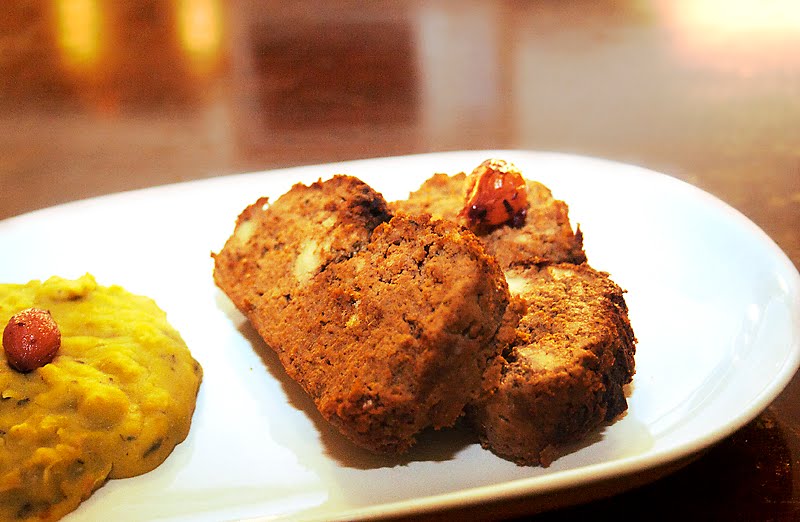
Tofu and Nut Loaf ‒ Tofu-pähkinämureke
Have a happy year 2011! I guess most Finns were shooting fireworks and throwing wild parties last night but to be quite honest, I've never really understood the fuss over a changing number or why Gregorian calendar even places the New Year to the middle of winter in the first place. After all, I already cast my new year tin during Kekri. So yesterday evening we just took a nap after an exhaustive work week, ate a nice meal, drunk some cider and watched a surprisingly boring movie about the French revolution.Anyway, here's a loaf recipe on the fancier side for such occasions. I've originally taken it from the Finnish animal rights forum and usually prepare it for the Yule table as the poster suggests (among my non-traditional food traditons). It's quite salty, because it's meant to be eaten together with several other standing table dishes (and fits excellently on toasted bread on the next morning). If you'd rather have it as the star of the table, you may want to replace some of the soy sauce with plain water or saltless vegetable stock.
- 75 g hazelnuts
- 90 g almonds
- 165 g cashew nuts
- 540 g firm tofu (I like it best smoked but plain goes just fine)
- 4 toasted white bread slices
- 1 punch of fresh parsley
- 1 small punch of fresh salvia
- 1 dl soy sauce
- 2 tablespoons Dijon mustard
- 1 teaspoon paprika
- basil
- thyme
- black pepper
Add the ingredients into a mixer one by one. Keep mixing until you have a paste. Butter a casserole or and spread evenly into it. Garnish with bread crumbs if you wish and make some wrinkles with your fingers. Bake in 175°C for about an hour or until beautifully brownish.
Nutritional values / 1200 g:
energy 3152 kcal
fat 224 g
protein 177 g
carbohydrates 115 g
fiber 37 g
Tunnisteet:
cold dishes,
main courses,
nuts and seeds,
on the bread,
oven dishes,
tofu/hefu,
winter,
Yule
11.12.10
Red Cabbage Salad ‒ Punakaalisalaatti
Tonight we'll be having our own traditional pikkujoulu party with a group of friends, just like we did last year. The idea of trying weird glögis turned out so well last time we thought we'd repeat it with some fresh recipes. I've also baked a chocolate cake for the occasion but I haven't tasted yet in which way is it to die for.While waiting for the dessert, here's an extremely simple sidekick salad. It takes practically no time to prepare so it's just what you need when noticing your Joulu table is still missing something fresh. Cabbage and lingonberry are quite a regular combination in Finnish kitchen but somehow the nuts give it that special festive feeling.
- 500 g red cabbage
- 3 dl walnuts
- 2 dl lingonberry cram (with only a hint of sugar)
Shred the cabbage. Combine everything. Say: "Hyvää ruokahalua!"
For hi-fi version, toast the nuts. Depending on what else you're having on the plate you could also add couple of tablespoons of (nut) oil and some fennel seeds.
Nutritional values / 815 g:
energy 1401 kcal
fat 119 g
protein 35 g
carbohydrates 47 g
fiber 41 g
Tunnisteet:
cabbage,
lingonberries,
nuts and seeds,
raw,
salads,
winter,
Yule
5.8.10
Tomato Morsels ‒ Suupalatomaatit
These are very simple cocktail bites to emphasize the pour goodness known as cherry tomatoes. I was pondering what to use as the filling when I came across this blog post. I guess you could grill them while you're at it but why bother?- 250 g cherry tomatoes
- 2 dl thick nut yogurt (I used macademias)
- 1 tablespoon fresh thyme (or herb of your choice)
Mince the thyme and mix with the nut paste. Hollow out the tomatoes. (Use the insides later in a soup or a sauce.) Refill with the nutty sourness.
Enjoy with black currant jam.
Nutritional values / 310 g:
energy 461 kcal
fat 44 g
protein 6 g
carbohydrates 17 g
fiber 9 g
Tunnisteet:
nuts and seeds,
raw,
snacks,
sour,
tomatoes
3.8.10
Clover Balls ‒ Apilapyörykät
I could swear I've seen a recipe for red clover balls somewhere but can't find it anymore. Now I just had to guess what would make a fitting base. Instead of just adding the flowers to my classic soy balls I decided to use raw nuts and prepare the balls like raw foodies do. With spices I thought it best to be careful and only use couple of my favourites. Oh well, I'm assuming the original recipe was published in the beginning of the last century so it wouldn't have helped me in deciding the spices anyway.This small test batch of mine turned out nice (especially with a spicy dip sauce) but not good enough yet for me not feeling the urge to fry them on a pan. Feel free to add all kinds of stuff you need to get rid of. Carrots, leek, champignons or rye bread should fit to suggest a few, and of course your favourite spices.
- 2 dl red clover flowers
- 2 dl hazelnuts
- 2 garlic cloves
- smoked paprika
- salt
Soak the hazelnuts in water overnight if you have time. Wash the clovers. Make a paste out of all the ingredients. Add water if you need to. Check the taste.
Roll into balls and dry them up. In most kitchens this is easiest done by turning your oven to a low temperature (I use 50°C), possibly keeping the door just a little bit ajar and turning them around couple of times. The problem with this method is that it takes some time, about 2 hours depending on the moisture of the paste.
(This time I'm leaving out the nutritional values since I wasn't able to find any source for the flowers and it doesn't make sense to count the nuts only.)
Tunnisteet:
balls and patties,
clover,
flowers,
nuts and seeds,
raw,
summer
20.7.10
Sandwich Cake ‒ Voileipäkakku
You can use any soft bread together with bread spreads you like, for example hummus, guacamole or thick mayonnaise. It's not even rare to see several flavour options in the same coffee table if there are a lot of guests (and coffee table culture is a serious business for Finns - something you shouldn't play around with). Here's one model to tweak.
- 1 loaf that fits into a loaf tin (white, dark or slices from both)
- 200 g cherry tomatoes
- 125 g radish
- 1 bunch of fresh parsley
- vegetable broth for moistening (or oat milk)
1. filling:
- 2 dl cooked horse beans
- 2 tablespoons tahini
- 1 bell pepper
- 1 onion
- 1 tablespoon rape oil
- basil
2. filling (and frosting):
- 1 portion of cold cucumber soup, only with the yogurt drained first and the cider replaced with two tablespoons of white wine to make it thicker.
3. filling:
- 100 g soft tofu
- 1 dl hazelnuts
- 1 artichoke (or a young cabbage head)
- 2 tablespoons of mustard
Cut the bread lengthwise in four pieces (and remove the crust if it feels hard). Moisten the pieces by sprinkling vegetable broth on them.
Chop the bell pepper, the onion and the artichoke. Oil them and roast in a 200C oven for about half an hour. Remember to turn them around every now and then. Prepare the fillings by mashing together the ingredients. It's ok to leave clumps.
Slice the radishes and half the cherry tomatoes. Now you're ready to put the whole beauty together. Place the top bread slice into your loaf. Spread with the first filling and add some radish slices. Place the second and the bottom layer in the same manner. Flip the whole thing over onto your serving plate and remove the loaf. Cover with the middle filling. Decorate with cherry tomatoes and parsley.
Nutritional values / 3574 g:
energy 5516 kcal
fat 126 g
protein 219 g
carbohydrates 806 g
fiber 168 g
Tunnisteet:
artichoke,
beans,
bell pepper,
coffee table,
cold dishes,
cucumber,
nuts and seeds,
on the bread,
radish,
Scandinavian,
slow cooking,
tofu/hefu,
tomatoes
14.5.10
Nettle Pesto ‒ Nokkoslevite
They say young nettles won't sting. "They" couldn't be more wrong. It's starting to be the best time to pick those delicious and nutritious shoots and leaves but don't do it like I do. Wear gloves. Can't believe I forget it each and every year.Another thing you might want to learn from my mistakes is to check what you're foraging exactly. Once again I fished out some grass, a few brown leaves and two dead larvae (that probably weren't dead to begin with) from my nettle pot. Nettles can be eaten raw as well but you do understand why I prefer to leach them.
- 2 dl young stinging nettle leaves
- 1 dl pine nuts (or sunflower seeds)
- 0.5 dl rape oil
- 2 tablespoons nutritional yeast
- 2 garlic cloves
- fresh coriander (or herb of your choice)
- black pepper
See that all your nettle leaves look healthy and free from insects. Leach them for ten minutes or so. Puré with all the other ingredients. Use as a pasta sauce or spread on your bread.
Nutritional values / 205 g:
energy 852 kcal
fat 87 g
protein 18 g
carbohydrates 13 g
fiber 8 g
Tunnisteet:
nuts and seeds,
on the bread,
sauces,
spinach/nettle
1.5.10
Tippaleipä
Tippaleipäs saw the day of light during the 18th century in the homes of the nobility but ironically enough they're nowadays almost entirely associated with Labour Day, along with potato salad, donuts, wieners and mead. The basic idea is pretty much the same as in strauben from Austria or funnel cake from Dutch area of the U.S. You drizzle batter into hot oil and get little cakes that demonstrate how human brains work. Somehow tippaleipäs manage to be crunchy and soft at the same time. Some find their outlooks rather dubious but I think they're fun to look and eat, tube by tube.So yes, they seemed like enough reason to boil a litre of oil for the first time in my life. To my surprise that turned out quite easy. Didn't get even first degree burns though I happen to be rather prone to accidents.
The batter:
- 5 dl dark wheat flour
- 4 dl soy milk
- 3 dl water
- 0.5 dl dark syrup
- 0.5 dl flax seed
- 2 teaspoons baking powder
- 0.5 lemon peel (plus a drop of the juice)
- salt
Other stuff:
- 1 l rape oil
- piping equipment (I used a washed ketchup bottle)
- round metal mould (I used washed fruit cans)
- tongs for the mould
- a slotted spoon for the tippaleipäs
- newspapers
Soak the flax seeds in the water for about an hour to achieve slime. (Filter out the seeds if you don't want them in the final pastries.) Whisk the slime together with the other batter ingredients. See that your batter is very even and clumpless. Fill the ketchup bottle.
Heat up the oil. Place the mould into the hot oil. Squeeze a free-form batter web into the mould. (If you have more patience than me you can add more layers after the previous layer has started floating, achieving a tall type of tippaleipä they sell in markets. If you add batter too soon it will loose its shape. I find it easier to just pile them up.) Let it fry for a moment, detach from the mould and flip it over. When the tippaleipä looks golden and delicious, fish it out with the slotted spoon and drain over newspapers. Repeat as long as you have batter.
If you wish decorate with powdered sugar. Serve with mead.
Nutritional values / 1285 g:
energy 3160 kcal
fat 206 g
protein 50 g
carbohydrates 277 g
fiber 29 g
Tunnisteet:
coffee table,
deep frying,
flax,
German,
May Day,
nuts and seeds,
spring,
sweet
27.3.10
Verdant Lunch Salad ‒ Vehreä lounassalaatti
Now that it's bright again and things are getting warmer it feels more attempting to skip a warm meal.- 4 dl canned peas or pea sprouts
- 10 g arame (or seaweed of your choice)
- 1 dl pickle dices
- 1 red onion
- 2 slices of rye bread
- 1 tablespoon oil used in preserving sun-dried tomatoes
- 1 tablespoon hazel nuts
- 1 tablespoon sea buckthorn juice
Let the seaweed soak in water. Dice the bread and sauté the cubes in the oil. Slice the onion into circles. Crush the nuts. Fish the seaweed out from the water (which you can use in a soup or sauce) and spice with the juice. Arrange everything but the nuts into an aesthetically pleasing art work that you can jumble up when eating. Sprinkle the nuts on top for the final touch.
Nutritional values / 648,5 g:
energy 734 kcal
fat 24 g
protein 34 g
carbohydrates 88 g
fiber 26 g
Tunnisteet:
algae,
nuts and seeds,
peas,
rye,
salads,
sea buckthorn
Subscribe to:
Posts (Atom)
Osta neljä tuotetta ja maksat vain kolmesta - Luomutallin kampanjatuotteet näet täältä

Teekauppa.fi - laadukasta teetä netistä
Ostoskorin loppusummasta vähennetään viisi euroa ja toimitus tapahtuu ilman postikuluja.
Syötä ostoskoriin kuponkikoodi:
syysteet
Tilauksen on oltava vähintään 35 eur, mistä jää maksettavaksi 30 eur.
Teekauppa.fi - laadukasta teetä netistä
Ostoskorin loppusummasta vähennetään viisi euroa ja toimitus tapahtuu ilman postikuluja.
Syötä ostoskoriin kuponkikoodi:
syysteet
Tilauksen on oltava vähintään 35 eur, mistä jää maksettavaksi 30 eur.