Showing posts with label main courses. Show all posts

11.4.14

Rutabaga Spaghetti with Peas and Pistachios ‒ Lanttuspagetti herneillä ja pistaaseilla


The spring has been early this year, after practically no winter. I saw catkins already in February, caltsfeet flowers in March and right now finding some leftover snow is a matter of some serious search. Yesterday there were, pushing out of the ground, something green which I am almost certain was ground elder. It's definitely the time to get rid of the last root vegetables, berries in the freezer and dried nettles to make room for the fresh stuff.

This pasta dish was something I came up with one night when I came home late and hungry, from the ingredients I happened to have. This time we tried it with a bit more special twist, using a "pasta" famous among so-called paleo eaters and low carbers. By hand, it required some work, but the idea seems so great I'm seriously considering to buy a new kitchen gadget just to make sure I'll prepare this more often from now on.

- 1 large rutabaga (the bigger you can find the easier this gets)
- 2 tbsp canola oil

- 200 g frozen peas
- 1 dl roasted and salted pistachios, peeled
- 1 orange
- black pepper

Peel the rutabaga. Then take your peeler, a cheese slicer or a dedicated kitchen gadget. Try to carve out as long stripes out of the rutabaga as you can. When the whole of the yellow root is spaghettisized, steam the stripes a few minutes to get them half done. (If you prefer your spaghetti a little al dente, you can skip this step.) Then fry them on a pan with oil just enough to get some delicious browning on the edges.

You can finish the spaghetti with any of your favourite pasta sauce, but for this version, simply peel and cut the orange and then add the pieces into the pot, together with peas and pistachios. Stir. The dinner is ready when the peas have fully melted.

Nutritional values / 1387 g:
energy 987 kcal
fat 59 g
protein 35 g
carbohydrates 76 g
fiber 32 g

26.2.14

Salmiakki Sauce for Seitan and Beet ‒ Salmiakkikastike seitanille ja punajuurelle


When I dine at a restaurant I find it very pleasant if the menu clearly states what's in a given dish, for example "Chili rubbed seitan steak, raspberry vinegar marinated beets and salmiakki sauce". It gives me as a customer much better idea of what to order if the name isn't just some fancy French word I don't know how to pronounce. But when I see this elsewhere, peculiarly in recipes, for some reason I find it annoying and just trying to sound fancy, for example "engine oil rubbed Tavastian soap with small stones and slowly caramellized rubber". It's really a combination of the different ingredients or even separate dishes, and guess my logic goes that this means that any given part of that plate isn't really worth repeating or at least the recipe writer doesn't believe it is. Guess I'm only annoyed because this has becme some sort of a fad among Finnish celebrity chefs. Anyway, I try to avoid that happening in my recipes, although I realize I might just have an attitude problem. Sometimes the combination of tastes truly is the more important thing than any given part of it. Taste pairing might just be the single most important part of kitchen art.

This is the case of this recipe too. Although the part needing a recipe is really just for the sauce, I couldn't help but putting a suggestion of what comes under the sauce in the headline. These three tastes are just fine on their own, but they work especially well together, so I thought to highlight the combo. The idea came from a salmiakki marinated beet starter dish, created by a salmiakki making company, but I thought to turn it into an entrée. For the seitan, I used chili in the dough and fried them well in oil. For the beets, I sliced them thin, drizzled with oil and raspberry vinegar, as well as spiced with salt and thyme before roasting them in the oven long just long enough to still have them crunchy. The portion is crowned by the sauce which has a lot subtler aroma than you might think.

- 150 g salmiakki candy (hard ones are best in this, I used Turkinpippuri) + 1 dl water
 - 4 dl strong vegetable bouillon
- 1 dl white wine
- 2 tbsp margarine
- 2 tbsp wheat flour
- black pepper
- salt

Prepare a salmiakki syrup by putting the candies in a small bowl and pouring water on them just enough to get them covered. Turn around with a spoon when you walk by. Dissolving only takes a few hours, so if you start in the previous evening, you can be sure they'll make it in time.

Melt the margarine in a sauce pan. Shift the flour on the melted stuff and stir. Pour in the stock before the roux start to turn brown (unlike in basic brown sauce). Let the sauce thicken on a low heat, stirring occasionally. Add the salmiakki syrup and the wine. Let the sauce reduce until the consistency is thick enough to stay on the seitan. Spice with salt and pepper according to your taste buds.

Nutritional values / 798 g:
energy 882 kcal
fat 22 g
protein 2 g
carbohydrates 144 g
fiber 1 g

6.2.14

Black Trumpet Sausage ‒ Mustatorvisienimakkara


Mustamakkara, literally "black sausage" is very likely the most famous speciality of my home city Tampere. It's basically a groat sausage which gets its Gothic colour from blood and is usually served with lingonberry sauce. For years I've had this weird urge to make a vegan version out of it (Hey why not? Edinbourgh is full of pubs serving vegan haggis.) but had absolutely no idea what I could use in it.

As I've mentioned before, there are several traditional Finnish sausage types with no meat in them. I was especially delighted to find a recipe for a mushroom sausage that is otherwise vegetarian but uses real intestines as mold. I wouldn't know how to get those even if I wanted to, but this gave me an idea of using black trumpets when mushrooms are called for. They should naturally make a black sausage, so this might be an idea in line with the name. My version is a bit different though, containing gluten flour for added firmness and fillingness.

I've never actually tasted the blood version so I did some questioning among my friends who had. Apparently some versions do taste like blood while others don't. That sounded like a relief. While you could easily add an effervescent tablet to bring the iron taste into this, it doesn't sound like something I'd really like my sausage to taste like. Especially when black trumpets have such a discreet taste on their own.

- 300 g salt-pickled black trumpets
- 5 dl water
- 4 dl gluten flour
- 2 dl oat cream
- 1.5 dl whole barley grains
- 100 g fresh soy cheese
- 3 garlic cloves
- 1 tbsp canola oil
- white pepper

Cook the barley in salted water. Mince the garlic. Rinse and drain the mushrooms couple of times, then cut them into smaller pieces. Mix all the ingredients except the gluten flour. Start kneading the flour into the rest by your hand, a small amount at a time, to get it evenly mixed with the rest of the sausage. If there seems to be too much of the dry stuff, add a dollop of water, but carefully, since you don't them to become too soggy.

Take a fistful of the mass and roll into a bar. Wrap into folio and roll some more. Repeat for the rest of the mass. I got myself six large sausages from this amount. Bake in a 175°C oven for an hour. Enjoy as a snack or on the dinner, preferably with lingonberry or cranberry sauce.

Nutritional values / 1 sausage / 242 g:
energy 308,5 kcal
fat 11,5 g
protein 29,3 g
carbohydrates 22,5 g
fiber 4,5 g

26.1.14

Green Lasagna ‒ Vihreä lasagne


This is already the third lasagna recipe in this so-called Finnish-style food blog. None of my lasagnas have been exactly traditional though, and my personal twist is using more Finnish ingredients in the place of those typical to Italian kitchen. So before, I've replaced your average white wheat noodles with something as imaginary as finncrisps and zucchini. In the version at hand I used what I had at hand and ended up doing a green sauce instead of the tomato-based red one. Next time I thought to try making the white sauce too a bit differently, from nuts. That was even better but ended up too dry, especially on the surface, so this final recipe I'm posting now is the third incarnation in the development process. Feel free to substitute the dark green veggies according to availability and season.

- 12 spinach lasagna noodles (or regular full corn noodles)
- 3 dl lupin seeds or lentils
- 200 g cashew nuts
- 150 g frozen spinach
-1.5 dl dry and crunched nettle
- 1 broccoli or 150 g kale
- 1 onion
- 100 g pesto (or a bunch of fresh basil if you're growing a window garden, plus some extra oil and salt)
- 100 g melting soy cheese
-  3 garlic cloves
- 1 tbsp canola oil
- nutmeg
- black pepper
- white pepper
- salt

If possible, put the cashews in water during the previous night so they'll soften up. Soaked nuts are easier to blend with your average kitchen equipment. Use the water as well, so the consistency is on the runny side. Spice with garlic, white pepper, nutmeg and salt.

Chop the onion and sauté it lightly in oil. Add the broccoli and then the frozen spinach too. When the spinach has melted, add the lupins and half a litre of water. Crumble in the nettle, spoon in the pesto and sprinkle with black pepper. When the lupins are done, check the consistency of the sauce. You probably need to add water, but don't make it so runny it doesn't stick on the noodles.

Cover the bottom of an oven casserole with the lupin sauce. Layer with noodles. Cover the noodles with the cashew sauce. Repeat the process three to four times. See that the white layer is the top one. Sprinkle with soy cheese. Bake in the lowest shelve of a a 175°C oven for about 45 minutes. Let the lasagna rest for a moment before cutting so the layers hold together nicer.

Nutritional values / 1556 g:
energy 3263 kcal
fat 201 g
protein 151 g
carbohydrates 219 g
fiber 47 g

4.12.13

Soy Stroganoff ‒ Soijastroganov

There's a lot of debate about what the original Stroganoff's beaf contained. There was an influential Stroganoff family who used to own practically half the Siberia. A recipe bearing their name was created in the 18th century, perhaps by one of their French chefs. Of the many competing recipes some feature mushrooms, sour cream, mustard or onions while others don't. Most versions of today mention tomato paste though tomatoes weren't even known in Russia at the time.

With not enough historical knowledge I'm not going to take part in this guessing game. Instead, I'm going to tell you how a dish called stroganoff became popular in the Nordic countries during the last century. In Finland different versions of it were served at practically every gas station. One very staple item in them, along with some form of meat and tomato paste, is pickles- Especially sausage stroganoff is still thought as a typical Finnish home food.

Sausages are fine too, but I used textured soy protein strips to make a cheap and easy winter dinner.

- 125 g soy strips
- 2 onions
- 2 pickles
- 2 dl oat cream
- 0.5 dl tomato paste
- 1 tbsp mustard
- 1 dose of stock
- oil for frying

Cook the soy strips for ten minutes in stock flavoured water. Chop and sauté the onions. Drain the soy strips and add them on the same pot with the onions.  Dice the pickles. Mix everything and let it simmer for ten more minutes.

Serve with barley or potatoes.

Nutritional values / 917 g:
energy 1052 kcal
fat 51 g
protein 74 g
carbohydrates 74 g
fiber 29 g

8.9.13

Mushroom Loaf with Black Currant Jelly ‒ Sienimureke mustaherukkahyytelöllä


The bolete season seems to be closing its end already. Two weeks ago the forest was so full of porcini it was hard to walk without stumbling on them. Now the only one I found was almost eaten by worms. Instead, fly agaric has become the king of the forest. They're pretty but don't make such a good meal. Since there wasn't any clear one species to pick I did what I usually avoid: mixed them in the same dish. There are for example velvet boletes, slimy spike-caps and purple russulas hidden in here.

I couldn't find a loaf recipe only using mushrooms instead of mixing them with lenses, meat, rice or nuts, so I made one up. (If you feel like adding any of the aforementioned, go ahead though.) It worked out wonderfully. The jelly idea came from Sillä sipuli's post about wild food and thought black currant juice would fit here especially well because its colour is the same as the caps of my russulas. I exaggerated a bit with the agar and used twice the amount I recommend here since the result was even too sturdy, but the taste fits here well.

- 1 l  mixed mushrooms
- 2 dl oat cream
- 1 onion
- 1 starchy potato
- 1 dl breadcrumbs
- oil for frying
- tarragon
- green peppers
- salt

For the Jelly:
- 1 dl blackcurrant juice (I used unsweetened but it's your call. Aronia would also fit here well.)
- 4 dl water
- 2 tsp agar

Clean and chop the mushrooms. Mince the onion and sauté until you start to see through it. Add the mushrooms and let them acquire some colour. Mix all the ingredients and pour into a buttered casserole. Set in a 200°C oven for 30-45 minutes.

In the meanwhile, you can also prepare the jelly. Mix the juice and the water. Let it come to a boil. Add the agar. Pour into a flat casserole, preferably of same size as the one containing the loaf.

When both have cooled down, carefully detach the jelly and place it on the loaf. You can cut serving-size pieces to help out the eaters. Serve cold.

Nutritional values / 1389 g:
energy 812 kcal
fat 37 g
protein 21 g
carbohydrates 91 g
fiber 18 g

6.9.13

Dill Seitan ‒ Tilliseitan


I've written about school meals and most hated memories about them before. But one of the classics of those dishes is still tilliliha (dill meat). The name itself has become kind of a symbol of how badly cooked institutional kitchen food can be. It was banished from schools before my time however, so I've never actually tasted it before.

But as I already told you, we have a nice bed of dill growing, so the first dish we came up with that would contain a lot of the stuff was dill seitan. This is not a new idea. Tofuhead and Nomad from Elitefood have also posted a version of the same dish. I have no idea what the cookers of the 50's did wrong, but this one turned out absolutely delicious. The combination of sour and sweet, perfected with fresh dill and cream worked so well we both licked our plates. I'm almost certain this version is much closer to the dish once popular during the beginning of the century than the one so loathed by many.

- 1 portion of seitan
- 2 carrots
- 1 small piece of celeriac
- 1 white part of a leek
- 1 punch of fresh dill (or 2-3 tbsp dried dill)
- 5 dl broth (the one you cooked the seitan in serves well)
- 2 dl oat cream
- 50 g margarine
- 3 tbsp wheat flour
- 2 tbsp white vinegar (some modern versions use lemon juice)
- 2 tsp sugar
- 10 allspice fruits
- 1 bay leave
- salt (if the broth doesn't already contain some)

Melt the margarine. Shift in the flour. Keep turning them around for ten minutes or so, being careful not to turn them brown. Add the broth, as well as the peppers, the bay leave and half the cream. Chop the veggies into the pot as well.

When the sauce has thickened, combine it other ingredients. Chop the seitan into mouth-fitting chunks. Wash and mince the dill. Finalize by adding vinegar and sugar according to your taste buds. The amounts I've given here are here to give you some direction, but really you should taste how much the sauce needs.

Enjoy with potatoes or barley.

Nutritional values / 1861 g:
energy 2147 kcal
fat 92 g
protein 187 g
carbohydrates 133 g
fiber 24 g

4.9.13

Zucchini Lasagna ‒ Kesäkurpitsalasagne


I've been planning to do lasagna to get rid of the spinach lasagna noodles that have been sitting in the closet for almost a year now. But then I decided that instead, I'd make the zucchini version that all low-carbers hype about, now that the zucchini season is still on.

Zucchini doesn't need softening like pasta or rye crisps in rye lasagna, one of my favourite dishes to date. So you can discard the white sauce and just sprinkle some soy cheese instead. Also, the tomato sauce should be a bit sturdier than the one you'd normally make.

Even with these precautions the end result reminded more of a stew than a layered dish. There was absolutely no way of holding it together on a plate long enough to take a pretty photo. This one here I've taken on the next morning. You can clearly see how it's the sauce that holds the piece together, not the actual "pasta". But the main thing, the actual taste was just yummy.

- 1 portion of marinated horse beans
- 1 portion of basic brown sauce
- 1 zucchini
- 400 g tomato sauce
- 200 g melting soy cheese
- 0.5 dl sun-dried cherry tomatoes
- 4 garlic cloves- basil
- marjoram or oregano

Set the horse beans to marinate on the day before if possible. Prepare the brown sauce. When it starts to thicken, add the tomato sauce in it. Spice with herbs and garlic. Cook a little to reduce the liquid, then add the horse beans and cherry tomatoes along.

Slice the zucchini length-wise. Try to cut as thin strips as you can. Scoop a generous amount of the sauce in the bottom of your oven casserole. Layer with zucchini slices. Sprinkle some cheese on them. Continue by making another sauce layer and so on, until you've used everything. Aim to finish with the cheese layer. A few pieces of margarine or some breadcrumbs aren't a bad idea either.

Set in a 200°C oven for 45 minutes.

Nutritional values / 1818 g:
energy 2380 kcal
fat 126 g
protein 97 g
carbohydrates 206 g
fiber 73 g

3.9.13

Stuffed Parasol Mushrooms ‒ Täytetyt ukonsienet


I've noticed that when seeing a new mushroom, if I instantly recognize what it is, I'm usually right. If I need to ponder, it's better to leave it in the forest. My first two parasol mushrooms clearly fell into the first category.

I haven't been that excited for a while. Parasol mushrooms look majestic. Their Finnish name ukonsieni, Ukko's mushroom, places them in the direct protection of the Finnish thunder god himself. They're huge in size, and the biggest ones can have a cap up to 30 cm in diameter. Their patterns are among the most beautiful ones with a weirdly snake-like features.

I rushed to sit by them. With trembling hands I dug my mushroom guide from my bag to check they match the description before proceeding to actually pick them. At home I drew some spontaneous awes when showing the twins off. And my spouse double checked I'm not mistaking them for royal fly agarics (ruskokärpässieni).

Parasols are thought as one of the finest tasting mushrooms there are. They have this nutty, slightly sweet aroma that often gets to be described as resembling almond. Many people use the caps as steaks in the same way as with sheep polypore. I copied my favourite mushroom recipe writer, Kirsti Eskelinen in her book Sienestäjän suosikit (Gummerus 2012) by turning the caps into cups. The stuffing here is my own adaptation though, so don't blame her in case something goes wrong. Either way, the woodier stalks go well in a soup base or can be dried, ground and used as a spice.

- 2 parasol mushroom caps (or other large enough mushroom caps)
- 2 slices of a big zucchini (or 2 big beet leaves)
- 1 small turnip
- 1 small onion
- 1 dl oat cream
- 2 tbsp rape oil
- 2 tbsp bread crumbs
- lemon pepper
- salt

Mince the onion. Peel and chop the turnip. Sauté both on a pan. Spice with lemon pepper and salt.

Roll the zucchini slices or beat leaves around the mushroom caps so they'll form a bowl. If you have trouble keeping them together, secure with a toothpick.

Scoop the onion and turnip inside the caps. Pour cream on them generously. Stick with a spoon a little to make sure the cream is evenly distributed. Finnish with breadcrumbs.

Set in a 200°C oven for 15-20 minutes. Serve as an appetizer or evening snack.

Nutritional values / mushroom / 320 g :
energy 277 kcal
fat 20 g
protein 5 g
carbohydrates 19 g
fiber 5 g

2.9.13

Boletes, Beet and Buckwheat ‒ Punainen tattitattari


One sure sign of autumn is that dishes start to lean to the east. During summer I find the idea of eating raw curious but but now I my meals already need to be warm and hearty. Of course mushrooms are quite a Karelian thing already by themselves. In Osthrobothnia mushrooms weren't considered edible human food even during famine. The Finnish name of a bolete is tatti, which has the same etymology as Estonian word tatt, meaning slime. However, when 12% of Finland's whole population was evacuated from Karelia, the cultures kind of had to melt together.

At the moment I'm completely nuts about mushrooms. My nearest forest seems to be full of young and firm boletes, especially porcini which the Italians consider the top species. They have a nicely fleshy flavour and just love to get on a frying pan with onions. Most of them I've put in the freezer after quickly showing them a dry frying pan, but obliviously I need to savour the best ones fresh from the bush. First I thought about making ohratto from them, but after deciding to add beet in the dish I realized buckwheat would fit here even better than the more mild-tasting barley.

Buckwheat is a nutritious and traditional domestic grain, but many people seem to avoid it. It does have a very distinctive flavour they perhaps aren't used to. Also, it's easier to cook it wrong than most grains and end up with slimy porridge. To avoid this, it's usually a good idea to roast it before the actual cooking if it's not pre-roasted already, just like with millet. You should also avoid using too much liquid or cooking it longer than needed.

- 400 g boletes
- 4 dl water
- 1.5 dl buckwheat
- 4 beetroots
- 2 onions
- 3 tbsp rape oil
- 2 tbsp black currant juice
- 2 tps dark syrup (leave out if the juice is sweetened)
- fresh parsley
- caraway
- white pepper
- salt

Peel and julienne the beetroots. Marinate the strips in the currant juice, syrup and two tablespoons of oil.

Roast the buckwheat on a dry pan. Move into a pot, add twice the amount of water (3 dl in this case) and salt. Turn the stove on and put a lid on. Remove from heat after 15 minutes. Let it gather itself for another 15 minutes before proceeding.

In the meanwhile, mince the onion and sauté it lightly in oil before adding the boletes, chopped roughly as well. Spice with pepper. When things start to look golden on the pan, combine all the ingredients, including rest of the water. Put the lid on again and let the pot simmer until the beets have softened up.

Nutritional values / 1620 g:
energy 1054 kcal
fat 46 g
protein 29 g
carbohydrates 130 g
fiber 30 g

27.8.13

Blue Lupin and Potato Mash in Bread Cover – Sininen lupiini-perunamuusi leipäkuoressa


Estonia isn't exactly a culinary heaven if you're a vegetarian. It's closer to becoming one than many other ex-Soviet countries though, perhaps thanks to the close cultural connections with Middle Europe and the Nordic countries or perhaps the way things are getting better economically speaking. But one time in Tartu I got this really friendly service. The restaurant we went to didn't have a single vegetarian option, but they prepared the tired travelers a meal from the things they did happen to have. That included a plateful of vegetables and a dip plus this funny bread filled with mashed potatoes. Ever since I've wanted to try replicating the idea at home, only with some protein source added.

I used an oat bread of a local bakery here, but for a self-made one something like rievä would be an excellent choice. The potatoes here are a proof we did manage to grow something after all. The variety is called Blue Congo because of its adorable purple colour even brighter when raw. They're floury so they work best in the mashed form and somehow remind of what potatoes really should taste like. With them I thought I'd pair another blue plant, blue lupin. Weirdly, the tempeh made from it is actually bright yellow though.

The combination tuned out very earthy and filling. This portion is too big to eat all on your own, so cater at least two forks. And forget that spaghetti from candlelight dinners already ‒ you wouldn't eat it without hands anyway. What could be more romantic than a bowl of mashed potatoes, except a bread bowl of mashed blue potatoes?

- 1 bread
- 700 g potatoes
- 150 g tempeh
- 2 dl oat cream
- 1 onion
- 3 garlic cloves
- rape oil for frying
- green peppers
- thyme
- mustard powder
- smoked paprika
- salt

Cook the potatoes, washed well and with their skins on if possible. While they're boiling, cut a hat off the bread and scoop carefully the inner part out, leaving about 2 cm thick wall. (You can use the scooped out bread later in a soup or such.) Chop and sauté the onion. Add the tempeh to the pan in small pieces as well. Spice with mustard and paprika.

When the potatoes are done, pour the water out. Don't throw it away yet, in case the mash should need more liquid than I suggest here. Mash the potatoes together with the cream. Spice up with garlic, thyme and salt. Mix the tempeh and onion with the potatoes.

Scoop the mash into the bread. If everything doesn't fit in, there's no need to overfill like I've done it the photo. Just save the leftovers for tomorrow's lunch. Place the hat on the bread. Lit the candles.

Nutritional values / 1494 g:
energy 1810 kcal
fat 46 g
protein 67 g
carbohydrates 276 g
fiber 26 g

24.8.13

Dill Yogurt Covered Sea Buckthorn Cutlets – Tilli-jugurttikuorrutteiset tyrnileikkeet


Seems like we're better herb farmers than anything else. Our small field seems to be full of wild mint though we never seeded it there. I really need to get my imagination running if we're going to use it in anything else than tea. And the only plant we did seed and has grown better than we hoped is dill. So now every other dish is spiced up with it. So far I'm not complaining though.

Recipes on how to use dry soy cutlets always sound the same. First they're boiled in vegetable stock and then fried, which means that if you use the same store-bought bouillon cubes you always end up with the similar tasting chunks. Now that's a bit boring, isn't it? So I thought it almost my responsibility to start creating more creative ideas. The idea for a yogurt sauce came from some salmon recipe I happened to see. Originally I used lemons for the marinade, but since berries make such an essential part of Northern cuisine, I thought this sounded a bit classier choice.

For the cutlets:
- 100 g dry soy cutlets
- 1.5 dl sea buckthorn juice
- 1 dl rape oil
- 2 tbsp dark syrup
- salt

For the sauce:
- 2.5 dl oat  yogurt (or soy, as long as it's au naturel)
- 1 small punch of dill
- 1 small punch of chives
- black pepper

Place the cutlets with the marinade ingredients in a plastic bag. Leave in the fridge overnight but turn around a little every time you go to find snack.

When starting to get hungry, place the cutlets with their liquid in a casserole and move around a little to make sure they're marinated evenly. Mince the herbs and mix the yogurt sauce. Spoon the yogurt on the cutlets.

Move into 200°C oven for half an hour. Enjoy with barley or potatoes and some nice sidekick salad.

Nutritional values / 720 g:
energy 1625 kcal
fat 104 g
protein 72 g
carbohydrates 95 g
fiber 20 g

22.8.13

Himalayan Balsam Pasta ‒ Jättipalsamipasta


The plant known as policeman's helmet or Himalayan balsam (Impatiens glandulifera) is native to the Himalayas, as the name might suggest for the brightest of us. In recent years however, it's become a real menace in Finland too. It looks pretty, so people have planted it in their gardens but it's managed to spread very effectively, invading the habitat areas of more domestic species with its huge and dense growing stalks. Luckily, unlike most other invasive weeds, this one is completely edible, so we can try to get rid of it by filling our bellies. Before flowering the stem can be used as a vegetable, the flowers themselves look decorative and the seeds make a nice snack. Unless of course, you let the pods explode and scatter their seeds all around up to seven metres. Simple minded people like me could be popping them open for hours in a row just for the fun of it.

This time of the year the stems have already gone a bit woody, but since I wanted to try this idea of filling them which I nicked from Sami Tallberg's Villiyrttikeittokirja (Readme.fi 2010), I wanted to try anyway. I was going to use cashew cheese here but since it had gone bad already while waiting for me to get round to actually doing this, I had to settle for basic store-bought spread. Tallberg describes the taste as peppery, but I got a little disappointed from the plant's lack of flavour, especially considering how aromatic it seems. This pasta might need something with more zest, say celery or extra apple. The seeds were crunchy and nice though, so they can make a nice addition to dishes. Next time I think Imight try roasting them a bit. Collecting them is less work if you wait until they're ready to pop open. Just place a bag around them and poke with your finger.

- 250 g good quality pasta
- 3 Himalayan balsam stems
- 1 dl Himalayan balsam seeds
- 4 small apples (not those watery market varieties but real apples)
- 5 spring onions with their stalks
- 50 g soy-based cream cheese spread
- 0.5 dl white wine
-  2 tbsp rape oil
- 1 tbsp spruce syrup
- 1 garlic clove
- white pepper
- salt
- flowers to decorate

Cook the pasta in well salted water. Chop the onions and sauté them in plenty of oil.Cut the apples in four parts and remove the core. Throw them on the pan as well. When the pasta is done, pour away the water. Then add the onions, the apples, the wine, the syrup and the seeds.

Crush the garlic. Mix it and pepper with the cream. Peel the balsam stems and fill them with the cream. I find this is easiest done with a syringe. If the cream seems too thick for this, add a little bit of oat milk. Cut the stems in pieces.

Arrange the stems on pasta portions. Decorate the plate with some flowers.

(I wasn't able to find any nutritional information for the balsam, so I guess there's no point in counting it for the rest of the dish either. I'll add it here in case the situation should change.)

13.8.13

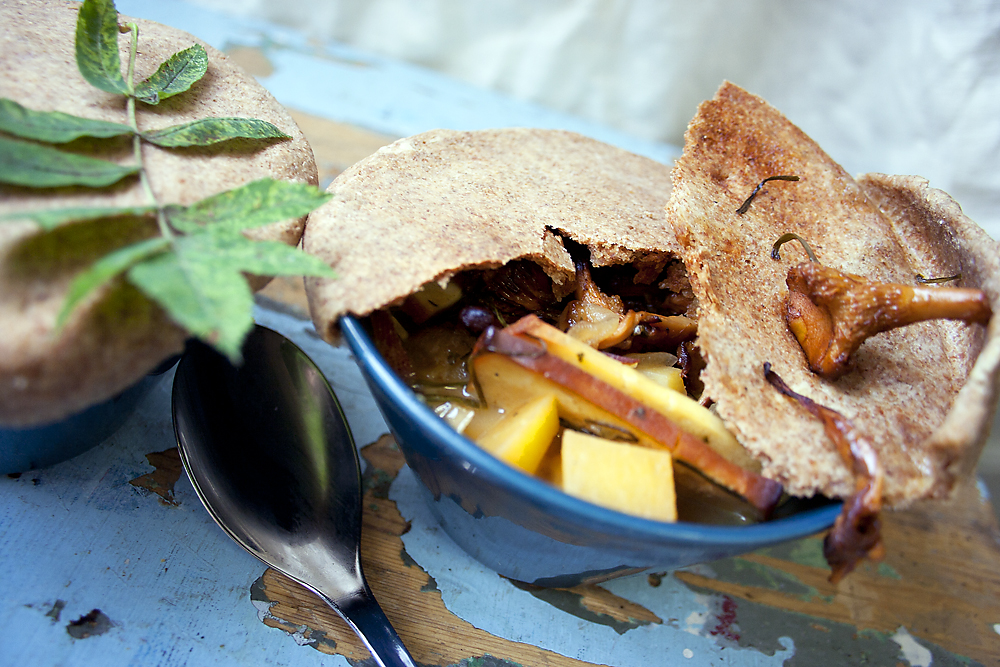
Gold Panner's Pots ‒ Kullanhuuhtojan ruukut


Things are really starting to look like autumn already, or at least like the harvest season. I accidentally emptied the market square in our neighbourhood. Only after that did I actually start to wonder what I could cook from all my beautifully golden turnips and stuff. The idea for this dish came from a bit different recipe, but I kept the name since the idea is still to feature golden-coloured ingredients. The place of gold panning in Finland is in the most northern part of the country, so they have a certain Lapland-theme. If you're serving a dessert, something with cloudberries would fit perfectly.

- 1 l golden chanterelles
- 2 turnips
- 300 g firm smoked tofu
- 4 shallots
- 2 dl oat cream
- 0.5 dl tar liqueur
- 0.5 dl rowan berries (sea buckthorn works as well)
- oil for frying
- pink peppercorn
- fresh chervil (or other mild herb)
- salt

Rye crust:
- 2 dl rye flour
- 1 dl water
- 1 dl wheat flour
- 1 tbsp oil
- 0.5 tsp salt

Start with the crust. Just mix the ingredients together with your hand. Move the chunk into the fridge for a while.

Plane thin slices out of the tofu. Fry on a pan with just a hint of oil until they've dried up a bit and perhaps curved from the edges. Peel the turnips, then chop them along with the onions and the mushrooms. Show them the pan as well, this time with a bit of more oil.

Mince the chervil and crush most of the rowan berries. Combine everything in a bowl. Divide evenly between oven-proof coffee mugs or other such serving-size pots (I got four of them). Add water to fill them up with liquid. Take the crust out of the fridge and divide into as many pieces as you have pots. Roll them into circles wide enough to cover the whole pot.

Move the pots into oven. As a precaution not to break the dishes, don't turn on the oven before this, so they'll get to warm up slowly along with the oven. Turn it to 200°C and leave them there for about half an hour or until the crusts look done.

Nutritional values /  1903 g:
energy 1917 kcal
fat 80 g
protein 89 g
carbohydrates 178 g
fiber 48 g

2.8.13

Countryside Bean Salad with Herb Oil ‒ Talonpojan papusalaatti ja yttiöljy


One more part to the salad trilogy. This one is something I've been planning for a long time. I wanted to make a very filling salad with a rustic feel to it. Something I'd like to have sitting by our allotment garden after some physical work. And since this is the time for green beans, they're really the main star of the plate.

The salad
- 250 g green beans
- 230 g giant beans
- 4 slices of rye bread
- 200 g cherry tomatoes
- 125 g radish
- 100 g fresh spinach
- 3 summer potatoes
- 1 red onion
- 0.5 dl sunflower seeds
- 2 garlic cloves
- oil for frying
- salt

The herb oil
- 1 dl flax seed oil
- 1 punch of fresh parsley
- 10 basil leaves
- 2 tbsp black currant juice (unsweetened, without added water)
- black pepper

Cook the potatoes and the green beans in salted water. Roast the sunflower seeds a bit on a dry pan. Move away the seeds, add some oil and minced garlic and place the bread there, cut down into mouth-fitting chunks. Fish out the green beans and place them on the pan as well.

Cut the onion in semi-circles and slice the radishes. When the potatoes are done, slice them as well. Mix everything and serve while still warm.

For the oil, just blend everything together. Serve alongside the salad or mix right into it.

Nutritional values / 1652 g:
energy 1852 kcal
fat 109 g
protein 49 g
carbohydrates 159 g
fiber 55 g

80's Salad with Horseradish Mayonnaise ‒ Kasarisalaatti piparjuurimajoneesilla


Continuing my perversion of dishes from the luckily bygone 80's, pasta salads are a must. The classic version features a certain bag of frozen vegetables abbreviated HMP, herne-maissi-paprika or pea, corn and bell pepper. There is also ham, mayonnaise and macaroni, or in a flashier version tricolour pasta. I thought I'd modernize it by improving every part of it a little, using fresh ingredients we now enjoy during summertime.

Now, I've had my share of failures when trying to make mayonnaise myself. Usually I just got soy milk with added features. The Youtube videos I tried to watch mostly left out the actual part where the ingredients are mixed together. Then I managed to bump into this instruction and had to laugh out loud when it worked so easily for me. The only important parts are the lemon juice and the oil, the rest is just up to your personal taste. And I'm pretty sure you could use vinegar instead of lemon juice, as well as experiment with different vegetable oils.

The salad
- 250 g funny-looking wholemeal pasta
- 200 g extra firm smoked tofu
- 5 dl pea pods
- 2 pre-cooked corn ears (grilling does wonders if that's an option)
- 2 red bell peppers

The mayonnaise
- lemon juice (about 2 tbsp)
- 2 dl rape oil (not cold pressed but the neutral type)
- 2 tsp mustard
- 2 tbsp grated horseradish
- salt
- white pepper

Cook the pasta and in salted water. While it's cooking, separate the peas from their pods, chop the bell peppers and take out the edible parts of the corn with a help of a knife. Cut the tofu into long thin pieces. When the pasta is ready, drain it and mix everything in a bowl.

For the mayonnaise, you'll need a hand-held immersion blender and a jar just the size of it. First, pour enough lemon juice to cover the bottom of the jar. Stick the blender firmly on the bottom and pour the oil on it. Start the blender and pull it out sloooowly. Now the mayonnaise should be firm and you can mix the spices in it. Serve as a salad dressing or mix about 0.5 dl of it right into the salad and put the rest into fridge for later purposes.

Nutritional values / 1415 g:
energy 1807 kcal
fat 43 g
protein 90 g
carbohydrates 258 g
fiber 39 g

1.8.13

Millet and Chickpea Salad ‒ Hirssi-kahvihernesalaatti


Lately I've been a bit tired and thus, a lazy cook. But that's OK during summer. You can eat healthy and well with very simple recipes as there's this abundance of tasty, fresh and local stuff available. I thought I'd share with you some of the best working salads or cold dishes I've been experimenting with.

The idea for this first one came from Prometheus camp I visited recently. It had chickpeas and probably something like couscous in it, but by the time I was home I couldn't remember the rest. So I just put together things that seemed to go well together and ended up with this.

- 2 dl millet
- 4.5 dl water
- 1 can  of chickpeas (230 g)
- 1 cucumber
- 0.5 dl hemp oil
- 1 punch of fresh dill
- 1 lemon
- mint
- black pepper
- salt

Roast the millet on a dry pan for ten minutes or so. (This should make it a bit more loose than just cooking it straight.) Be careful not to burn it though. When you start to smell popcorn, move it into a pot with the water. Let it come into a boil. Turn of the heat, add some salt and cover with a lid. Let the millet swell for about 25 minutes.

In the meanwhile, chop the cucumber and mince the dill. Rinse the chickpeas. Grate the lemon peel and squeeze half of the juice into the salad bowl as well. Add the millet and everything else. Muddle up and move into the fridge to cool down before eating.

Nutritional values / 1365 g:
energy 1265 kcal
fat 57 g
protein 36 g
carbohydrates 151 g
fiber 32 g

15.7.13

Whiskey Marinade for Seitan ‒ Viskimarinadi seitanille


Last weekend we were celebrating Karhunpäivä, the traditional summer feast for the honour of what is likely the most sacred animal in Finnish mythology, the bear. The tradition holds July the 13th the warmest day of the year just like Talvennapa, January the 13th, is said to be the coldest. Too early to say if that was true this year, but it did feel warm. And the rugged scenery of Karhunahas, a canyon where bears used to be chased and killed, seemed more than appropriate for the day.

One part of any traditional feast is eating well. Seitan can really be the star of a grill evening if you just cook it right. One good thing to do is to marinade it for at least a day to build a great aroma. If you don't want to waste perfectly great whiskey like I did, you can of course use any marinade designed for meat with it, as making marinades only involves combining different taste-giving condiments you wish. A good thing to add in them though is some oil as meats are usually very greasy on their own and seitan isn't. So unless you're cooking them on a frying pan it's a good idea to make sure they won't end up terribly dry.

This is enough for about six precooked, well-sized seitan steaks.

- 1 dl your favourite whiskey (I used Talisker)
- 0.5 dl rape oil (or other neutral tasting oil)
- 2 tbsp soy sauce
- 2 tbsp maple syrup
- 2 tbsp apple wine vinegar
- 2 garlic cloves
- black pepper

Combine the marinade ingredients and mix well. Roll seitan steaks in it one by one and place them in a plastic bag. Pour the rest of the marinde on them and close the bag. Move in the fridge for a day or two, but turn around every now and then.

Place the seitan chunks on the grill straight from the bag and cook from both sides so they'll get some crispy surface. You can use the extra marinade by applying on the steaks while they grill. What ever you do, don't throw away the goodness. Use it in some other dish instead.

Nutritional values / 268 g (just the marinade; for the seitan itself see this post):
energy 790 kcal
fat 45 g
protein 4 g
carbohydrates 276 g
fiber 0 g

2.7.13

Fruity Summer Salad ‒ Hedelmäinen kesäsalaatti


All my main course salads basically consist of three parts: the green, the red and the brown. They don't necessarily need to be of the colour mentioned. The green part refers to the stuff we normally think when someone mentions salad: leafy vegetables like lettuce, salad rocket or endive. In this case I used the wild vegetables I happened to find along a short walk in the forest. The red part means juicy vegetables like tomato, cucumber, radish or in this case, fruits currently being sold on the market square next to me. This part is the most versatile as you could also add some cooked oat, fried bread, olives or sun dried tomatoes into it. The brown part refers to protein, which might come in the form of tofu, beans, nuts, sprouts or in this case, pea tempeh.

You could also turn this into a side salad for a summer evening's dinner by just leaving the tempeh out. Or skip the need for a kitchen stove by using extra firm smoked tofu instead. As a perhaps interesting side note, I thought I had made a mistake counting the nutritional values since the protein amount seemed quite high. It wouldn't be the first time I've made mistakes so I checked where it comes from. I quickly noticed that chickweed was responsible for the second biggest part of protein and though I must have values wrong somehow since it's just a simple, neutral-tasting weed. But googling a bit I found out that no, it really is that surprisingly rich in protein, consisting 15‒24 percent of the stuff. Nice.

- 300 g tempeh
- 300 g strawberries
- 300 g cherries
- 300 g water melon
- chickweed
- fireweed top leaves
- young dandelion leaves
- 3 spring onions
- pineapple weed or lemon balm
- oil for frying

Wash the onions, the weeds and the leaves and cut them into mouth-fitting pieces. Cut strips from the tempeh and fry them lightly from both sides.(At this point you can also apply some spices to them if you wish.) Cube the watermelon, half the cherries and slice the strawberries. Jumble up.

This doesn't necessarily require any added dressing, but if you wish for one, choose an equally fruity type. For example, some puréed raspberries from the freezer with a little bit of oil and vinegar added.

Nutritional values / 1480 g:
energy 1109 kcal
fat 51 g
protein 82 g
carbohydrates 170 g
fiber 40 g

26.6.13

Omelette in Bell Pepper ‒ Paprikoitu munakas


Quite a while now I've had this idea of cooking pea omelette inside circles (or whatever their shape is) cut from bell peppers. I've waited patiently as it hasn't been the right time for bell peppers. I even had to try whether this would work with tomatoes and grill first, but I missed the fried surface of the omelette part and the tomatoes of course needed a folio around  them since they went all soft before the omelette batter managed to coagulate at all.

Chickpea omelette makes a perfect quick meal for a lazy day. Adding the bell peppers around them doesn't give much more trouble than that but it's a change to adding them into the omelette, and besides looks nice on a dinner with friends. Usually I've made them with chickpea flour only, but this time I added some tofu to make the structure thicker and softer. For a fluffier structure, I also used sparkling water as the liquid and added a teaspoon of baking powder, but they're not necessary. Spicing them well is, since they can quite easily remain a bit lame.

- 4 bell peppers (you can be more adventurous than me and use different colours)
- 300 g silken tofu
- 3 dl chickpea flour (also called gram flour)
- 3 dl sparkling water
- 5 spring onions
- 0.5 dl nutritional yeast
- 2 tbsp rape oil
- 1 tsp baking powder
- cilantro leaves
- mustard powder
- turmeric
- salt

Cut circles of the bell peppers. Save the tops and bottoms to be used later. Blend the tofu. Sprinkle the flour with it little by little, stirring while you're at it. Add the spices, the baking powder, the water and the onions too. Mix well.

Heat up a frying pan. Apply oil, place the bell peppers and pour the batter inside them. When the omelette has coagulated, turn around and cook from the other side as well. Serve with a zesty and fruity sauce.

Nutritional values / 1458 g:
energy 1323 kcal
fat 47 g
protein 72 g
carbohydrates 146 g
fiber 44 g
Osta neljä tuotetta ja maksat vain kolmesta - Luomutallin kampanjatuotteet näet täältä


Teekauppa.fi - laadukasta teetä netistä
Ostoskorin loppusummasta vähennetään viisi euroa ja toimitus tapahtuu ilman postikuluja.
Syötä ostoskoriin kuponkikoodi:

syysteet

Tilauksen on oltava vähintään 35 eur, mistä jää maksettavaksi 30 eur.
Related Posts Plugin for WordPress, Blogger...