Unlike in most of the Europe, in Finland May Day is a huge carnival. Students may start a moist celebration even a week early. Streets are full of paper streamers and balloons. The eve is usually reserved for heavy drinking and the actual day off has traditionally had more political approach. Especially leftists are famous for their parades and speeches, though they're not what they used to be when the Soviet Union was still alive and kicking. It doesn't really resemble the more traditional spring celebration hela at all and could be more accurately described as a newcomer tradition.
Me and couple of my friends have usually hold a picnic on the May Day eve, inside since it's usually raining and as far as possible from all that merry-go-round. This year our health care professionals had to work on the eve, so we moved the partying for today. Since there isn't much growing outside yet I thought this year I'd try spicing my traditional sima with juniper berries.
- 4 litres water
- 500 g farin sugar (Muscovado would probably work just as well, but you might condsider replacing some of it with regular sugar.)
- 1 dl juniper berries
- about 50 g piece of ginger
- a fingertip sized piece of fresh yeast
Crush the juniper berries a little so they're more ready to release their aroma. Peel and chop the ginger. Put both of them into a bucket that is able to hold the whole portion. Boil 2 litres water and pour over the spices. Add the sugar and the rest of the water straight from the tap. Mix it all. When the water has cooled down to lukewarm, you may let the yeast loose. Cover the bucket.
Wait a day or even two. Stir the liquid a few times. Through a filter, pour the sima into bottles. Add a teaspoonful of sugar into each of them if you want your sima to sprinkle. The drink is ready in three days and at its best after a week. Remember to monitor the pressure isn't driving it out of the bottles before you want it out.
Here's an apropriate song to accompany the tasting.
Nutritional values / 4 l:
energy 1950 kcal
fat 0 g
protein 1 g
carbohydrates 485 g
fiber 0 g
Showing posts with label juniper. Show all posts
1.5.13
25.4.13
Cider Sauce with Juniper Berries ‒ Katajanmarjoilla höystetty siiderikastike
I've had some cider and juniper berries waiting for the next time I'll make seitan for a while now. Laura in her blog Kasvisruokaa has created an excellent sounding marinade from juniper, garlic and rosemary, but as at the moment I was thinking what we'd eat today, waiting untill the next night to get seitan properly marinated seemed like forever. So instead, I made a sauce from the cider and spiced it up with juniper and rosemary. The taste is quite strong and wouldn't fit together with terribly many things, but for a good seitan steak it's just perfect. Cider gives it a very zesty basic taste while juniper adds up a more foresty flavour. And while I was busy with this, my spouse cooked us an accompaniment that reminds me of Hungaria, paprika potatoes. I'll give ten points to this dinner.
- 5 dl dry apple cider (please stay away from those carbonated sugar drinks)
- 6 juniper berries
- 1 tbsp margarine
- 2 tbsp wheat flour
- allspice
- rosemary
- salt
Pour the cider in a small pot. Crush the juniper berries and add them as well as the allpsice and the rosemary. Cook until the cider has reduced to half. Take aside (and if you're feeling energetic, fish out the spices). Prepare a roux as if you were making a basic brown sauce. That means melt the margarine, sift in the flower and keep stirring until things turn all nice and golden (but not black, hopefully). Pour the reducer cider back on, add some salt and remove from the stove.
Nutritional values / 534 g:
energy 336 kcal
fat 11 g
protein 3 g
carbohydrates 23 g
fiber 1 g
4.6.10
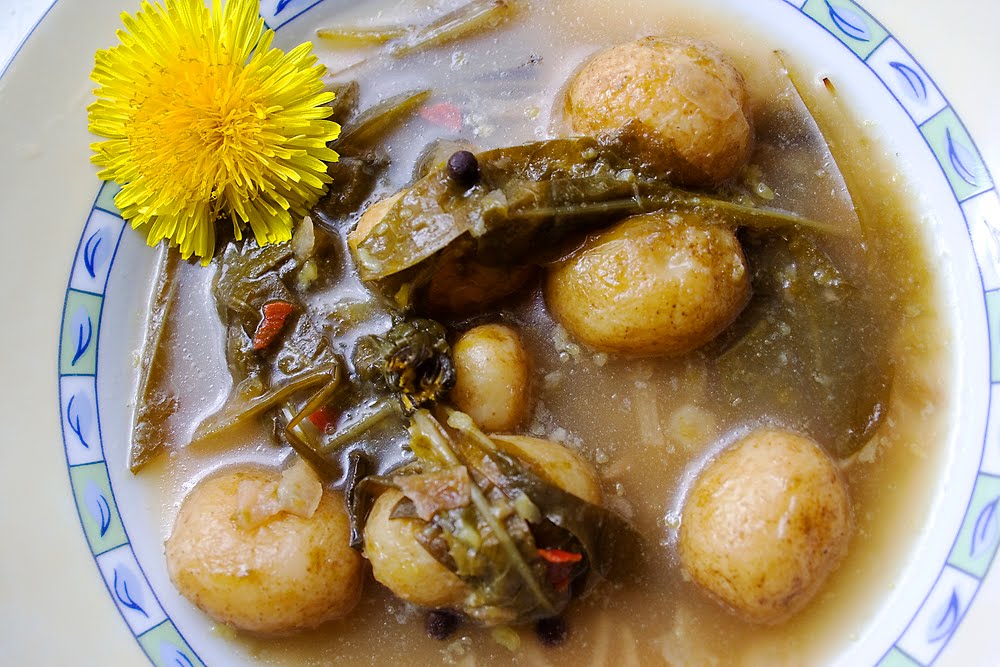
Dandelion Soup ‒ Voikukkakeitto
In case that supikas recipe yesterday sounded appetizing, here's a suggestion for the remaining broth. But if you want the soup only, dice a small rutabaga to cook with the potatoes.Dandelion is among one of my favourite wild veggies because it's so multifunctional and grows just about everywhere. The leaves and buds for this soup I picked when returning along my jogging path, trying to find my breath that had got lost somewhere on the way.
- 20 unopened dandelion flower buds
- 2 dl young dandelion leaves
- 2 l rutabaga broth
- 5 dl new potatoes (or noodles)
- 0.5 dl seaweed
- 0.5 dl dried onion (or caramelized)
- 1 chili pepper
- whole black peppers or juniper berries
Wash the potatoes and remove the bad parts but don't bother to peel. Cook them in the rutabaga broth until soft. Add the rest of the ingredients and let the soup come to a boil. Eat right away.
In the present form the soup is more like a starter or an evening snack but if you want to turn it into a lunch you might want to add beans or such.
Nutritional values / 2 l:
energy 500 kcal
fat 3 g
protein 27 g
carbohydrates 96 g
fiber 11 g
10.2.10
Piny Cutlets ‒ Mäntyiset leikkeleet
Marinades are fun to play around with. Much like stocks, they can be made out of anything your imagination allows you to. Just for inspiration, here's one that I used for textured soy protein cutlets I've had lying in the closet for ages but can't see no reason why it wouldn't work just as well for precooked seitan or firm tofu.The fallen but still fresh pine twig I used here sort of followed me home from a forest trip. Another thingy I wanted to get rid of was half a bottle of Gambina ‒ theoretically red vermut and juniper-spiced gin sound like a great combination but I found this way too sweet for me. It was probably a fine aperitif drunk from a stemware when first introduced in 1932 but is nowadays mostly consumed by teenagers and boozers straight from the bottle because of the cheap prize.
- 3 dl pine needles
- 2 dl Gambina
- 2 tablespoons rape oil
- 2 tablespoons apple wine vinegar
- 2 garlic cloves
- salt
- lemon pepper (continuing with the theme "something I just want to get rid of")
Crush the needles and smooth down with the rest. Move into a plastic bag with your cutlets for a few hours. Turn around now and then.
If you'd rather use a bowl, add some water to achieve a thinner mixture and soak your cutlets for the whole night.
Brush out the biggest bits and pieces and cook on a pan. One thing I noticed is that the surface gets burned quite easily so don't go reading food blogs while you cook!
Tunnisteet:
by the campfire,
juniper,
main courses,
seitan,
textured soy protein,
tofu/hefu,
trees
28.10.09
Black Trumpet Rolls ‒ Mustatorvirullat
The idea of black trumpet roll was actually in strong-tasting mushrooms which these are not. But since I have to wait another year to get my hands on black trumpets I thought I could just as well check if the recipe idea works otherwise.
Seitan part:
- 3 dl seitan flour
- 2 dl graham flour or rye flour
- 1 dl tar liqueur or 2 dl smoked beer
- 0.5 dl rape oil
- 3 garlic cloves
- salt
- water (about 1-2 dl, more than you'd normally use)
Mushroom part:
- 2 dl dried black trumpets
- 2 tablespoons soy-based cream spread (for example tofutti)
- 2 tablespoons vegan mayonnaise
- 1 dl oat cream
- juniper berries
- black pepper
- 1 punch of fresh rosemary
Mix the seitan dough and roll it into a flat rectangle. Mix the cream spread, mayonnaise, cream, rosemary and spices together and then add the dried mushrooms as well.
Now you can spread the mushroom filling on the other long edge of the seitan, as if you were making a Swiss roll. Carefully roll the mushrooms inside the seitan and cut it in six pieces (though I do assume this also makes a nice centre piece for a dinner table if you leave it intact).
Arrange the rolls into a casserole and pour some vegetable broth on the bottom so they won't dry up in the oven. Cover with a folio. Cook about 40 minutes in a 200°C. Serve with some strong tasting sidekick that emphasizes the main dish, for example lingonberry cram or sea buckthorn and carrot sauce.
Nutritional values / 1 roll:
energy 330 kcal
fat 14 g
protein 23 g
carbohydrates 23 g
fiber 3 g
8.6.09
Sahti
Sahti's taste is soft, sweet and thick, often described as banana-like. Instead of hops it's flavoured with juniper. It doesn't bubble much and stores only a month at most the fridge. The old poems describe mash bushel being lifted on the roof for the thunder (=ukkonen) god Ukko water it and then fermented with the drool of a horny boar. And as you probably understand from this description sahti has a special place in certain pagan feasts.
At the moment I'm making my very first round of sahti for the most important holiday of the year, midsummer, the nightless day. This feast originally known as Vakkajuhla (= bushel feast) used to be celebrated with a big punch of friends by a lake to ask Ukko send rain for the harvest to grow. Christian invaders turned pretty much all the Finnish feasts to have Christian meanings but the only thing they managed to change in this one was its name: it's nowadays known as Juhannus which refers to John the Baptist. It still involves gatherings by lakes, drinking and eating, bonfires and fertility rites. I'll update this post after I've seen how my sahti turns out but I thought I'd post this plan already in the hope of inspiring the rest of you to try as well.
To be a purist you should keep in mind that:
1. Sahti doesn't contain hops. Instead it's usually flavoured with juniper (though I've heard some other herbs like heather or wild rosemary have been used as well).
2. Sahti is always made of barley malts. Some people also use rye or caramel malts but only small amounts for flavouring.
3. Don't use added sugar. All the sugar should come from the malts and sahti isn't supposed to sparkle either. You won't need sugar even in the bottling stage since it can't be stored long anyways. Besides, well cooked wort should already produce 10-11 % beer which in most beer types is more than enough to make it taste like alcohol and thus ruin its own taste.
4. Never let the mash temperature rise over 70°C or you'll get porridge. The wort shouldn't be cooked at all, only quickly sterilized at most.
5. The most common yeast used today is common baking yeast, not normal ale yeast. This gives sahti a distinct flavour. (Of course in the old times people just saved some yeast from every round for the next one. I wouldn't want to annoy an angry boar.)
6. Approximately, 1 kg of malts makes about 2 l of sahti. Yes, it's thick.
7. Sahti is served unfiltered. Actually the leftover yeast helps it last better.
8. Three most important things to remember are cleanliness, cleanliness and cleanliness. Sterilize all the tools you use, including your hands.
Of course, rules only exists to be broken. But if you do make exceptions to please your own taste then please don't call your beer sahti. You may feel it doesn't change that much if you use hops but names used very broadly cease to really mean anything. Here's what I did:
- 3 l sahti malts
- 3 dl rye malts
- 20 g juniper berries
- 7 l water
- 50 g baking yeast
Sterilize all your equipments. Put 3 l of water in a big pot and let it come to a boil. Add the malts. Keep stirring until you've got a porridge. Heat up until the temperature has reached 70°C and make sure it doesn't rise further. Simmer for an hour. Crush the juniper berries and throw them in. Simmer another three hours. Taste to make sure it's sweet enough. It's also desirable to measure the gravity at this point so it'll be easier to trace what went wrong.
Filter and pour into an air tight fermentation vessel (with airlock). Boil the rest of the water and pour in. When the temperature has dropped to about 20°C add the yeast, dissolved in a mug of lukewarm water. Let your sahti-to-be ferment in room temperature as long as it wants to. This should take about 3-5 days. Check the gravity again and bottle your sahti and store in cold for a week. Apparently, the bigger the barrel the longer the taste lasts. Don't leave room for oxygen. If you see a foam your sahti hasn't finished yet and shouldn't be drunk (unless you want stains in your underpants).
Ask your friends over to drink your sahti fresh! Here's a suggested drinking song as well.
Tunnisteet:
beer,
beverages,
fermentation,
juniper,
slow cooking,
summer,
Tavastian,
Yule
1.4.09
Stock ‒ Liemipohja
Some general guidelines:
1. Making a stock is a perfect way to recycle all the vegetable leftovers like peels and heads. If you use whole vegetables wash them normally and remove the clearly rotten parts but don't bother to peel. Remember you're not going to eat them.
2. Try to add something from all the basic tastes (except fat which has also got into this category lately): bitter, salty, sour, sweet and savory (aka umami).
3. Keep fat out of this since it doesn't store well. You can always add margarine or cream to the soup itself to make it richer.
4. Many alcohol drinks like wines or brandies fit this purpose well. But as much as I love beer this isn't the place for it since it turns bitter when boiled (as I learned when trying to make beer soup).
5. Don't exaggerate with any of the ingredients. If you want your broth to taste like white wine add white wine to the broth itself. Try to keep the stock well balanced and multifunctional.
6. Frying the veggies isn't necessary but it adds to the taste. The one you shouldn't fry is garlic since it may turn bitter.
7. If you for some weird reason want to clarify the stock use for example a clay called bentonite which is widely sold for winemaking.
8. When you're using the stock remember to let it come to a boil to get the taste out of it.
9. How much you should use the stock at once depends on your personal likings, the amount of other spices you're going to use and the denseness of your stock (aka how tighly you concentrate it). It may just as well be 2-3 ice cubes or 1 dl at a time.
Just to show you a couple of examples, here are the recipes for three stocks I've made so far. Next time I might try for example yeast pate (for example Tartex), cider, laurel, lovage, juniper berries or birch sap. Perhaps even a hint of strong tastes like salmiakki (Ammonium chloride), tar or horseradish might work.
Hearty stock:
- 0.5 rutabaga plus the skin and the head of the other half
- skins and heads of 500 g carrots
- skins and heads of 500 g beets
- 1 onion
- 1/2 garlic
- 1 punch of dill
- 8 whole black peppers
- 0.5 dl dark syrup
- 0.5 dl miso (dissolved in water)
- 0.5 dl apple wine vinegar (more aromatic than apple cider vinegar)
- 1 tsp monosodium glutamate
- 1 tsp salt
Zesty stock:
- leftovers from 1 white cabbage
- leftovers from 1 cauliflower
- cores and peels of 3 apples
- 1 sheet of algae (nori)
- 2 tsp dried yarrow flowers
- 2 dl white wine
- 0.5 dl lemon juice
- 0.5 dl mustard powder (Remember mustard condiment also contains oil and sugar.)
- 1 tbsp brown sugar
- 1 tsp monosodium glutamate
- 1 tsp salt
Spicy stock:
- 1 leek
- 500 g tomatoes
- 1 bell pepper
- 1 chili pepper
- all the dried herbs I had in the closet but couldn't recognize anymore
- 2 dl red wine
- 0.5 dl mämmi
- 0.5 dl sea buckthorn juice
- 1 tsp monosodium glutamate
- 1 tsp salt
Chop and fry the veggies on a dry pan. Put them in a cattle with the rest of the ingredients and 1.5 litres of water. Let them simmer without a lid. The stock is ready when at least half of the liquid has vaporized and the veggies have turned mashy (after approximitely two hours). Filter the stock, pour it into an ice cube tray (if you've saved plastic soy yoghurt cups or such they're also ideal for this) and freeze. The part that didn't fit there stores a few days in the fridge.
Tunnisteet:
algae,
apple,
beet,
bell pepper,
birch,
cabbage,
carrot,
cauliflower,
juniper,
leek,
mämmi,
rutabaga,
salmiakki,
sauces,
sea buckthorn,
slow cooking,
soups,
tar,
the basics,
tomatoes
26.3.09
Kalja
I have a 1.5 litre jug where I wanted to make kalja but could only find recipes for big portions. So I compared a few of them and adapted a smallish version myself. It worked well so I'll post it for you too.
- 1.5 l water
- 1 dl rye malt
- 3/4 dl sugar
- 1/4 tsp yeast
Boil the water for about ten minutes and pour it on the malt and sugar. Let it cool down for couple of hours and then add the yeast crumb. Place in a warm place for a day. Filter the liquid and move it in a cool place. This is at its best after couple of days.
Like another Finnish beer sahti, kalja too would ideally be spiced with juniper berries. Unfortunately I haven't been able to find any lately.
Tunnisteet:
beer,
beverages,
childhood,
fermentation,
juniper,
slow cooking,
the basics
Subscribe to:
Posts (Atom)
Osta neljä tuotetta ja maksat vain kolmesta - Luomutallin kampanjatuotteet näet täältä

Teekauppa.fi - laadukasta teetä netistä
Ostoskorin loppusummasta vähennetään viisi euroa ja toimitus tapahtuu ilman postikuluja.
Syötä ostoskoriin kuponkikoodi:
syysteet
Tilauksen on oltava vähintään 35 eur, mistä jää maksettavaksi 30 eur.
Teekauppa.fi - laadukasta teetä netistä
Ostoskorin loppusummasta vähennetään viisi euroa ja toimitus tapahtuu ilman postikuluja.
Syötä ostoskoriin kuponkikoodi:
syysteet
Tilauksen on oltava vähintään 35 eur, mistä jää maksettavaksi 30 eur.