Showing posts with label beet. Show all posts
26.2.14
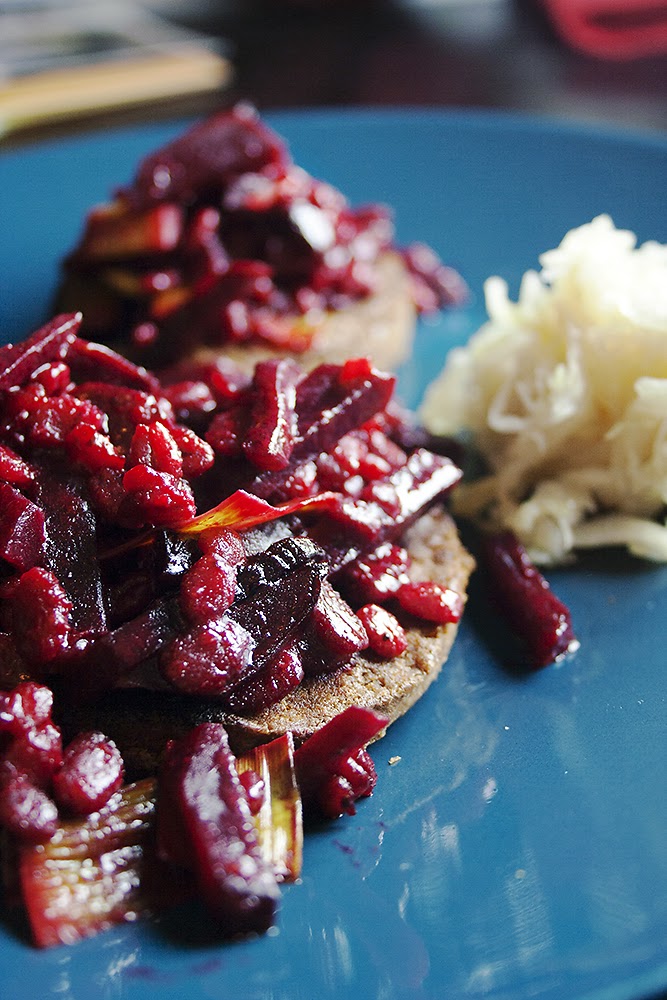
Salmiakki Sauce for Seitan and Beet ‒ Salmiakkikastike seitanille ja punajuurelle
When I dine at a restaurant I find it very pleasant if the menu clearly states what's in a given dish, for example "Chili rubbed seitan steak, raspberry vinegar marinated beets and salmiakki sauce". It gives me as a customer much better idea of what to order if the name isn't just some fancy French word I don't know how to pronounce. But when I see this elsewhere, peculiarly in recipes, for some reason I find it annoying and just trying to sound fancy, for example "engine oil rubbed Tavastian soap with small stones and slowly caramellized rubber". It's really a combination of the different ingredients or even separate dishes, and guess my logic goes that this means that any given part of that plate isn't really worth repeating or at least the recipe writer doesn't believe it is. Guess I'm only annoyed because this has becme some sort of a fad among Finnish celebrity chefs. Anyway, I try to avoid that happening in my recipes, although I realize I might just have an attitude problem. Sometimes the combination of tastes truly is the more important thing than any given part of it. Taste pairing might just be the single most important part of kitchen art.
This is the case of this recipe too. Although the part needing a recipe is really just for the sauce, I couldn't help but putting a suggestion of what comes under the sauce in the headline. These three tastes are just fine on their own, but they work especially well together, so I thought to highlight the combo. The idea came from a salmiakki marinated beet starter dish, created by a salmiakki making company, but I thought to turn it into an entrée. For the seitan, I used chili in the dough and fried them well in oil. For the beets, I sliced them thin, drizzled with oil and raspberry vinegar, as well as spiced with salt and thyme before roasting them in the oven long just long enough to still have them crunchy. The portion is crowned by the sauce which has a lot subtler aroma than you might think.
- 150 g salmiakki candy (hard ones are best in this, I used Turkinpippuri) + 1 dl water
- 4 dl strong vegetable bouillon
- 1 dl white wine
- 2 tbsp margarine
- 2 tbsp wheat flour
- black pepper
- salt
Prepare a salmiakki syrup by putting the candies in a small bowl and pouring water on them just enough to get them covered. Turn around with a spoon when you walk by. Dissolving only takes a few hours, so if you start in the previous evening, you can be sure they'll make it in time.
Melt the margarine in a sauce pan. Shift the flour on the melted stuff and stir. Pour in the stock before the roux start to turn brown (unlike in basic brown sauce). Let the sauce thicken on a low heat, stirring occasionally. Add the salmiakki syrup and the wine. Let the sauce reduce until the consistency is thick enough to stay on the seitan. Spice with salt and pepper according to your taste buds.
Nutritional values / 798 g:
energy 882 kcal
fat 22 g
protein 2 g
carbohydrates 144 g
fiber 1 g
17.12.13
Beet Temptation ‒ Punajuurikiusaus
I've talked before about the wonderful casserole type of dish called temptations.They usually involve potatoes cut into strips but it being December and all, this time I wanted to use beets. Their colour is so wonderfully dark and Christmassy, though this is still quite an everyday dish.This makes a creamy and fruity accompaniment for a more humble main course.
- 1 kg beetroot
- 4 dl oat cream
- 1 leek
- 1 dl barley
- 1 chili (I personally think habanero gives a nice fruity aroma. But if hotness isn't your thing, try a winter apple instead.)
- thyme
- green pepper
- bread crumbs and margarine to top with
Peel and julienne the beets. Cut the leek and chili too. Mix all the ingredients in a casserole. Bake for half an hour in a 175°C oven.
Mix things a bit with a spoon. Sprinkle bread crumbs on the casserole. Top with a few margarine pieces. Bake for another half an hour.
Nutritional values / 1765 g:
energy 1297 kcal
fat 54 g
protein 30 g
carbohydrates 169 g
fiber 45 g
2.9.13
Boletes, Beet and Buckwheat ‒ Punainen tattitattari
One sure sign of autumn is that dishes start to lean to the east. During summer I find the idea of eating raw curious but but now I my meals already need to be warm and hearty. Of course mushrooms are quite a Karelian thing already by themselves. In Osthrobothnia mushrooms weren't considered edible human food even during famine. The Finnish name of a bolete is tatti, which has the same etymology as Estonian word tatt, meaning slime. However, when 12% of Finland's whole population was evacuated from Karelia, the cultures kind of had to melt together.
At the moment I'm completely nuts about mushrooms. My nearest forest seems to be full of young and firm boletes, especially porcini which the Italians consider the top species. They have a nicely fleshy flavour and just love to get on a frying pan with onions. Most of them I've put in the freezer after quickly showing them a dry frying pan, but obliviously I need to savour the best ones fresh from the bush. First I thought about making ohratto from them, but after deciding to add beet in the dish I realized buckwheat would fit here even better than the more mild-tasting barley.
Buckwheat is a nutritious and traditional domestic grain, but many people seem to avoid it. It does have a very distinctive flavour they perhaps aren't used to. Also, it's easier to cook it wrong than most grains and end up with slimy porridge. To avoid this, it's usually a good idea to roast it before the actual cooking if it's not pre-roasted already, just like with millet. You should also avoid using too much liquid or cooking it longer than needed.
- 400 g boletes
- 4 dl water
- 1.5 dl buckwheat
- 4 beetroots
- 2 onions
- 3 tbsp rape oil
- 2 tbsp black currant juice
- 2 tps dark syrup (leave out if the juice is sweetened)
- fresh parsley
- caraway
- white pepper
- salt
Peel and julienne the beetroots. Marinate the strips in the currant juice, syrup and two tablespoons of oil.
Roast the buckwheat on a dry pan. Move into a pot, add twice the amount of water (3 dl in this case) and salt. Turn the stove on and put a lid on. Remove from heat after 15 minutes. Let it gather itself for another 15 minutes before proceeding.
In the meanwhile, mince the onion and sauté it lightly in oil before adding the boletes, chopped roughly as well. Spice with pepper. When things start to look golden on the pan, combine all the ingredients, including rest of the water. Put the lid on again and let the pot simmer until the beets have softened up.
Nutritional values / 1620 g:
energy 1054 kcal
fat 46 g
protein 29 g
carbohydrates 130 g
fiber 30 g
24.3.13
Pimped Soy Balls ‒ Tuunatut Soijapyörykät
Soy balls are such a basic everyday meal that nearly everyone has developed their own special way of preparing them. No big surprise, I like to keep pimping them a bit differently every time. Yesterday I seasoned them with onion and pickled beet which gave them not only more taste but also this adorable pink colour. I also tried baking them in oven instead of frying on a pan as normally, but that didn't really work out. The structure came a bit too soft and many of them broke down from the bottom. Oh well, didn't effect the taste.
- 3 dl textured soy protein crumble
- 3 dl water
- 1 dose of stock
- 1 onion
- 1 dl pickled beetroot
- 1 dl breadcrumbs
- 3 tbsp soy flour
- 2 tbsp soy sauce
- your favourite chili sauce
- black pepper
- 2 tbsp rape oil
Heat up the water and mix with the stock. Let the soy crumble swallow in it. In the meanwhile, mince the onion and sauté lightly. Mix everything but the oil together in a bowl. Roll the paste into balls between your hands. Cook on a pan or in a 200°C oven for about twenty minutes, in any case with plenty of oil.
Nutritional values / 718 g:
energy 1004 kcal
fat 52 g
protein 57 g
carbohydrates 76 g
fiber 20 g
- 3 dl textured soy protein crumble
- 3 dl water
- 1 dose of stock
- 1 onion
- 1 dl pickled beetroot
- 1 dl breadcrumbs
- 3 tbsp soy flour
- 2 tbsp soy sauce
- your favourite chili sauce
- black pepper
- 2 tbsp rape oil
Heat up the water and mix with the stock. Let the soy crumble swallow in it. In the meanwhile, mince the onion and sauté lightly. Mix everything but the oil together in a bowl. Roll the paste into balls between your hands. Cook on a pan or in a 200°C oven for about twenty minutes, in any case with plenty of oil.
Nutritional values / 718 g:
energy 1004 kcal
fat 52 g
protein 57 g
carbohydrates 76 g
fiber 20 g
Tunnisteet:
balls and patties,
beet,
cold dishes,
main courses,
textured soy protein
23.3.13
Roasted Root Vegetables with Herbs ‒ Yrttijuurekset
Root vegetables are perfect seasonal food. They're cheap, healthy, filling and easy to prepare. During the deepest winter I might've used chili and liquid smoke, but now that daytime is already as long as darkness I'm starting to prefer fresh tastes again and therefore spiced these up with dried herbs. The fresh ones are growing with speed too. Can't wait to be able to snip them while cooking.
- 500 g beetroot (I used a striped variety)
- 500 g rutabaga
- 500 g sunroot
- 1 parsnip
- 1 whole garlic (rest assured, the taste softens in the oven)
- 0.5 dl rape oil
- 1 tsp rosemary
- 1 tsp tarragon
- 1 tsp dill
- salt
Oil a casserole. Peel and cut the vegetables into mouth-size chunks. Free the garlic cloves from their skin. Mix the veggies, the herbs and rest of the oil in the casserole. Put in a 175°C oven. Remember to turn them around every now and then. They should be ready in about an hour.
Nutritional values / 1705 g:
energy 1000 kcal
fat 49 g
protein 18 g
carbohydrates 120 g
fiber 47 g
4.12.10
Pea and Beetroot Sauce ‒ Herne-punajuurikastike
Continuing with simple and humble comfort foods. Peas and beetroot make a really nice combination. I was making pea soup anyway, so I put some of the cooked peas aside for a fast dinner couple of day later. If you happen to have some canned pea soup in the closet it would also work as the basis. I think the cook book Härkäpapua sarvista (Irina Somersalo & al., Multikustannus 2007) has a similar pasta sauce but I didn't even look at the recipe while cooking so don't blame them.- 5 beetroots (mine were rather small)
- 2 dl dry peas
- 1 tablespoon rape oil
- 1 tablespoon vinegar (or a dollop of the sour broth used for preserving beetroots)
- 1 chili pepper
- 3 garlic cloves
- 1 dose of stock
- fennel seeds
- basil
- salt
- water
Soak the peas overnight. Cook them in plenty of water. Peel and slice the beetroots. Fry them on a hot pan with oil, chili and garlic. When they have softened up but still feel firm, add them to the pea pot, as well as the rest of the ingredients. Let the sauce simmer for a few minutes more.
Enjoy the sauce for example with pasta. If you add some dark syrup, it gets a rather christmassy clang to it.
Nutritional values / 772 g:
energy 744 kcal
fat 16 g
protein 35 g
carbohydrates 111 g
fiber 27 g
16.10.10
Beetroot Soup with Potato Dumplings ‒ Punajuuri-perunamykykeitto
All beetroot soups aren't borschtes, just like all cold tomato soups aren't gazpachos. According to Jaakko Rahola's excellent food glossary, borsch is a hot or cold Eastern European soup consisting of different vegetables. In Russia, these veggies always include beet and fermented broth used for pickling the beets, giving its distinctive taste which for most Finns is way too sour. One ingredient it never ever includes is vinegar, which by comparison is nearly always found from Finnish beetroot soups. So I wouldn't call this pink treat with the name of the famous Russian stuff but there is nevertheless a lot of resemblance with the neighbor. Shall we say it has a rather Eastern Finnish cling to it.Then again, I topped my soup with dumplings which are more of a Western Finnish thing. Myky or more often klimppi is basically the same stuff as Russian pelmeni, German knödel, Italian gnocchi and numerous other dishes found around the world. But for some reason mykys aren't nearly as popular. In fact, many modern day Finns seem to find the whole idea of them repulsive. This shall definitely change if I can do anything about it!
- 5 beetroots (plus their leaves if you manage to acquire them intact)
- 300 g cabbage
- 1 carrot
- 1 onion
- 1 apple
- 1 sausage
- 1 dose of stock
- 2 tablespoons rape oil
- 1 tablespoon vinegar
- 1 tablespoon ketchup
- 1 small bunch of thyme
- 1 dried chili pepper
- salt
- 2 l water
For the mykys:
- 5 cooked potatoes
- 1 dl semolina
- soup broth for boiling
Peel the root vegetables and shred them. Cook them together with the water and the spices. In the meanwhile, shred the cabbage and cook it on a frying pan with oil until it has softened up. Add the cabbage into the soup pot. Chop the sausage, the apple and the onion and roast them a bit on the pan as well. Add into the pot with the rest. The soup is ready when the beetroot pieces have turned soft.
If you wish to have mykys as well, simply mash the potatoes and mix the semolina thoroughly with them. Shape small balls out of the mass, a dessert spoonful at a time. Take enough broth from the soup to fill a saucepan and bring it to a boil. Drop the balls into the boiling broth carefully one at a time. Let them simmer for about ten minutes. Serve with the soup.
Nutritional values / 3773 g:
energy 1420 kcal
fat 36 g
protein 62 g
carbohydrates 198 g
fiber 40 g
Tunnisteet:
beet,
Karelian,
main courses,
Ostrobothnian,
Slavic,
soups,
sour
7.3.10
Beetroot Wraps ‒ Punajuurirullat
Since I've managed to constrain myself from posting a beetroot recipe for couple of months after Christmas I can now continue:I've been wanting to make something like these ever since I saw this pretty picture. The rieska part is adapted from here. In a way they come close to Celia Brooks Brown's beetroot tortilla recipe (a photo here) and Nami-nami also recently posted a sandwich filling which is kind of like a simpler version.
Then I just figured out that buckwheat fits with sour creams, sour creams go together with beetroot while beetroot pairs nicely with peas which go together with horseradish. So naturally, horseradish should fit perfectly with buckwheat! Just kidding. These ingredients do sound random but at the end, the ensemble plays it groovy. In case you want a whole lunch wrap instead of finger food for cocktail parties add some pea crush.
Buckwheat rieska:
- 5 dl oat yogurt
- 2.5 dl buckwheat grains
- 1.5 tablespoons sunflower oil
- 2 tablespoons buckwheat flour (or wheat)
Beetroot filling:
- 2 beetroots, cooked or pickled
- 1 good punch of pea shoots
- 2 tablespoons mayonnaise (I used a cheap market brand that happens to be vegan but real chefs make it themselves)
- 2 tablespoons black currant cram
- horseradish (wasabi paste goes fine)
- mint (fresh if you have)
Let the grains soak in the yogurt overnight (or at least two hours if you're in a hurry). In the morning, mix in the oil and the flour. If the mixture looks a lot drier than last night, add some oat milk as well. Spread on a baking tray and cook 30 minutes in a 250°C oven.
I find it helps to roll the rieska inside its baking sheet as soon as it comes out from the oven. If it looks crumbly already at this point, sprinkle with water and let it rest for a moment.
In the meanwhile, dice one of the beetroots and mash the other. Mix the mashed one even with the mayonnaise, the black currant and the spices.
Spread the beetroot paste on the lowest third of the rieska. Array the beetroot dices below the paste and the pea shoots above it. Roll as if you were making a Swiss roll and cut into pieces as if you were making makisushi (I got ten pieces). Secure with tootpicks if you wish. Serve with more pea shoots.
Nutritional values / 1 roll / 90 g:
energy 147 kcal
fat 3,8 g
protein 4,5 g
carbohydrates 23,4 g
fiber 2,8 g
Tunnisteet:
beet,
black currant,
buckwheat,
coffee table,
cold dishes,
peas,
rieska,
snacks
14.1.10
Pyttipanna ‒ Pyttipannu
Well, in a household of two little piggies the problem is usually reversed. No matter how much sauce I make there's never anything left for my breakfast bread. No matter how big a bread I bake there's never enough to dry it for breadcrumbs or croutons. And no matter how big a soup pot, it will never end up into handy freezer portions. This time however, I managed to cook enough potatoes to make the next dinner out of them. Normally I would get this treat only by buying a microwave meal.
Pyttipannu (from Swedish pytt i panna, small things in a pan) is a classic way to use leftovers. Feel free to throw in anything around you. For example tofu, beetroot, sausage, tempeh, peas, rye bread and beanstalks fit here perfectly as well. This time I made it like this:
- 5 potatoes
- 1 onion
- 1 small rutabaga
- 3 dl fava beans
- 1 chili pepper
- smoked paprika (my current favourite spice)
- salt
- 1 tablespoon sunflower oil (I bought a bottle of this for a change)
Dice everything. Throw into a very hot pan. Fry until the little cubes have got deliciously brown. (If you have a large batch or a small pan fry your pyttipannu in small portions and flush the pan between them.) Sprinkle the spices when the food is on your plate. Enjoy with something pickled.
Nutritional values / 1109 g:
energy 666 kcal
fat 15 g
protein 24 g
carbohydrates 110 g
fiber 21 g
Tunnisteet:
beans,
beet,
bread,
by the campfire,
childhood,
main courses,
potatoes,
rutabaga,
Scandinavian,
tempeh,
tofu/hefu
28.12.09
Beetroot and Pea Loaf ‒ Punajuuri-hernemureke
My parents on the other hand have a history of being much harder to please. I'd like to think they've stopped mocking my vegetarianism cause they now realize I'm a responsible grown-up and have started enjoying my dishes since I've become a better cook but actually, think the change happened when I dragged home a 34-year old, hairy, oveweight and loud guy who refused to eat meat. The power of example is amazing. Still, for them, I thought the beetroot and pea loaf from the book Härkäpapua sarvista (Irina Somersalo & al., Multikustannus 2007) would be a safer option.
Last time I tried something like this was a fiasco (lacking of taste and crumbling apart) so this time I wanted to follow a recipe rather faithfully. The medley of different herbs is naturally very dominant, and since there are so many of them you can't really put your finger on any specific one. Somehow I thought they made the loaf taste more like summer than Yule but liked the result anyway. It doesn't make a centerpiece for a dinner table but it's a good sidekick on the fancier side.
Pea layer:
- 1 dl crushed peas (or 3 dl cooked peas)
- 3 dl water
- 2 potatoes
- 0.5 dl buckwheat flour
- 2 teaspoons dried marjoram
- 0.5 teaspoon ground coriander
- 2 teaspoons dried basil
- 1 teaspoon herb salt
Beetroot layer:
- 2 large beetroots
- 1 potato
- 0.5 dl buckwheat flour
- 1 onion
- 1 garlic clove
- 1 teaspoon dried thyme
- 0.5 teaspoon dried sage
- 3 teaspoon parsley
- 0.25 teaspoon ground black pepper
- 1 teaspoon herb salt
Cook the peas with the two potatoes in scarce amount of water. Let them cool down. Then mash and mix with the other ingredients of the pea layer. Cook the beetroots with the potato (again, with minimum amount of water so you won't have to waste any taste into the sewer). Cool down as well. Mash them smooth with the rest of the beetroot layer ingredients (you can either smooth down the onion in a blender or such like the rest or just chop crunchy pieces out of it).
Butter a mold. Pour in the pea layer and spread it even. Pour the beetroot layer on the pea layer and spread even as well. Cook 40 minutes in a 200°C oven in a water bath (this can be achieved by placing the mold into a larger casserole where you pour some water).
Serve cold. Enjoy with some perky sauce or slice on crackers.
Nutritional values / 1055 g:
energy 771 kcal
fat 2 g
protein 33 g
carbohydrates 149 g
fiber 24 g
Tunnisteet:
beet,
cold dishes,
oven dishes,
peas,
sidekicks
22.12.09
Rosolli
Well, actually that was yesterday but I was celebrating it in Estonia. That's when the holiday starts for me, lasting all the way to Talvennapa (January 13th), supposedly the coldest day of the year. Meanwhile, the Sun is sleeping so we have to light candles instead and feast.
One of those dishes that really make my Joulu is rosolli. Think I could eat a whole bucket of it. Rosolli or sallatti is a simple beetroot salad known in all of northern side of Europe from Netherlands to Russia. The name rosolli comes from Russian rosol, meaning salty. Of course everybody uses a bit different amounts, some leave apple or onion out altogether and some even put salted herring in it. But here's a recipe to start with.
- 4 beetroots
- 3 potatoes
- 3 carrots
- 1 apple
- 1 onion
- 2 pickles
Cook and peel the root vegetables. Cut all the ingredients into cubes. Mix. Serve cold, possibly together with whipped oat cream coloured and spiced with the vinegary pickling juice of beetroots.
Nutritional values / 1350 g:
energy 475 kcal
fat 1 g
protein 13 g
carbohydrates 96 g
fiber 25 g
22.11.09
Warmer Röstis ‒ Lämmitysröstit
This time of the year I tend to long for all kinds of things that warm my bones. Therefore this challenge for hot recipes circulating in Finnish food blogs seemed to come straight from heaven. I've never taken part of these before but as you may have noticed already, I use chili in everything but strawberry cake (well there's an idea), even though my own babies never seem to grow old enough to bare fruit. And so I thought I'd post a dish where chili is truly essential part and not just my personal soft spot.
Röstis are fried root vegetable patties most often made of potato. For some reason I've most found of the beet version, perhaps cause the colour won't reveal whether I've managed to grate some of my fingers in them as well. (You wouldn't believe if I told you how good I am in that. At the moment I've got a plaster in my right index finger and two smaller cuts in my left hand.)
A must spice with any beet dish is chili. The amount of course depends on your choose of species and how used you are to capsaicin. The ideal dosage should give that heavenly endorphin stimuli but not block all the taste which is what happens if there's more chili than your tongue buds can handle. In my household a good balance means about 4-5 small rawits or 1 habanero.
- 1 kg beetroot
- 3 dl soy crumbles (TSP)
- 3 dl rye flour
- 1 onion
- chili peppers
- 1 tablespoon dark syrup
- 1 teaspoon salt
- white pepper
- dragon's wort
- rape oil for frying (about 0.5 dl)
Peel and grate the beets. Chop and sauté the onion. Mix all the ingredients except the oil together. Pat the mush into thin discs.
Fry the röstis from both sides on a hot pan to get both a crispy surface and a soft inside. Beet turns dark when fried but don't mistake that as scorched. If you're hosting a dinner party or posting to your food blog, cut the röstis into heart shapes. Otherwise, enjoy as such.
Warmer Röstis are best accompanied by a sour sauce that softens the burning sensation a bit and emphasizes the sweetness. The next day they're terrific on a rye bread.
Nutritional values / 1659 g:
energy 1833 kcal
fat 66 g
protein 68 g
carbohydrates 238 g
fiber 71 g
Tunnisteet:
balls and patties,
beet,
chili,
cold dishes,
main courses,
on the bread,
rye,
textured soy protein
25.10.09
Pine Nut and Root Vegetable Mash ‒ Männynsiemen-juuressose
The original recipe didn't give any amounts so I tried to document what I used. The oat cream however, wasn't such a good idea since the mash turned a bit too runny. Oh well, the taste is what matters and I already have a long experience of claiming my beet mash is meant to be a puré soup. Next time I'll just replace the cream with some margarine and perhaps roast the pine kernels a bit before marinating them.
EDIT: Yeap, as you can see from the new photo, this turned out just perfect without the cream. Didn't even replace it with anything. Roasting the kernels was also a good idea.
- 2 large carrots
- 4 potatoes
- 1 small rutabaga
- 1 dose of stock
- 1 dl pine nuts
- gin (about 1 dl)
- spruce syrup
- salt
- white pepper
- 0.5 dl oat cream
Put the pine nuts in a mug and pour enough gin on them to cover them. Peel the root vegetables and cook them in water with the stock. Pour the water away and mash them. (If you're really clever you can save the water to make a sauce for example.) Spice with spruce syrup, salt and white pepper. Add the cream, the soaked nuts and as much of the gin as you wish. Let the mash marinate at least for an hour before serving.
Nutritional values / 1080 g:
energy 1197 kcal
fat 61 g
protein 21 g
carbohydrates 99 g
fiber 19 g
Tunnisteet:
beet,
carrot,
failures,
nuts and seeds,
potatoes,
rutabaga,
sidekicks,
spinach/nettle
1.4.09
Stock ‒ Liemipohja
Some general guidelines:
1. Making a stock is a perfect way to recycle all the vegetable leftovers like peels and heads. If you use whole vegetables wash them normally and remove the clearly rotten parts but don't bother to peel. Remember you're not going to eat them.
2. Try to add something from all the basic tastes (except fat which has also got into this category lately): bitter, salty, sour, sweet and savory (aka umami).
3. Keep fat out of this since it doesn't store well. You can always add margarine or cream to the soup itself to make it richer.
4. Many alcohol drinks like wines or brandies fit this purpose well. But as much as I love beer this isn't the place for it since it turns bitter when boiled (as I learned when trying to make beer soup).
5. Don't exaggerate with any of the ingredients. If you want your broth to taste like white wine add white wine to the broth itself. Try to keep the stock well balanced and multifunctional.
6. Frying the veggies isn't necessary but it adds to the taste. The one you shouldn't fry is garlic since it may turn bitter.
7. If you for some weird reason want to clarify the stock use for example a clay called bentonite which is widely sold for winemaking.
8. When you're using the stock remember to let it come to a boil to get the taste out of it.
9. How much you should use the stock at once depends on your personal likings, the amount of other spices you're going to use and the denseness of your stock (aka how tighly you concentrate it). It may just as well be 2-3 ice cubes or 1 dl at a time.
Just to show you a couple of examples, here are the recipes for three stocks I've made so far. Next time I might try for example yeast pate (for example Tartex), cider, laurel, lovage, juniper berries or birch sap. Perhaps even a hint of strong tastes like salmiakki (Ammonium chloride), tar or horseradish might work.
Hearty stock:
- 0.5 rutabaga plus the skin and the head of the other half
- skins and heads of 500 g carrots
- skins and heads of 500 g beets
- 1 onion
- 1/2 garlic
- 1 punch of dill
- 8 whole black peppers
- 0.5 dl dark syrup
- 0.5 dl miso (dissolved in water)
- 0.5 dl apple wine vinegar (more aromatic than apple cider vinegar)
- 1 tsp monosodium glutamate
- 1 tsp salt
Zesty stock:
- leftovers from 1 white cabbage
- leftovers from 1 cauliflower
- cores and peels of 3 apples
- 1 sheet of algae (nori)
- 2 tsp dried yarrow flowers
- 2 dl white wine
- 0.5 dl lemon juice
- 0.5 dl mustard powder (Remember mustard condiment also contains oil and sugar.)
- 1 tbsp brown sugar
- 1 tsp monosodium glutamate
- 1 tsp salt
Spicy stock:
- 1 leek
- 500 g tomatoes
- 1 bell pepper
- 1 chili pepper
- all the dried herbs I had in the closet but couldn't recognize anymore
- 2 dl red wine
- 0.5 dl mämmi
- 0.5 dl sea buckthorn juice
- 1 tsp monosodium glutamate
- 1 tsp salt
Chop and fry the veggies on a dry pan. Put them in a cattle with the rest of the ingredients and 1.5 litres of water. Let them simmer without a lid. The stock is ready when at least half of the liquid has vaporized and the veggies have turned mashy (after approximitely two hours). Filter the stock, pour it into an ice cube tray (if you've saved plastic soy yoghurt cups or such they're also ideal for this) and freeze. The part that didn't fit there stores a few days in the fridge.
Tunnisteet:
algae,
apple,
beet,
bell pepper,
birch,
cabbage,
carrot,
cauliflower,
juniper,
leek,
mämmi,
rutabaga,
salmiakki,
sauces,
sea buckthorn,
slow cooking,
soups,
tar,
the basics,
tomatoes
23.2.09
Veg Pan ‒ Kasvispaistos
It's often the spices that make the dish. My basic meals typically consist of anything I find from the fridge fried in a pan. Today it meant:
- 1 potato
- 1 cauliflower
- 1 beet
- 1 apple
- 1 onion
- 1 cup of textured soy protein strips (Wow, that sounds healthy! Can someone please tell me if there exists some handier name for this in English?)
- 1 dl sunflower seeds
With a little oil, garlic and chili this is already tasty in its own right.
This time however, I added some stuff in order to imitate Indian cuisine: curry, turmeric, ginger, lemon pepper, cinnamon, cardamom and at the very end 2 dl coconut milk. And of course we enjoyed the pan with lentils as sidekick.
But trying to spice it in a Finnish way I'd have to be more subtle. The idea is to emphasize the tastes of the ingredients, not to cover them. This I imagine is best done with herbs like chives, marjoram or caraway, pine leaves, juniper berries or lingonberries, perhaps even a drop of dark syrup. And this is of course best served with creamy barley grains.
Nutritional values / 1010 g (without the coconut milk or lenses)
energy 1002 kcal
fat 62 g
protein 48 g
carbohydrates 66 g
fiber 34 g
- 1 potato
- 1 cauliflower
- 1 beet
- 1 apple
- 1 onion
- 1 cup of textured soy protein strips (Wow, that sounds healthy! Can someone please tell me if there exists some handier name for this in English?)
- 1 dl sunflower seeds
With a little oil, garlic and chili this is already tasty in its own right.
This time however, I added some stuff in order to imitate Indian cuisine: curry, turmeric, ginger, lemon pepper, cinnamon, cardamom and at the very end 2 dl coconut milk. And of course we enjoyed the pan with lentils as sidekick.
But trying to spice it in a Finnish way I'd have to be more subtle. The idea is to emphasize the tastes of the ingredients, not to cover them. This I imagine is best done with herbs like chives, marjoram or caraway, pine leaves, juniper berries or lingonberries, perhaps even a drop of dark syrup. And this is of course best served with creamy barley grains.
Nutritional values / 1010 g (without the coconut milk or lenses)
energy 1002 kcal
fat 62 g
protein 48 g
carbohydrates 66 g
fiber 34 g
Tunnisteet:
beet,
cauliflower,
Indian,
lingonberries,
main courses,
nuts and seeds,
potatoes,
textured soy protein,
the basics
Subscribe to:
Posts (Atom)
Osta neljä tuotetta ja maksat vain kolmesta - Luomutallin kampanjatuotteet näet täältä

Teekauppa.fi - laadukasta teetä netistä
Ostoskorin loppusummasta vähennetään viisi euroa ja toimitus tapahtuu ilman postikuluja.
Syötä ostoskoriin kuponkikoodi:
syysteet
Tilauksen on oltava vähintään 35 eur, mistä jää maksettavaksi 30 eur.
Teekauppa.fi - laadukasta teetä netistä
Ostoskorin loppusummasta vähennetään viisi euroa ja toimitus tapahtuu ilman postikuluja.
Syötä ostoskoriin kuponkikoodi:
syysteet
Tilauksen on oltava vähintään 35 eur, mistä jää maksettavaksi 30 eur.