Showing posts with label winter. Show all posts
26.2.14
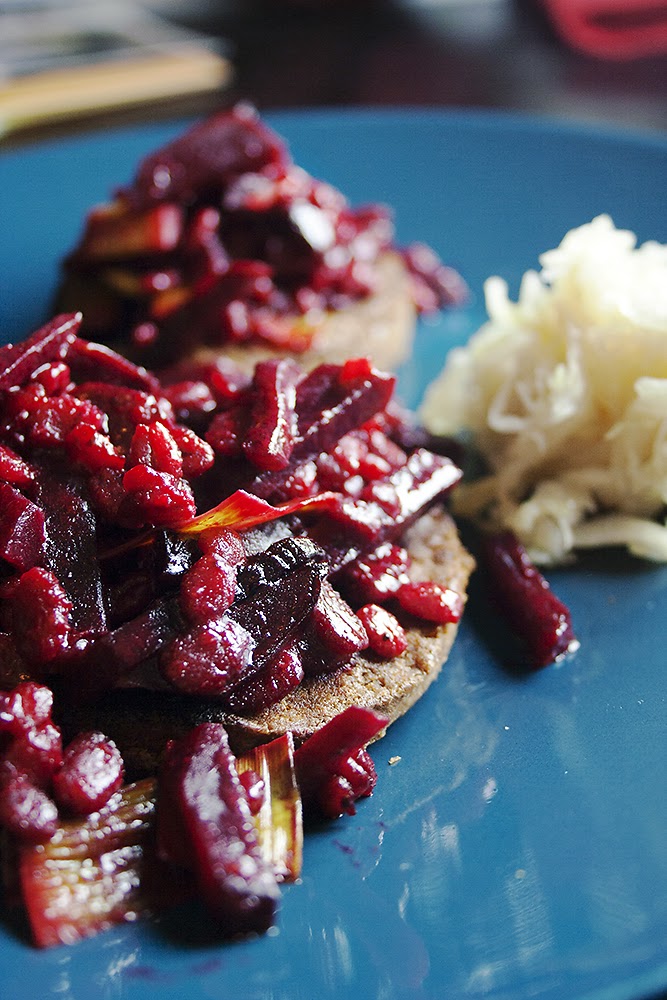
Salmiakki Sauce for Seitan and Beet ‒ Salmiakkikastike seitanille ja punajuurelle
When I dine at a restaurant I find it very pleasant if the menu clearly states what's in a given dish, for example "Chili rubbed seitan steak, raspberry vinegar marinated beets and salmiakki sauce". It gives me as a customer much better idea of what to order if the name isn't just some fancy French word I don't know how to pronounce. But when I see this elsewhere, peculiarly in recipes, for some reason I find it annoying and just trying to sound fancy, for example "engine oil rubbed Tavastian soap with small stones and slowly caramellized rubber". It's really a combination of the different ingredients or even separate dishes, and guess my logic goes that this means that any given part of that plate isn't really worth repeating or at least the recipe writer doesn't believe it is. Guess I'm only annoyed because this has becme some sort of a fad among Finnish celebrity chefs. Anyway, I try to avoid that happening in my recipes, although I realize I might just have an attitude problem. Sometimes the combination of tastes truly is the more important thing than any given part of it. Taste pairing might just be the single most important part of kitchen art.
This is the case of this recipe too. Although the part needing a recipe is really just for the sauce, I couldn't help but putting a suggestion of what comes under the sauce in the headline. These three tastes are just fine on their own, but they work especially well together, so I thought to highlight the combo. The idea came from a salmiakki marinated beet starter dish, created by a salmiakki making company, but I thought to turn it into an entrée. For the seitan, I used chili in the dough and fried them well in oil. For the beets, I sliced them thin, drizzled with oil and raspberry vinegar, as well as spiced with salt and thyme before roasting them in the oven long just long enough to still have them crunchy. The portion is crowned by the sauce which has a lot subtler aroma than you might think.
- 150 g salmiakki candy (hard ones are best in this, I used Turkinpippuri) + 1 dl water
- 4 dl strong vegetable bouillon
- 1 dl white wine
- 2 tbsp margarine
- 2 tbsp wheat flour
- black pepper
- salt
Prepare a salmiakki syrup by putting the candies in a small bowl and pouring water on them just enough to get them covered. Turn around with a spoon when you walk by. Dissolving only takes a few hours, so if you start in the previous evening, you can be sure they'll make it in time.
Melt the margarine in a sauce pan. Shift the flour on the melted stuff and stir. Pour in the stock before the roux start to turn brown (unlike in basic brown sauce). Let the sauce thicken on a low heat, stirring occasionally. Add the salmiakki syrup and the wine. Let the sauce reduce until the consistency is thick enough to stay on the seitan. Spice with salt and pepper according to your taste buds.
Nutritional values / 798 g:
energy 882 kcal
fat 22 g
protein 2 g
carbohydrates 144 g
fiber 1 g
22.2.14
Roasted Garlic Soup ‒ Paahdettu valkosipulikeitto
I recently noticed my whipped porridge in a Buzzfeed post about Finnish foods. It was an interesting listing altogether, featured many things you can find from this blog as well, like pea soup or cabbage casserole, and also reminded me of some dishes I'm yet to post, like korvapuusti or Karelian stew. But one item there didn't feel quite right. Garlic soup. Is that supposed to be some Finnish speciality? Yes, many Finns love garlic and there's even a garlic restaurant in Helsinki which serves garlic icecream, but I wouldn't call it any countryside stable. This soup I'd locate somewhere around Spain or perhaps even France.
Still, this is a perfect winter time soup to keep away flu, vampires and small-minded people. The modest outlooks don't really do justice to the wonderful complexity of the taste. Even if garlic isn't usually your cup of tea, you might still want to try this pleasantly smooth and sweet twist of it. Similarly to best of beers, the thing tastes like many things at once. You shouldn't start the cooking when your already hungry though, because it needs some time to develop all that symphony. Notice it's more of a starter than an entrée soup, though we enjoyed it paired with oven sandwiches consisting of rye bread, sun-dried tomatoes, smoked tofu, vegan sour cream and basil. The only important things in the soup are naturally the garlic roasting and onion caramelizing, but we based our version to a recipe which uses some beer as well, since hey, didn't someone just mention how good it tastes like?
- 7 whole garlics
- 4 onions
- 1 l vegetable broth
- 4 dl oat cream
- 2 dl strong tasting beer (or apple cider)
- 1 dl canola oil
- 2 tbsp farin sugar
- thyme
- black pepper
- salt
Cut the garlics in half breadth-wise. No need to remove the now halved cloves from their place, just put them in an oven casserole open side above and drizzle some oil on them. Roast in a 125°C oven for 1.5 hours. Now the cloves should be quite easy to peel.
Peel and chop the onions coarsely. Pour rest of the oil in a pan and heat up. Put the onions and garlics in the pan, turn down the heat to a mild temperature. This part takes a lot of patience as it may take up to 45 minutes. You shouldn't fry the onion but let it caramelize in time. Turn them occasionally and keep a low heat to prevent them from burning. They're ready when they look golden and taste sweet, just like the garlics when they came out of the oven.
Add the sugar and the beer with the onions. Let the mixture come in to a boil and then quickly add the broth. Put the lid on and let the soup simmer for half an hour or so. Add the rest of the ingredients. Cook for a few minutes more, smooth down with a hand blender and cure your flu.
Nutritional values / 2635 g:
energy 2136 kcal
fat 133 g
protein 44 g
carbohydrates 170 g
fiber 21 g
Tunnisteet:
garlic,
slow cooking,
soups,
winter
17.12.13
Beet Temptation ‒ Punajuurikiusaus
I've talked before about the wonderful casserole type of dish called temptations.They usually involve potatoes cut into strips but it being December and all, this time I wanted to use beets. Their colour is so wonderfully dark and Christmassy, though this is still quite an everyday dish.This makes a creamy and fruity accompaniment for a more humble main course.
- 1 kg beetroot
- 4 dl oat cream
- 1 leek
- 1 dl barley
- 1 chili (I personally think habanero gives a nice fruity aroma. But if hotness isn't your thing, try a winter apple instead.)
- thyme
- green pepper
- bread crumbs and margarine to top with
Peel and julienne the beets. Cut the leek and chili too. Mix all the ingredients in a casserole. Bake for half an hour in a 175°C oven.
Mix things a bit with a spoon. Sprinkle bread crumbs on the casserole. Top with a few margarine pieces. Bake for another half an hour.
Nutritional values / 1765 g:
energy 1297 kcal
fat 54 g
protein 30 g
carbohydrates 169 g
fiber 45 g
4.12.13
Soy Stroganoff ‒ Soijastroganov
There's a lot of debate about what the original Stroganoff's beaf contained. There was an influential Stroganoff family who used to own practically half the Siberia. A recipe bearing their name was created in the 18th century, perhaps by one of their French chefs. Of the many competing recipes some feature mushrooms, sour cream, mustard or onions while others don't. Most versions of today mention tomato paste though tomatoes weren't even known in Russia at the time.
With not enough historical knowledge I'm not going to take part in this guessing game. Instead, I'm going to tell you how a dish called stroganoff became popular in the Nordic countries during the last century. In Finland different versions of it were served at practically every gas station. One very staple item in them, along with some form of meat and tomato paste, is pickles- Especially sausage stroganoff is still thought as a typical Finnish home food.
Sausages are fine too, but I used textured soy protein strips to make a cheap and easy winter dinner.
- 125 g soy strips
- 2 onions
- 2 pickles
- 2 dl oat cream
- 0.5 dl tomato paste
- 1 tbsp mustard
- 1 dose of stock
- oil for frying
Cook the soy strips for ten minutes in stock flavoured water. Chop and sauté the onions. Drain the soy strips and add them on the same pot with the onions. Dice the pickles. Mix everything and let it simmer for ten more minutes.
Serve with barley or potatoes.
Nutritional values / 917 g:
energy 1052 kcal
fat 51 g
protein 74 g
carbohydrates 74 g
fiber 29 g
With not enough historical knowledge I'm not going to take part in this guessing game. Instead, I'm going to tell you how a dish called stroganoff became popular in the Nordic countries during the last century. In Finland different versions of it were served at practically every gas station. One very staple item in them, along with some form of meat and tomato paste, is pickles- Especially sausage stroganoff is still thought as a typical Finnish home food.
Sausages are fine too, but I used textured soy protein strips to make a cheap and easy winter dinner.
- 125 g soy strips
- 2 onions
- 2 pickles
- 2 dl oat cream
- 0.5 dl tomato paste
- 1 tbsp mustard
- 1 dose of stock
- oil for frying
Cook the soy strips for ten minutes in stock flavoured water. Chop and sauté the onions. Drain the soy strips and add them on the same pot with the onions. Dice the pickles. Mix everything and let it simmer for ten more minutes.
Serve with barley or potatoes.
Nutritional values / 917 g:
energy 1052 kcal
fat 51 g
protein 74 g
carbohydrates 74 g
fiber 29 g
Tunnisteet:
main courses,
Slavic,
sour,
stews,
textured soy protein,
winter
15.5.13
Sailor Steak ‒ Merimiespihvi
I haven't managed to find out the origin of this dish. It used to be quite a common home food, but the name leads to assume it really does originate from ship menus. According to a legend, in the seas it was better known as "One Has Gone from the Lot" ("Yksi on joukosta poissa") as it was usually served right after some crew member had been reported missing. "No land ahoy this week either, but don't worry guys, we did have some meat after all."
Merimiespihvi consists of sliced beef, potato and onion, all simmered in beer (which in some modern versions is unforgivably replaced by regular broth). It doesn't resemble a steak for one bit, so I can only assume this is the closest thing to a steak your average sailors in the old days ever managed to see. Instead of beef I used seitan which we happened to have quite a lot left from this meal. The long preparation time somehow turns these simple ingredients into a rather original tasting dish that wouldn't be the same at all if you just combined them on the plate.
Oh, and by the way: I created a Facebook page for Mämmi to help some of you to follow what I post and have yet another way for conversation. You're all welcome to join!
- 1 portion of seitan (worth of about 4 dl gluten flour)
- 1 bottle of beer (schwarzbier or smoked beer fit here)
- 8‒10 potatoes
- 4 onions
- oil for frying
- 1 tsp whole black peppers
- thyme or a bay leaf
- stock in case you need to complement the beer
- salt
Cut and club the seitan into mouth-sized, flat pieces. Fry on a pan. Slice the onions and sauté them a bit as well. Slice the potatoes. Arrange seitan, onion and potatoes in an oven pot layer by layer. Put a potato layer on top. Add the spices. Pour enough beer to just about to cover the upmost layer (and continue with stock in case one beer bottle isn't enough).
Cover the pot. Heat up the oven to 180°C and let the stew simmer there for at least two hours. Add water or broth in case it starts to look terribly dry while cooking. The final Merimiespihvi isn't meant to swim in broth anymore though.
Serve with pickles and/or pickled beet.
Nutritional values / 2295 g:
energy 2316 kcal
fat 49 g
protein 194 g
carbohydrates 226 g
fiber 32 g
Merimiespihvi consists of sliced beef, potato and onion, all simmered in beer (which in some modern versions is unforgivably replaced by regular broth). It doesn't resemble a steak for one bit, so I can only assume this is the closest thing to a steak your average sailors in the old days ever managed to see. Instead of beef I used seitan which we happened to have quite a lot left from this meal. The long preparation time somehow turns these simple ingredients into a rather original tasting dish that wouldn't be the same at all if you just combined them on the plate.
Oh, and by the way: I created a Facebook page for Mämmi to help some of you to follow what I post and have yet another way for conversation. You're all welcome to join!
- 1 portion of seitan (worth of about 4 dl gluten flour)
- 1 bottle of beer (schwarzbier or smoked beer fit here)
- 8‒10 potatoes
- 4 onions
- oil for frying
- 1 tsp whole black peppers
- thyme or a bay leaf
- stock in case you need to complement the beer
- salt
Cut and club the seitan into mouth-sized, flat pieces. Fry on a pan. Slice the onions and sauté them a bit as well. Slice the potatoes. Arrange seitan, onion and potatoes in an oven pot layer by layer. Put a potato layer on top. Add the spices. Pour enough beer to just about to cover the upmost layer (and continue with stock in case one beer bottle isn't enough).
Cover the pot. Heat up the oven to 180°C and let the stew simmer there for at least two hours. Add water or broth in case it starts to look terribly dry while cooking. The final Merimiespihvi isn't meant to swim in broth anymore though.
Serve with pickles and/or pickled beet.
Nutritional values / 2295 g:
energy 2316 kcal
fat 49 g
protein 194 g
carbohydrates 226 g
fiber 32 g
Tunnisteet:
beer,
main courses,
onion,
oven dishes,
potatoes,
Scandinavian,
seitan,
stews,
winter
30.4.13
Sun Rolls ‒ Aurinkosämpylät
We've had an exceptionally cold spring this year, but now it finally looks like the snow has withdrawn (at least for a while). To get to enjoy wild veggies quicker, I tried to lure out the Sun from behind those clouds with these rolls I made for a housewarming present.
Rolls like these are usually among the first things Finnish kids learn to bake on their own. Still, I've been looking for the perfect recipe for most of my life. They didn't rise at all, they became too dense, they tasted like sugar buns. Eventually I've come to the conclusion it's not really about the recipe, it's about the touch and some basic rules you need to learn by experience. This is why I tried to include some tips I've found helpful in the recipe, so the instruction part may seem a bit complicated than usual, though it's not really.
- 10-12 dl flour (mostly white wheat flour, but do try experimenting with adding different full corn flours, wheat germ or such for less bun-like results)
- 5 dl water (some use oat milk or such but I wouldn't bother)
- 50 g margarine
- 50 g fresh yeast (I've found dry yeast harder to control)
- 1 tbsp dark syrup
- salt
- 2 carrots
- 1.5 dl sun flower seed
Make sure all the ingredients are room temperature. Dissolve the yeast in water (which doesn't need to be warm). Add the syrup, the salt, part of the flours and the margarine. Keep kneading with your hand while you add flours little by little. Optionally, crate in the carrot and the sunflower seeds too.
Add flour just enough to get the dough to detach from your bowl but see it still sticks to your fingers. Using more flour than you absolutely need just gives you hard buns. Also, if you're using old flours you'll need less than fresh ones. Knead at least ten minutes more to make sure you get long, pretty strings and gets some of that seitan-style structure. Smoothen the surface of the dough, cover with a towel and let it rise until it's doubled its size (should take less than an hour).
With a sharp knife, take fist-size pieces of the dough and carefully roll a bit between your hands. If you wish, decorate by cutting a cross (Sun symbol!) on them and sprinkling some more seeds. Place the rolls on the baking sheet, put the baking sheet in a warm place (like over a sink filled fit hot water if you don't have any better place) and cover again for half an hour. For a bit nicer colour, spray a little water with a spray bottle.
Bake in 225°C for 8-10 minutes. If you let them be a little longer you'll get crunchier surface. When they come out of the oven, instantly cover them with a towel to keep them soft longer. These are at their best on the same day.
Nutritional values / 1505 g:
energy 3426 kcal
fat 97 g
protein 116 g
carbohydrates 525 g
fiber 43 g
Tunnisteet:
bread,
carrot,
nuts and seeds,
snacks,
winter
25.4.13
Cider Sauce with Juniper Berries ‒ Katajanmarjoilla höystetty siiderikastike
I've had some cider and juniper berries waiting for the next time I'll make seitan for a while now. Laura in her blog Kasvisruokaa has created an excellent sounding marinade from juniper, garlic and rosemary, but as at the moment I was thinking what we'd eat today, waiting untill the next night to get seitan properly marinated seemed like forever. So instead, I made a sauce from the cider and spiced it up with juniper and rosemary. The taste is quite strong and wouldn't fit together with terribly many things, but for a good seitan steak it's just perfect. Cider gives it a very zesty basic taste while juniper adds up a more foresty flavour. And while I was busy with this, my spouse cooked us an accompaniment that reminds me of Hungaria, paprika potatoes. I'll give ten points to this dinner.
- 5 dl dry apple cider (please stay away from those carbonated sugar drinks)
- 6 juniper berries
- 1 tbsp margarine
- 2 tbsp wheat flour
- allspice
- rosemary
- salt
Pour the cider in a small pot. Crush the juniper berries and add them as well as the allpsice and the rosemary. Cook until the cider has reduced to half. Take aside (and if you're feeling energetic, fish out the spices). Prepare a roux as if you were making a basic brown sauce. That means melt the margarine, sift in the flower and keep stirring until things turn all nice and golden (but not black, hopefully). Pour the reducer cider back on, add some salt and remove from the stove.
Nutritional values / 534 g:
energy 336 kcal
fat 11 g
protein 3 g
carbohydrates 23 g
fiber 1 g
23.4.13
Pearl Gruel ‒ Helmiryynivelli
Free school lunches have shaped Finnish food culture since 1948. It tends to give whole generations equal experiences and helps especially the lifes of the poorest families. The cooks actually spend a lot of time planning the menus so for many kids this is the healthiest and most nutritionally sound meal they'll eat all day ‒ something that isn't always as self-evident as you'd like to think.
Every generation also seems to have strong favourites and anti favourites.School food is generally criticised as lacking of taste, in the same way as say, hospital food, but the environment of hurry and lack of aesthetics also gathers critique. Sometimes I've thought you could put together an interesting cook book just by collecting together most hated school foods from different times. I grew up during the depression of the 90's in the Finnish version of Bible Belt, Ostrobothnia, and was one of the only three vegetarian students, so I still have a hard time eating square-shaped dry bread, grated root vegetables or raw cabbage ‒ what an excellent salad projet for the next winter. (Then again, I loved pea soup and spinach pancakes.)
For the generation of my parents, pearl porridge and pearl soup were definitely among the most hard-to-swallow items. And can't blame them, I mean gosh, those things are slimy. They're just potato starch pressed together, something I imagine didn't exist before second world war.
I, on the other hand, came to like pearl soup since it was something my grandmom used to make. Come to think of it, it doesn't actually differ much from the macaroni soup my dad made, so if you have a hard time finding "pearls", try macaronis instead. It might prove difficult since I haven't heard they would be used anywhere else in the world (although this might help). This version gets a bit more taste from fennel seeds and that medieval treat, almond milk, which is usually sold lightly sweetened so I omitted sugar altogether though in my records this is definitely a dish on the more sweet side.
- 1 l almond milk (you can choose any milk you like, I just thought this would give a nice aroma)
- 1.5 dl potato starch pearls
- 1 tbsp fennel seeds
- 1 tbsp margarine
- salt
- sugar to serve
Heat up the milk. (Don't leave it alone as it might come out from the pot if it misses you.) When you start to see bubbles appearing, add the pearls and the fennel seeds. Let them cook for about 8 minutes. Add a pinch of salt and if you wish, a spoonful of margarine. Let the eaters decide if they want to sprinkle sugar on top.
Nutritional values / 1090 g:
energy 611 kcal
fat 22 g
protein 5 g
carbohydrates 306 g
fiber 16 g
6.4.13
Mashed Cabbage ‒ Kaalimuusi
Reading my father's autopsy report I learned that in the time of the death his arteries were already so clogged his life expectancy wasn't terribly long anyway. Knowing how good old daddy ate and how much he loved butter that didn't really surprise me much. But considering coronary disease is still the most common death reason in Finland (accounting to a whole quarter of all the deaths) and especially wide-spread among men, the low-carb craze occuring here for the last couple of years has seemed a bit worrying. Or to be more precise, at least the way most people seem to carry the it out in practise.
All this of course, should be no reason to disapprove every principle that comes from low-carb communities, say cutting down on so called fast carbohydrates or favouring home cooking from fresh ingredients. Nor a reason not to read their forums in search of good ideas. One of the brightest ones I've encountered is mashing cabbage just like potatoes. A extremely simple idea, helps to include more veggies in your meal during the cold season and most importantly, delicious as hell. During the past couple of weeks this is the third time already we've prepared this. Bear in mind that this isn't as filling as mashed potatoes, so remember it's going to vanish from the table much quicker.
- 1 small cabbage
- 50 g margarine
- green pepper
- nutmeg
- salt
Chop the cabbage and cook it until soft. Pour the water away (and save for tomorrow's soup). Add the rest of the ingredients. Mash until smooth.
Nutritional values / 850 g:
energy 507 kcal
fat 37 g
protein 10 g
carbohydrates 33 g
fiber 17 g
All this of course, should be no reason to disapprove every principle that comes from low-carb communities, say cutting down on so called fast carbohydrates or favouring home cooking from fresh ingredients. Nor a reason not to read their forums in search of good ideas. One of the brightest ones I've encountered is mashing cabbage just like potatoes. A extremely simple idea, helps to include more veggies in your meal during the cold season and most importantly, delicious as hell. During the past couple of weeks this is the third time already we've prepared this. Bear in mind that this isn't as filling as mashed potatoes, so remember it's going to vanish from the table much quicker.
- 1 small cabbage
- 50 g margarine
- green pepper
- nutmeg
- salt
Chop the cabbage and cook it until soft. Pour the water away (and save for tomorrow's soup). Add the rest of the ingredients. Mash until smooth.
Nutritional values / 850 g:
energy 507 kcal
fat 37 g
protein 10 g
carbohydrates 33 g
fiber 17 g
15.1.11
Stuffed Holiday Roast with Cranberry Glaze ‒ Täytetty juhlapaisti karpalokuorrutteella
Yule ended last Thursday with Talvennapa, "the navel of the winter". It's said to be the coldest day of the year. The Great Oak is symbolically cut down from covering the Sun so it gets to shine and daytime starts to grow longer again. Most people celebrating the day choose a weekend instead of the "official" day when there's more time to relax.This roast should be a perfect centerpiece for any feast table. I took the inspiration from Vegan Dad's seitan roast and tofu glaze. The latter one especially turned out excellent. The stuffing portions need some adjusting as I got quite a lot of leftovers. But don't worry, you can eat them while waiting for the roast to cook.
- 1 dough for seitan roast
Stuffing:
- 1 dl barley
- 1 dl pine nuts
- 1 dl horse beans
- 1 dl grinded celeriac
- 1 dl frozen cranberries
- 0.5 dl roasted onion
- 1 tablespoon margarine
- 1 tablespoon wheat flour
- green pepper
- salvia
- thyme
- herb salt
Glazing:
- 2 dl frozen cranberries
- 1 dl water
- 0.5 dl dark sugar
- 1 tablespoon vinegar
- cinnamon
- allspice
Roast the nuts if you wish. Cook the barley and the beans. Mix all the stuffing ingredients together. While it's cooling down, prepare the seitan part.
Roll out the seitan dough into a thin rectangle. Spread the stuffing in the centre lengthwise. Make sure it's firm. Roll the seitan tightly so the edges will touch each other. Seal the roast and wrap inside a tin foil. Roast for an hour in 175°C oven.
In the meanwhile, prepare the glaze. In a saucepan, cook the cranberries with the water until they're soft. Blend smooth. Stir in all the other ingredients. Refrigerate. When the roast comes out of the oven, let it cool down as well. Then move the roast into a casserole and cover all over with the glaze. Bake 10-15 minutes more.
Enjoy hot or cold!
Nutritional values / 1680 g:
energy 3318 kcal
fat 121 g
protein 242 g
carbohydrates 321 g
fiber 56 g
Tunnisteet:
barley,
cranberries,
main courses,
nuts and seeds,
seitan,
winter,
Yule
2.1.11
Rutabaga Cubes in Syrup ‒ Siirappiset lanttukuutiot
Instead of rutabaga casserole I made what my mum used to cook on Yule. Simple fried rutabaga cubes with syrup. The basic idea was to re-fry them every day as long as there was something left. They just got softer and better each time. But it didn't work like that now. Almost all of them were gone after the first meal and then I ate the remains cold next day when I got hungry,- 1 kg rutabagas
- 2 tablespoons dark syrup
- 1 tablespoon rape oil
- salt
Peel the rutabagas and cube them. Fry on a hot pan with oil. Season with syrup and a pinch of salt.
Nutritional values / 1054 g:
energy 490 kcal
fat 17 g
protein 10 g
carbohydrates 76 g
fiber 18 g
Carrot Casserole ‒ Porkkanalaatikko
A year ago I posted two of the four essential casseroles of Finnish Yule table: potato and raisin. This time I thought I'd continue with the carrot version. Like so many traditional dishes, this is most often made with rice which at some point was though fancier than home-grown grains, mostly barley. Some like it plain carrot, without any grains. As a halfway solution I use just enough semolina to keep it nicely together.- 1 kg carrots
- 1.5 dl oat cream
- 2 tbsp dark syrup
- 1 dl semolina
- 1 tsp salt
- 1 tsp ginger
- 0.5 tsp nutmeg
- breadcrumbs and margarine
Peel, cook in small amount of water and puré the carrots. Save 1 dl of the broth you used for cooking. Add it as well as all the other ingredients with the carrot mash. Butter a casserole (or six oven-proof coffee mugs as I did) and pour the carrot mixture in it. Top with breadcrumbs and margarine pieces. Put into a 175°C oven for an hour.
Nutritional values / 1300 g:
energy 993 kcal
fat 30 g
protein 19 g
carbohydrates 158 g
fiber 32 g
Tunnisteet:
carrot,
oven dishes,
sidekicks,
winter,
Yule
1.1.11
Tofu and Nut Loaf ‒ Tofu-pähkinämureke
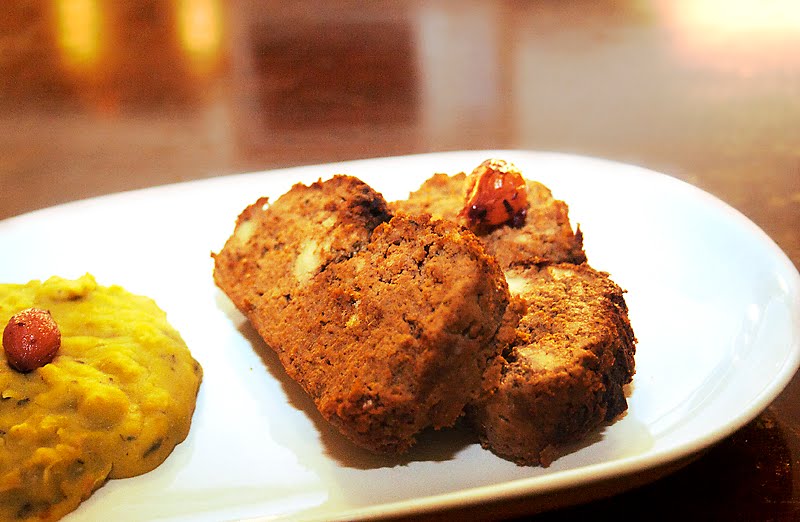
Have a happy year 2011! I guess most Finns were shooting fireworks and throwing wild parties last night but to be quite honest, I've never really understood the fuss over a changing number or why Gregorian calendar even places the New Year to the middle of winter in the first place. After all, I already cast my new year tin during Kekri. So yesterday evening we just took a nap after an exhaustive work week, ate a nice meal, drunk some cider and watched a surprisingly boring movie about the French revolution.Anyway, here's a loaf recipe on the fancier side for such occasions. I've originally taken it from the Finnish animal rights forum and usually prepare it for the Yule table as the poster suggests (among my non-traditional food traditons). It's quite salty, because it's meant to be eaten together with several other standing table dishes (and fits excellently on toasted bread on the next morning). If you'd rather have it as the star of the table, you may want to replace some of the soy sauce with plain water or saltless vegetable stock.
- 75 g hazelnuts
- 90 g almonds
- 165 g cashew nuts
- 540 g firm tofu (I like it best smoked but plain goes just fine)
- 4 toasted white bread slices
- 1 punch of fresh parsley
- 1 small punch of fresh salvia
- 1 dl soy sauce
- 2 tablespoons Dijon mustard
- 1 teaspoon paprika
- basil
- thyme
- black pepper
Add the ingredients into a mixer one by one. Keep mixing until you have a paste. Butter a casserole or and spread evenly into it. Garnish with bread crumbs if you wish and make some wrinkles with your fingers. Bake in 175°C for about an hour or until beautifully brownish.
Nutritional values / 1200 g:
energy 3152 kcal
fat 224 g
protein 177 g
carbohydrates 115 g
fiber 37 g
Tunnisteet:
cold dishes,
main courses,
nuts and seeds,
on the bread,
oven dishes,
tofu/hefu,
winter,
Yule
27.12.10
Rye Gingerbread ‒ Ruispiparit
I made a small batch of gingerbread cookies this year as well. I used half of my last year'sgingerbread recipe but replaced the wheat flour with sifted rye flour. There wasn't much difference in outlooks or taste really. Perhaps the structure seemed a bit crunchier or maybe I just hoped so. I think regular, unsifted rye flour would make even a better option.
Remember kids, anything with rye in it is health food!
Tunnisteet:
coffee table,
rye,
slow cooking,
sweet,
winter,
Yule
24.12.10
Return of the Weird Glögis ‒ Outojen glögien paluu
Exceptionally, this Yule I don't plan to travel around the country but stay home and be lazy. I started it early on 21. with a friend of mine (since he didn't remember Winter Solstice was 22. this year) by raising a pint of Hyvä Tuomas for the rising Sun on the ice of the lake Näsijärvi. We didn't actually see the star of the 5-hour day at all since it was so cloudy but seeing that neverending white horizon I felt sorry I didn't bring my camera. Well, my fingers were all frozen already so maybe it was for the better.Since I'm defintely not going to do anything useful during these few days the Sun rests on the shoulders of the Great Oak (in Finnish mythology they're called Pesäpäivät, "nest days") I could finally do things I've wanted to do quite a long time: read some novels, install Ubuntu and update this blog for a change. These hot drinks are from the pikkujoulu party me and my friends had. As you may remember, we did the same last year. (If the word "glögi" is all Creek to you, read this post first.) Everyone got to bring one recipe (I did the sea buckthorn version). I've made some minor alterations to them, for example by removing extra sugar if it seemed way too sweet. But feel free to adjust them according to your own taste.
Apple Tea Glögi
- 1 l water
- 2 dl apple juice
- 6 teaspoons of your favourite tea
- 4 tablespoons fariinisokeri or muscovado
- 2 tablespoons glögi spices (cinnamon, clove and ginger)
(- mint liqueur)
Prepare the tea. Remove the tea leaves. Add the other ingredients and let the mixture simmer for another ten minutes. Pour in cups and let everyone add mint liqueur as much as they please.
Black Currant Glögi with Mandarine
- 1 l apple juice
- 2 dl black currant juice (without added water)
- 1 cinnamon stick
- 5 cloves
- 0.5 dl sugar
- 1 dl raisins
- 200 g preserved mandarine slices
(- vodka)
Put the juices, the sugar and the spices into a pot and let them simmer for five minutes. Pour the liquid part into cups. Finish off with the raisins, the mandarines and the vodka.
Pirate Glögi
- 8 dl pineapple juice
- 4 dl orange juice
- 2 dl water
- 2 dl dark rum
- 2 tablespoons fresh ginger, chopped
Cook the ginger in the water for about ten minutes. Add both the juices. Heat the whole thing up but don't boil. Portion the rum into four glasses and pour the mixture on it. Decorate with small Pirate Party flags.
Sea Buckthorn Glögi
- 1 l unfiltered apple juice
- 2 dl sea buckthorn juice
- 1 cinnamon stick
- 2 star anises
- 1 piece of ginger
(- sugar)
Let the apple juice simmer together with spices for about an hour. Mix with the sea buckthorn juice only a moment before serving. Add sugar if you wish. I don't recommend alcohol with this since we noticed a surprising effect: half the taste seemed to disappear somewhere after adding only a sip of vodka.
Tunnisteet:
apple,
beverages,
black currant,
feeling adventurous,
sea buckthorn,
winter,
Yule
11.12.10
Red Cabbage Salad ‒ Punakaalisalaatti
Tonight we'll be having our own traditional pikkujoulu party with a group of friends, just like we did last year. The idea of trying weird glögis turned out so well last time we thought we'd repeat it with some fresh recipes. I've also baked a chocolate cake for the occasion but I haven't tasted yet in which way is it to die for.While waiting for the dessert, here's an extremely simple sidekick salad. It takes practically no time to prepare so it's just what you need when noticing your Joulu table is still missing something fresh. Cabbage and lingonberry are quite a regular combination in Finnish kitchen but somehow the nuts give it that special festive feeling.
- 500 g red cabbage
- 3 dl walnuts
- 2 dl lingonberry cram (with only a hint of sugar)
Shred the cabbage. Combine everything. Say: "Hyvää ruokahalua!"
For hi-fi version, toast the nuts. Depending on what else you're having on the plate you could also add couple of tablespoons of (nut) oil and some fennel seeds.
Nutritional values / 815 g:
energy 1401 kcal
fat 119 g
protein 35 g
carbohydrates 47 g
fiber 41 g
Tunnisteet:
cabbage,
lingonberries,
nuts and seeds,
raw,
salads,
winter,
Yule
14.2.10
Pea Soup ‒ Hernerokka
Long flaxes, fine hemps and turnips size of a plate to everyone! That's what you're supposed to shout when sliding down a snowy hill on Laskiainen (the name of which refers to either descending or sliding). You see, today is one of those ancient Finnish holidays that are slowly gaining back their popularity. Connections to English Shrove Tuesday are close but in the Finnish version both Sunday and Tuesday are equally important.During christianization Laskiainen became so intensely affected by the beginning of the Easter lent that we can now only speculate about its original meaning – and what could possibly be more fun! Slavic peoples celebrated the Sun (eating blintzes to symbolize it) and the end of the winter at this time so some believe this is also true about Laskiainen. One hint is all the well-wishing for the next harvest season. It actually looks like this time of the year used to mark the beginning of the spring all around Europe. Flax and hemp, the most important fiber plants, had a position especially significant as well as combing hair, a clear symbol for flax. All weaving and spinning was paused during the holiday. According to one theory (by Kustaa Vilkuna) it was in a way an ancient Labour Day but this sounds like a rather modern idea to me.
Today was foggy which makes the air feel really cold. So after couple of hours of sliding a thick pea soup is a must. It's an essential dish for Laskiainen but also something even a child knows you're supposed to have on Thursdays. This is how I usually make the basic version, tuned with herbs. Sometimes I like to make a double portion for the freezer.
- 500 g dried peas
- 1.5 l water (more if needed)
- 1 punch of sage
- 1 dose of stock (miso fits here as well)
- 1 carrot
- 1 onion
- 4 dl textured soy protein flakes (or smoked tofu)
- 1 tablespoon rape oil
- yarrow flowers (just a hint)
- salt
Soak the peas at least overnight. (This shortens the cooking time). You can sprout them as well if you have time. Rinse. Add the water, the stock, the salt, the pepper and the yarrow. Cook until the peas are starting to get mushy (the time needed depends a lot on how long you soaked and sprouted, but prepare yourself to at least three hours).
Chop the onion. Sauté on an oiled pan with the soy flakes until they turn golden or even crunchy. Grate the carrot and cut up the sage. Add everything into the soup. The longer you cook or more times you rewarm the soup the better it gets.
Enjoy with mustard and rye bread.
Nutritional values / 2 l:
energy 1922 kcal
fat 29 g
protein 123 g
carbohydrates 277 g
fiber 66 g
Tunnisteet:
childhood,
main courses,
peas,
slow cooking,
soups,
textured soy protein,
tofu/hefu,
winter
11.2.10
Sweet and Salty Winter Salad ‒ Makeansuolainen talvisalaatti
Everyone hopefully knows by know what a wonderful pair raw carrots and salted nuts make. Well, I was chopping carrots for a soup on the other day and thought I'd make a hi-fi version of the theme while I'm at it.Once I remember seeing a satay carrot salad recipe I thought awesome but can't find anymore. The carrots were first grated the way Finns normally serve them but then the cold salad was garnished with hot and sweet nuts. I had been thinking a way to variate the idea without making it too similar to this hot and sweet salad. Then I saw Kahvila Vegaani's excellent selection of winter salads where the idea was to marinate (and raw cook) root vegetables and then combine them with vinaigrettes made of fruits. The combination of hot and cold fits salads well and combining sweet and salty at the same time gives it even more twist. I'm sure I'll be trying more of these.
- 300 g carrots
- 0.5 dl black currant juice (non-sweetened)
- 2 tablespoons spruce syrup
- aniseed (or star anise or liquorice)
- 0.75 dl hemp seeds (sprouted if you have time)
- salt
Peel and shred the carrots. Put them into a bowl, add the spruce syrup and sprinkle with a fair amount of aniseed. Pour the juice over the carrots and turn them over a bit. Refrigerate the bowl and forget it for a night.
Arrange the marinated carrots on your serving plate. Gulp down the remaining juice. Roast the hemp seeds on a dry pan. Salt them well. Place over the cold carrots while still hot. Serve immediately.
Nutritional values / 389 g:
energy 351 kcal
fat 17 g
protein 13 g
carbohydrates 39 g
fiber 19 g
Tunnisteet:
black currant,
carrot,
hemp,
nuts and seeds,
raw,
salads,
slow cooking,
winter
5.2.10
Runeberg's Tart ‒ Runebergintorttu
Today is a flagging day for the honour of Finland's national poet Johan Ludvig Runeberg. These little cakes are just as much named after his wife Fredrika Runeberg who is nowadays also a highly respected writer but was left in the shadow of her husband at the time. The recipe she had probably adapted from a confectioner called Lars Astenius was found recently and naturally has very little to do with the numerous versions we now know as Runeberg's Tarts.At this point I have to confess the only work I've ever heard or read from either of them is Johan's poem Vårt Land (Maamme in Finnish, Our Land in English) that became Finland's national anthem ‒ and I don't even like the song. The Runebergs were a part of the Swedish-speaking elite whom I can hardly relate to. The reason I find this couple so important is that they were key figures among the Fennomans who created the idea of Finnish people as we now understand it. Thanks to them, I can now get academic education in the language of my ancestors and read the most massive poem collection of the whole world: the Finnish Folklore Archives, mostly written in the magical ancient poem form Kalevala metre. In a way I even feel me and my spouse are following their large footsteps, trying to get Finnish cultural heritage better known in our humble ways. Perhaps I really should read some of their writings.
The tarts of today typically feature almonds and gingerbread crumbs. They're decorated with raspberry jam and powdered sugar plus water icing. I used arctic raspberry, possibly the most decadent tasting berry on the face of the planet, but apple sauce fits here as well. Store-bought tarts are usually cylinder-shaped though you could also make small muffins or just one big cake. A major part of the taste comes from the moisturizing and it's hard to spread it evenly so make sure to choose something you love. (I strongly recommend my Finnish-speaking readers to read this story about making a cut brandy version.)
- 150 g margarine
- 1 dl sugar
- 2 dl almonds
- 2 dl bread crumbs (preferably consisting of gingerbread and rye crisps)
- 1 dl wheat flour
- 1 tablespoon flax seeds
- 1 dl water
- 2 teaspoons baking powder
- rum or arrack punsch for moisturizing (about 1 dl)
Heat up the water and leave the flax seeds soak in it. Beat the margarine and the sugar together so they form a fluffy mixture. Grind the almonds. Add everything except the moisturizer into the batter. If you're using baking tins (or four oven-proof coffee mugs like I did) oil and sprinkle with breadcrumbs. Be careful not to overfill your tins or paper cups since the tarts will rise in the oven. Even the surfaces and put them into a 175°C oven for about half an hour.
Let the tarts cool down. Moisture and wait a few hours before flipping them out of the tins. Add more rum onto the other end and decorate if you wish.
If you have the patience, refrigerate them overnight. I didn't. Eating half of these after only couple of hours was the only way to save the pecan chocolate cheese cake my spouse made for his mum.
Nutritional values / 1 mug-size tart:
energy 707 kcal
fat 48 g
protein 13 g
carbohydrates 42 g
fiber 6 g
Tunnisteet:
coffee table,
pies and cakes,
raspberries,
rye,
sweet,
winter
30.12.09
Ice Cream for Troll Winter ‒ Jäätelö taikatalveksi
First I thought I'd use glögi spices but then those more ethereal flavours drove over. There's no point in repeating the same things you have in the gingerbread crumbles. Think this is a wonderful dessert option for all those heavy chocolate boxes everyone has lying on the table this time of the year. And actually, a pretty healthy one as well.
The name refers to a book of Tove Jansson where Moomintroll wakes up in the middle of his hibernation, feeling all cold and alone. I can so relate to that. I'm almost certain that I ought to hibernate during wintertime but the society forces be to stay up.
- 200 g lingonberries
- 3 tablespoons lingonberry jam
- 400 g soft tofu (If you're making hemp tofu for this just forget the pressing part.)
- 3 dl gingerbread crumbs (The lovers of the unbaked paste can try rolling small balls out of raw gingerbread.)
- heather flowers
- lavender flowers (Just a hint since their scent unfortunately associates with perfume and you wouldn't want to eat perfume. It's the same problem with spearmint and tooth paste.)
Leave the frozen berries on the table for a moment to soften them up enough so you can crush them. Whip everything but the gingerbread crumbs together and stick the bowl into freezer. (Don't press the tofu even if you normally would.) Stir occasionally to break down any forming ice crystals. When you start to have hard time with the stirring (after about five hours) throw in the gingerbread crumbs and freeze one more hour. Serve with a hot drink.
The freezing of tofu ice cream seemed to be taking longer than normally and then again, it seemed to freeze really thoroughly. (This may be just due to the berries.) So thoroughly that if you don't eat it right away you have to leave it on the table for about an hour before serving in order to scoop anything out of it. The partly frosted, partly melted structure on the other hand is just heavenly.
Nutritional values / 690 g:
energy 512 kcal
fat 16 g
protein 25 g
carbohydrates 66 g
fiber 16 g
Subscribe to:
Posts (Atom)
Osta neljä tuotetta ja maksat vain kolmesta - Luomutallin kampanjatuotteet näet täältä

Teekauppa.fi - laadukasta teetä netistä
Ostoskorin loppusummasta vähennetään viisi euroa ja toimitus tapahtuu ilman postikuluja.
Syötä ostoskoriin kuponkikoodi:
syysteet
Tilauksen on oltava vähintään 35 eur, mistä jää maksettavaksi 30 eur.
Teekauppa.fi - laadukasta teetä netistä
Ostoskorin loppusummasta vähennetään viisi euroa ja toimitus tapahtuu ilman postikuluja.
Syötä ostoskoriin kuponkikoodi:
syysteet
Tilauksen on oltava vähintään 35 eur, mistä jää maksettavaksi 30 eur.