Showing posts with label cold dishes. Show all posts

20.9.13

Soy Lihapiirakka ‒ Soijalihis


This is a bit of a deviation from the "seasonal" theme since lihapiirakkas are sold rather evenly around the year. The name literally means "meat pie" which gave me some trouble naming the soy version since I don't think anyone would understand if I just called them soy pies. You do see a lot of naming variance like "meatless pie" or "soy meat pie", but I decided to go with a shortening in Finnish and keep the English name intact since it's already detached from the original meaning. Anyway, they're deep-fried pastries made from a doughnut type of dough and filled with rice and minced meat. Or, in the vegan version, usually rice and TVP.

Lihapiirakkas are an extremely popular fast food in Finland. You can find them cheap from practically every food store's convenience food section. Non-chain-owned street kiosks sell them even in the smallest villages with one shop and no restaurants, along with french fries and hamburgers. In bigger cities you have a chance of finding them all self-made and vegan. Quite often they're cut in half and filled with things.

When I was a teenager, a friend of mine ate at least one of them every day after school, filling them with ketchup and liver sausage, along with a glass of cold cocoa as the drink option. To her and her parents' defence I have to say my diet at the time wasn't exactly from the healthiest end either.

The regular kiosk filling includes what I like to call "the grill spices", the holy trinity of ketchup, mustard and cucumber relish. In case of cheap cucumber relish raw onion is also often added for crunchiness. With a little extra fee the fillings may include different meat products, but nothing stops from using the same forms made from plant-based ingredients, like bean patties, chickpea omelettes or soy weeners. The kiosks often serve their own specialities and understanding the subtle differences takes a real connoisseur. For a little vocabulary, these have become regional dishes known nation-wide:

Atomi and vety (Lappeenranta): "Atom and hydrogen". Vety includes a boiled egg and ham, atomi either one of these.
Hotsi (Hämeenlinna): It's role model probably being hot dog, hotsi is filled with half cut lauantaimakkara or "Saturday sausage", a certain thick and floury sausage type. In Forssa two wieners are used instead.
Möttönen (Helsinki): An especially big and thick lihapiirakka which were originally sold at the main train railway station.
Riihimäkeläinen (Riihimäki): Includes a fried egg and a minced meat patty. In Rovaniemi the same version is called ropsilainen after the local football team.
Lörtsy (Savonlinna): The good people of Savonlinna are probably going to hang me from balls for implying these are the same thing, and I do need to write a separate post about them sometime later. I haven't been able to find a recipe for lörtsy or any "official" difference in their dough, but lörtsys are about twice as large and always flat. They're one of the oldest variants and have been around since the fifties. Originally they had an apple jam filling instead of meat but nowadays you can find them in all possible sweet and savory flavours.

The dough
- 14 dl wheat flour (many prefer a version where some of this is graham)
- 6 dl oat milk
- 50 g yeast
- 2 tbsp rape oil
- 1 tbsp dark syrup
- 1 tbsp salt

 The filling
- 2.5 dl soy crumble
- 1.5 dl barley grains
- 1 dl roasted onion
- 1 dose of stock
- 2 tbsp rape oil
- 1 tbsp apple wine vinegar
- smoked paprika
- white pepper
- salt

Dissolve the yeast in lukewarm water. Add the oil, the syrup and the salt. Knead in enough flour to achieve a consistency that doesn't stick to the bowl but still feels a bit runny. Cover with a towel and let rest for an hour.

Cook the barley. Soak the soy crumble in water where you've added the stock. Fry on the pan, adding the spices as you go. Combine the barley, the soy and the onion.

Divide the dough into 16 pieces. Roll each of them round between your hands, flatten and roll into a disc of about 15 cm in diameter. Keep more flour at hand to help the dough from sticking. Scoop a spoonful or two of the filling in the middle of the disc. Fold one edge on the opposite one and press it to keep it closed. Secure the edges by pressing with a fork.

Deep fry from both sides until golden in neutral tasting oil that is fine with high temperatures, for example non-virgin rape oil.

Nutritional values / 1 lihapiirakka / 114 g (before deep frying):
energy 299 kcal
fat 7 g
protein 10 g
carbohydrates 48 g
fiber 4 g

18.9.13

Stuffed Black Currant Leaves ‒ Viinimarjanlehtikääryleet

I'm a bit of a fan of making "Finnishized" versions of dishes normally attributed to whole different nations. You take the basic idea of the dish but swap the main ingredients into some local ones. Often the result is closer to the original idea than the hardcore versions that count on finding preserved but hard-to-acquire ingredients in the place of fresh ones.

Last summer I got a packet of grape leaves so we made a large pot of dolmades, a Greek dish where rice is wrapped inside the leaves. They were great though I still don't know what grape leaves really taste like since those were heavily preserved in tartaric acid.

This year I thought I'd localize the recipe. Black currant leaves are very aromatic and currants in general are called "wine berries" or viinimarja in Finnish so I thought they'd work great in this type of a dish. Seems I'm not exactly the first person who's used them this way so I took some model from this recipe which also uses rice as the stuffing. Whenever a recipe calls for rice I usually apply oat but it tastes a bit mild. So this time I thought I'd try processed spelt for a slightly nuttier flavour. Most recipes seem to call for a really long list of spices which to me sounds like they're not sure to what direction they want to take it, so I went with a fairly simple list instead.

- 40 large black currant leaves
- 2 dl pearl spelt
- 0.5 dl pine nuts
- 1 small punch of fresh mint
- 3 garlic cloves
- 2 tbsp rape oil
- cinnamon
- clove
- salt

For the broth
- 1 dl rape oil
- 0.5 dl lemon juice
- 1 dose of stock
- 2 tsp brown sugar
- salt

Cook the spelt in salty water for about 20 minutes. Roast the nuts on a dry pan a bit so they'll get colour on their cheeks. Mince the garlic and the mint. Mix the stuffing ingredients together.

Cook the currant leaves in plenty of water for about five minutes to soften them up. Take two leaves at a time. Cut their stems off and place them on each other so they'll overlap in the middle. Scoop a teaspoonful of the stuffing in the middle. Fold the edges of the leaves on the stuffing and roll them into small cigars. Place each cigar carefully but tightly into a casserole.

Mix the broth ingredients and pour over the casserole. (Add some water too if the amount of liquid doesn't seem enough.) Place in a 150°C oven for about an hour. You can eat them right away, but if you have the patience you can wait a day or two for them to juice up in the fridge. This is also the reason why it's a great idea to make a big portion of them while you're at it.

Nutritional values / 628 g:
energy 2371 kcal
fat 192 g
protein 43 g
carbohydrates 149 g
fiber 30 g

17.9.13

Kale and Fava Bean Dip ‒ Lehtikaali-härkäpapudippi


I've had this wonderful sounding spinach dip in my bookmarks, waiting for me to do it with fresh nettle. There are some new shoots growing now, but since I have a lot of kale and green fava beans waiting I thought I'd try something similar with them instead. I did add some dry nettle from last year though.

The amounts in the original recipe are in those archaic measures that are a pain to convert into SI-system (I know, you doing the conversions the other way around end up with just as cumbersome fractions). Since this type of dish doesn't really call for specific amounts like, say, cookies would, I just added things with a freehand style. This base I developed would call for more liquid, but I have absolutely no complaints about the taste. It goes best together with rye crisps, corn snacks, veggie sticks or other such stuff with a more flavour and toughness than your average potato chip does.

- 200 g kale
- 200 g soy cheese
- 3 dl cooked fava beans
- 2 dl cashew nuts
- 0.5 dl lemon juice
- 0.5 dl dried nettle
- 0.5 dl  nutritional yeast
- 3 garlic cloves
- 1 tbsp rape oil
- 1 tbsp pesto
- salt and pepper

Soak the nuts overnight or boil for about 20 minutes (this "quick-soaking" must be among the best kitchen tips I've heard for a while) to soften them up. Blend all the ingredients together, but save some of the cheese to sprinkle on top.

Bake for 15 minutes in a temperature of 175°C. Serve as a hot dip sauce or use between sandwiches.

Nutritional values / 969 g:
energy 2105 kcal
fat 139 g
protein 94 g
carbohydrates 119 g
fiber 32 g

8.9.13

Mushroom Loaf with Black Currant Jelly ‒ Sienimureke mustaherukkahyytelöllä


The bolete season seems to be closing its end already. Two weeks ago the forest was so full of porcini it was hard to walk without stumbling on them. Now the only one I found was almost eaten by worms. Instead, fly agaric has become the king of the forest. They're pretty but don't make such a good meal. Since there wasn't any clear one species to pick I did what I usually avoid: mixed them in the same dish. There are for example velvet boletes, slimy spike-caps and purple russulas hidden in here.

I couldn't find a loaf recipe only using mushrooms instead of mixing them with lenses, meat, rice or nuts, so I made one up. (If you feel like adding any of the aforementioned, go ahead though.) It worked out wonderfully. The jelly idea came from Sillä sipuli's post about wild food and thought black currant juice would fit here especially well because its colour is the same as the caps of my russulas. I exaggerated a bit with the agar and used twice the amount I recommend here since the result was even too sturdy, but the taste fits here well.

- 1 l  mixed mushrooms
- 2 dl oat cream
- 1 onion
- 1 starchy potato
- 1 dl breadcrumbs
- oil for frying
- tarragon
- green peppers
- salt

For the Jelly:
- 1 dl blackcurrant juice (I used unsweetened but it's your call. Aronia would also fit here well.)
- 4 dl water
- 2 tsp agar

Clean and chop the mushrooms. Mince the onion and sauté until you start to see through it. Add the mushrooms and let them acquire some colour. Mix all the ingredients and pour into a buttered casserole. Set in a 200°C oven for 30-45 minutes.

In the meanwhile, you can also prepare the jelly. Mix the juice and the water. Let it come to a boil. Add the agar. Pour into a flat casserole, preferably of same size as the one containing the loaf.

When both have cooled down, carefully detach the jelly and place it on the loaf. You can cut serving-size pieces to help out the eaters. Serve cold.

Nutritional values / 1389 g:
energy 812 kcal
fat 37 g
protein 21 g
carbohydrates 91 g
fiber 18 g

21.8.13

Pea Soup from Fresh Peas ‒ Hernekeitto tuoreista herneistä


The weekend was quite inspirational when it comes to food. This is why every food enthusiast should regularly try dishes completely different from their own stables. It helps to remember: oh yes, so many different flavours and mouth feels exist and I too, could try achieving them and learn how to change between worlds so different.

On Saturday I went to my 2-month old godchild's naming ceremony. The proud parents invited both of their families to enjoy oh-so-classic standing stable meal similar to the ones I've eaten in almost every wedding and funeral I've ever taken part of. I had potatoes with brown sauce, bean salad, broccoli gratin, a nettle-filled bread roll and the drink of Louhisaari. And the star of the day got a pretty name too. She became Taru, a name meaning fairytale in Finnish. With a name like that she just must inherit her mum's red hair. After all, daddy already bought her first tank.

On Sunday we went to four pop-up restaurants of the Restaurant Day held all over the city. We got dadaist Russian-inspired pizza with sauerkraut, chili packed inside focaccia in the park, raw sushi and green smoothie from an Alice of Wonderland and vegetable soup with very lovingly combined garnishes together with kombucha in the balcony of a yoga school located in the harmonious surroundings of Pyynikki. All of them were made with care and carried along the very personalities of their makers. This is something I never seem to find from real restaurants. Recently I flipped through an acquaintance's portfolio pictures from cook school and got really depressed on how uninspired and unappetizing their meals looked and sounded. But it's only his first year so perhaps I shouldn't blame the whole field yet. At least they seem to concentrate on something of more substance than disguising the plates as abstract art.

On both days I also dropped by in Chilifest, held in the main square, where some severely badass people compete over the world championship of eating naga morich. We just settled for shopping sauces and spices. No new younglings as impulse buying this time since our window shield is quite full of chili plants already. Perhaps I should try more about incorporating the fiery fruits in traditional Finnish dishes.

Coming back to the "what should I cook today" subject with my head squirming with fresh ideas, I thought that for once, I could try making the classic Thursday soup while the main ingredient is still fresh from the stalk. Interestingly enough, nearly all the recipes I found when trying to google similar ones actually used frozen peas though the name talked about freshness. It's quite alright to make this quick soup for lunch or dinner in wintertime too, but please don't try to deceive me with a badly chosen title.

Unlike in the dried pea version, I pureed most of the peas to achieve a velvety structure and tweaked it more summerish with fresh tasting herbs. The main spice is sage, inspired by the famous Saint-Germain soup. You can also let this cool down before enjoying on a hot day.

- 1 l fresh pea pods (or 400 g frozen peas)
- 5 dl water
- 1 dl oat cream
- 1 small punch of fresh sage
- 2 garlic cloves
- 1 portion of stock
- small piece of horseradish
- mint
- thyme
- salt

Peal the pods and put  the peas in a pot together with the water. Add the spices as well. Let the peas summer until they're soft. Puree the whole soup. (I like to use a hand-held blender for this since it still leaves bits and pieces untouched and the structure thus more varying.)

Mix the cream with the rest of the soup. Garnish with herb oil, lightly roasted sunflower seeds and couple of salvia leaves. Especially nice if served with an oven-baked bread.

Nutritional values / 1000 g:
energy 283 kcal
fat 10 g
protein 13 g
carbohydrates 38 g
fiber 13 g

2.8.13

80's Salad with Horseradish Mayonnaise ‒ Kasarisalaatti piparjuurimajoneesilla


Continuing my perversion of dishes from the luckily bygone 80's, pasta salads are a must. The classic version features a certain bag of frozen vegetables abbreviated HMP, herne-maissi-paprika or pea, corn and bell pepper. There is also ham, mayonnaise and macaroni, or in a flashier version tricolour pasta. I thought I'd modernize it by improving every part of it a little, using fresh ingredients we now enjoy during summertime.

Now, I've had my share of failures when trying to make mayonnaise myself. Usually I just got soy milk with added features. The Youtube videos I tried to watch mostly left out the actual part where the ingredients are mixed together. Then I managed to bump into this instruction and had to laugh out loud when it worked so easily for me. The only important parts are the lemon juice and the oil, the rest is just up to your personal taste. And I'm pretty sure you could use vinegar instead of lemon juice, as well as experiment with different vegetable oils.

The salad
- 250 g funny-looking wholemeal pasta
- 200 g extra firm smoked tofu
- 5 dl pea pods
- 2 pre-cooked corn ears (grilling does wonders if that's an option)
- 2 red bell peppers

The mayonnaise
- lemon juice (about 2 tbsp)
- 2 dl rape oil (not cold pressed but the neutral type)
- 2 tsp mustard
- 2 tbsp grated horseradish
- salt
- white pepper

Cook the pasta and in salted water. While it's cooking, separate the peas from their pods, chop the bell peppers and take out the edible parts of the corn with a help of a knife. Cut the tofu into long thin pieces. When the pasta is ready, drain it and mix everything in a bowl.

For the mayonnaise, you'll need a hand-held immersion blender and a jar just the size of it. First, pour enough lemon juice to cover the bottom of the jar. Stick the blender firmly on the bottom and pour the oil on it. Start the blender and pull it out sloooowly. Now the mayonnaise should be firm and you can mix the spices in it. Serve as a salad dressing or mix about 0.5 dl of it right into the salad and put the rest into fridge for later purposes.

Nutritional values / 1415 g:
energy 1807 kcal
fat 43 g
protein 90 g
carbohydrates 258 g
fiber 39 g

1.8.13

Millet and Chickpea Salad ‒ Hirssi-kahvihernesalaatti


Lately I've been a bit tired and thus, a lazy cook. But that's OK during summer. You can eat healthy and well with very simple recipes as there's this abundance of tasty, fresh and local stuff available. I thought I'd share with you some of the best working salads or cold dishes I've been experimenting with.

The idea for this first one came from Prometheus camp I visited recently. It had chickpeas and probably something like couscous in it, but by the time I was home I couldn't remember the rest. So I just put together things that seemed to go well together and ended up with this.

- 2 dl millet
- 4.5 dl water
- 1 can  of chickpeas (230 g)
- 1 cucumber
- 0.5 dl hemp oil
- 1 punch of fresh dill
- 1 lemon
- mint
- black pepper
- salt

Roast the millet on a dry pan for ten minutes or so. (This should make it a bit more loose than just cooking it straight.) Be careful not to burn it though. When you start to smell popcorn, move it into a pot with the water. Let it come into a boil. Turn of the heat, add some salt and cover with a lid. Let the millet swell for about 25 minutes.

In the meanwhile, chop the cucumber and mince the dill. Rinse the chickpeas. Grate the lemon peel and squeeze half of the juice into the salad bowl as well. Add the millet and everything else. Muddle up and move into the fridge to cool down before eating.

Nutritional values / 1365 g:
energy 1265 kcal
fat 57 g
protein 36 g
carbohydrates 151 g
fiber 32 g

2.7.13

Fruity Summer Salad ‒ Hedelmäinen kesäsalaatti


All my main course salads basically consist of three parts: the green, the red and the brown. They don't necessarily need to be of the colour mentioned. The green part refers to the stuff we normally think when someone mentions salad: leafy vegetables like lettuce, salad rocket or endive. In this case I used the wild vegetables I happened to find along a short walk in the forest. The red part means juicy vegetables like tomato, cucumber, radish or in this case, fruits currently being sold on the market square next to me. This part is the most versatile as you could also add some cooked oat, fried bread, olives or sun dried tomatoes into it. The brown part refers to protein, which might come in the form of tofu, beans, nuts, sprouts or in this case, pea tempeh.

You could also turn this into a side salad for a summer evening's dinner by just leaving the tempeh out. Or skip the need for a kitchen stove by using extra firm smoked tofu instead. As a perhaps interesting side note, I thought I had made a mistake counting the nutritional values since the protein amount seemed quite high. It wouldn't be the first time I've made mistakes so I checked where it comes from. I quickly noticed that chickweed was responsible for the second biggest part of protein and though I must have values wrong somehow since it's just a simple, neutral-tasting weed. But googling a bit I found out that no, it really is that surprisingly rich in protein, consisting 15‒24 percent of the stuff. Nice.

- 300 g tempeh
- 300 g strawberries
- 300 g cherries
- 300 g water melon
- chickweed
- fireweed top leaves
- young dandelion leaves
- 3 spring onions
- pineapple weed or lemon balm
- oil for frying

Wash the onions, the weeds and the leaves and cut them into mouth-fitting pieces. Cut strips from the tempeh and fry them lightly from both sides.(At this point you can also apply some spices to them if you wish.) Cube the watermelon, half the cherries and slice the strawberries. Jumble up.

This doesn't necessarily require any added dressing, but if you wish for one, choose an equally fruity type. For example, some puréed raspberries from the freezer with a little bit of oil and vinegar added.

Nutritional values / 1480 g:
energy 1109 kcal
fat 51 g
protein 82 g
carbohydrates 170 g
fiber 40 g

21.6.13

Yogurt Garnish for New Potatoes ‒ Jugurttilisuke uusille perunoille


One of the biggest holidays in Finland, the midsummer or Juhannus, is on the door. As this is the celebration of the Finnish thunder god Ukko, the tradition is to tent or sleep in a cabin by a lake, with lots of friends, do love magic and eat (and especially drink) well. For the first time in years I'm going to spend it in city.  Today we're probably going to see the bonfire in Pispala, a city district known from one of the biggest hippie and artist concentrations in all Europe. On Sunday there's a grill party at a friend's garden, so that still leaves the "official" day open for negotiations. One of the plus sides of a city midsummer is of course being able to use your own kitchen, so I think we're going to take the eating part especially seriously this year.

Usually I belong to the school that thinks new potatoes should have very simple sauces or sidekicks. I usually just eat them with plain margarine or white sauce. When cooking the first batch of the year I add a carton of oat cream, salt and some spring onions to their boiling water ‒ only a step away from summer soup.

This time I wanted to make a use for the fake shrimps I once bought from an Asia store and had been sitting in the freezer for months. I've never quite grasped the urge of Asians to make vegetarian dishes that replicate the look of different meats as perfectly as possible, but oh well, if it tastes good that's all that matters. I've never cooked shrimps in my life but the look kind of lead me to design a dish that uses the same methods I at least imagine would fit with them. I don't know about the (apparently authentic) texture of the "shrimps" themselves, which turned out to be ridiculously low in protein too, but the sauce turned out delicious. It complemented well the sweet taste of new potatoes, but might also be used as a filling for oven potatoes or as a pasta sauce.

- mock shrimps (or simply precooked soy strips)
- 5 dl soy yogurt
- 1 dl white wine (or apple wine)
- 1 rhubarb stalk (or a lemon)
- 1 small punch of fresh dill
- 1 piece of leek
- 2 tbsp margarine
- salt
- white pepper

Chop the leek and the rhubarb. Melt the margarine on a frying pan. Add the "shrimps", the rhubarb and the leek. Turn them around so the "shrimps" get some colour and the rhubarb mashes. Pour the wine on them, stir and let the whole thing simmer for as long as the liquid has reduced.

Mix the shrimp pan with the yogurt. Sprinkle with salt and pepper. Stir. Mince the dill on top. Serve with potatoes or pasta.

Nutritional values / 1145 g:
energy 1780 kcal
fat 40 g
protein 26 g
carbohydrates 67 g
fiber 8 g

26.5.13

Beggar's Nettle Purses ‒ Kerjäläisen nokkosnyytit


My spouse loves making crepes although I need to watch his back since he can get quite picky on which ones looks absolutely perfect and which ones he tries to dump into bio waste bucket. It usually falls into my responsibility to decide how to top them. This time the fresh nettle leaves I had just been picking  were the oblivious choice.

I do fully admit using nettle inside crepes is really just another variation of making classic nettle pancakes. But it's a nice one, no way around it. And wrapping the crepe around the filling into a surprise package does give it a whole new touch. Somehow wrapping thing inside each other always feels more exciting than just placing them next to each other on the plate. The original beggar's purses are mini-size appetizers filled with caviar so for these more filling versions, I came up with the idea of using beluga lenses which are sometimes called "vegetarian's caviar".

The crepes:
- 1 litre oat milk
- 3 dl barley flour
- 3 dl wheat flour
- 1.5 dl melted margarine
- 1 tbsp sugar
- 1 tsp salt
- oil or margarine for frying

The filling:
- 1 l fresh nettle leaves (or 150 g blanched and frozen)
- 2 dl beluga lenses
- 2 dl oat cream
- 2 tbsp tar liqueur (or 1 tbsp dark syrup and 1 tsp liquid smoke)
- salt

For decoration:
- Spring onion stalks

Whisk the flours into the cold milk little by little. Add the rest of the crepe batter. You can also sprinkle a little bit of turmeric Leave alone for an hour or so. Heat up the frying pan and make sure you're using enough oil to keep the crepes from sticking. Pour a ladleful of batter evenly on the pan. Tilt the pan to make sure it spreads evenly but thinly. When the edges start look golden and the center also holds together. Loosen with a spatula and turn around. When the other side is done as well, move aside and add more oil before continuing with the next crepe.


Rinse the lenses. Wash the nettles, cut out bad parts or stalks and chop the rest into smaller pieces. Put all the filling ingredients into the same pot and add enough water to almost cover them. Cook until the liquid has absorbed and the lenses are done. About 30‒40 minutes should do.

For the serving, place a spoonful of the filling on the crepe. Collect the edges into a perfect looking package.and tie carefully together with a string or a spring onion stalk.

Nutritional values / 2337 g (without the frying oil):
energy 3671 kcal
fat 149 g
protein 114 g
carbohydrates 452 g
fiber 68 g

12.5.13

Tofu and Nettle Pie ‒ Tofu-nokkospiiras


Your average stinging nettle is very likely the most versatile and nutritious Finnish plant. It grows just about everywhere and is at its best while still young and tender, so if you're planning to fill your freezer with just one foraged plant, this is a great choice. Nettle and spinach are fully replaceable in recipes but nettle doesn't contain oxalate so the taste is milder. This also makes it a great source for iron and calcium. It likes to collect nitrate in itself though, so please don't pick it near nitrogen-rich places such as composts or barns. The stinginess kind of prevents you to use it in salads, but it goes away by blanching, drying or just blending smooth.

This recipe combines a simple quiche-type of crust with Jael's way of making a filling that I've found excellent before and which I should've used back when I made this.

The Filling:
- 2 litres fresh nettle (or 150 g blanched and frozen)
- 2 onions
- 2 tomatoes
- 300 g silken tofu (if you're using regular soft tofu, blend it with a little bit of oil)
- 2 dl oat milk
- 3 tbsp nutritional yeast
- 1 tbsp cornstarch
- oil for frying
- marjoram
- salt
- black pepper

The crust:
- 3.5 dl spelt or wheat flour
- 160 g margarine
- 3 tbsp cold water
- salt

On the previous day, wash the fresh nettles and put them in a water bowl to soak overnight. This way they won't sting when you pick their stalks off and you get to use the water to treat you hair or houseplants. Optionally, you can just use gloves and scissors and bleach them right away by cooking in water for a short period.

Make the crust by combining the ingredients by your hand. Butter you pie plate and spread the dough evenly. It's recommended that you cool down the dough in a refrigerator before using it and then precook the crust for ten minutes without the filling but I don't usually bother.

Chop and sauté the onion. When starting to acquire some colour, add the nettle and cook for a moment more. Blend the tofu, the milk, the  nutritional yeast, the cornstarch and the spices together, then mix with the onion and the nettle. Slice the tomatoes and place them on the crust. Then pour the rest of the filling on it and spread.

Cook for about 40 minutes in a 200°C oven. Enjoy warm or cold, as a main course or as  a salty snack.

Nutritional values / 1504 g:
energy 2352 kcal
fat 142 g
protein 61 g
carbohydrates 203 g
fiber 31 g

4.5.13

Wiener Rolls ‒ Nakkipiilot


I was born in a completely different world than where I now live. It's not just in the 80's there was no WWW or mobile phones, no one cared whether the environment was being destroyed or not and people lived in constant fear of nuclear war that would destroy the whole planet. Also, Finland was much poorer, closed and conservative place back then. You couldn't import vegetables that were cultivated domestically, which basically means there was no watery Spanish tomatoes during winter. No one had heard of mangos either, and wild veggies were something you wouldn't feed even to your pet rabbit. Perhaps this already explains why there was no vegetarian restaurants either.

Though I wouldn't want to return to that time when I wore diapers, I still have this weird nostalgic affair with 80's recipes which sound just as awful as the clothes they wore back then. These once so popular party snacks are called Wiener Hideouts in Finnish. And yes, that sounds just as suggstive as it does in English. Someday I should really try to make the basic flaky pastry myself, but right now the store-bought just felt too cheap, easy to find and nearly always vegan.

- 250 g flaky pastry (or puff pastry)
- 1 package of gluten-based teeny-weeny sausages (they're called prinssinakit or prince wieners in Finnish)
- 0.5 dl ketchup
- oregano

Roll and cut the pastry into as many squares as you have wieners. Apply spices if you wish. Place the wiener in the middle and close the pastry around it. Place it on a baking sheet with the seam side down. Cook 10‒15 minutes in a 225°C oven.

Nutritional values / 460 g:
energy 1363 kcal
fat 85 g
protein 73 g
carbohydrates 74 g
fiber 4 g

13.4.13

Lettuce Wraps ‒ Salaattikääröt


I've sometimes thought about ordering tempeh fungus and try if it would work with peas as well. Turns out someone else has thougt about that as well and succeeded. You can now find domestic pea and lupine tempeh from Finnish stores. Apparently, horse bean tempeh is also possible to make. Next time I feel like a chemistry project, this is very likely the way to go. In the meanwhile, I can recommend at least the lupine version. In this case it's made of blue lupins grown in Lapua.

The package was rather small, so I had to come up with a way to incorporate it into a bigger dish without losing the tempeh taste in the mix. So I tried using salad leaves as a wrap like I've seen done in raw food blogs. On paper the combination sounded great and fresh but in practise these started to turn me off quite soon. Perhaps I shoul've used some less bland type of lettuce or collard than an iceberg head. Or maybe I shouln't have used that virgin oil when making the mayo since it tends to have much too strong a flavour. Nevertheless, this combination was clearly missing something. Perhaps this combination was a bad one all in all. Still, I'm going to write it down to hopefully give you guys better ideas.

- 1 lettuce head
- 150 g lupine tempeh
- 2 dl hazel nuts
- 1 dl mayonnaise
-  240 g canned artchoke hearts
- 1 tbsp mustard
- oil for frying
- black pepper
- salt

Blend the mayo with artichoke hearts and mustard. Slice the tempeh and fry lightly, seasoning only with salt and pepper. Crunch the nuts.

Carefully peel the lettuce leaves off. Fill them with a spoonful of artichoke mayonnaise, tempeh pieces and nut crunch. Wrap the edges on each other so the fillings will keep inside. Enjoy fresh.

Nutritional values /  1144 g:
energy 1575 kcal
fat 125 g
protein 52 g
carbohydrates 62 g
fiber 29 g

24.3.13

Pimped Soy Balls ‒ Tuunatut Soijapyörykät

Soy balls are such a basic everyday meal that nearly everyone has developed their own special way of preparing them. No big surprise, I like to keep pimping them a bit differently every time. Yesterday I seasoned them with onion and pickled beet which gave them not only more taste but also this adorable pink colour. I also tried baking them in oven instead of frying on a pan as normally, but that didn't really work out. The structure came a bit too soft and many of them broke down from the bottom. Oh well, didn't effect the taste.

- 3 dl textured soy protein crumble
- 3 dl water
- 1 dose of stock
- 1 onion
- 1 dl pickled beetroot
- 1 dl breadcrumbs
- 3 tbsp soy flour
- 2 tbsp soy sauce
- your favourite chili sauce
- black pepper
- 2 tbsp rape oil

Heat up the water and mix with the stock. Let the soy crumble swallow in it. In the meanwhile, mince the onion and sauté lightly. Mix everything but the oil together in a bowl. Roll the paste into balls between your hands. Cook on a pan or in a 200°C oven for about twenty minutes, in any case with plenty of oil.

Nutritional values /  718 g:
energy 1004 kcal
fat 52 g
protein 57 g
carbohydrates 76 g
fiber 20 g

1.11.11

Hemp Balls ‒ Hamppupyörykät

My blog has been sleeping under all other projects for a long time now. But today I was asked for the recipe of the balls I had prepared for this autumn's kekri table so I thought it would be almost the same to share them with everyone interested.

I've come to love hemp and its versatility more and more. Crushed seeds are something easy to throw into every other pot you happen to be cooking, but this was the first time I tried rolling balls with hemp as the main ingredient. Hemp is an excellent oil plant, which explains pretty well why people said these taste like fish and why they remind me of the oil colours my dad used when I was a child.

This recipe is an adaptation from Jere Nieminen's cook book Vegaanin kotiruokakirja (Kustannusosakeyhtiö moreeni 2010). Originally I made a portion about five times this large since we had 30 people eating them but this amount should be sufficient for about 20 balls.

- 1 mealy potato
- 3 cloves of garlic
- 1 small punch of parsley
- 4 dl crushed hemp seeds
- 1 dl pea flour
- 0.5 dl water
- 0.5 dl tahini
- 0.25 dl rape oil
- 1 tablespoon lime juice
- 1 tablespoon mustard powder
- 1 tablespoon dark syrup
- 1 dried chili pepper
- 1 teaspoon black pepper
- 1 teaspoon salt
- rape oil for frying

Peel and grind the potato. Crush the garlic. Mix all the ingredients. Blend a bit to get a sticky paste. Roll it into balls between your hands and fry with oil. Enjoy with some neutral sidekick like mashed potatoes or barley.

Nutritional values / 720 g:
energy 2851 kcal
fat 228 g
protein 109 g
carbohydrates 111 g
fiber 74 g

1.1.11

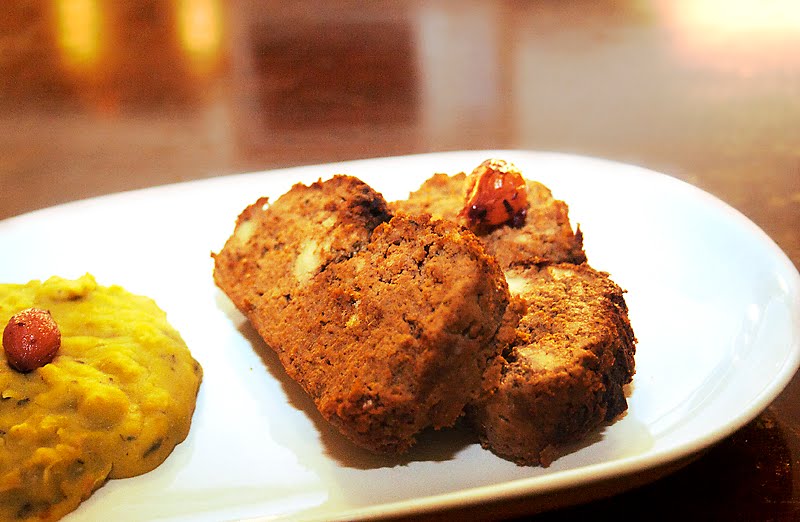
Tofu and Nut Loaf ‒ Tofu-pähkinämureke

Have a happy year 2011! I guess most Finns were shooting fireworks and throwing wild parties last night but to be quite honest, I've never really understood the fuss over a changing number or why Gregorian calendar even places the New Year to the middle of winter in the first place. After all, I already cast my new year tin during Kekri. So yesterday evening we just took a nap after an exhaustive work week, ate a nice meal, drunk some cider and watched a surprisingly boring movie about the French revolution.

Anyway, here's a loaf recipe on the fancier side for such occasions. I've originally taken it from the Finnish animal rights forum and usually prepare it for the Yule table as the poster suggests (among my non-traditional food traditons). It's quite salty, because it's meant to be eaten together with several other standing table dishes (and fits excellently on toasted bread on the next morning). If you'd rather have it as the star of the table, you may want to replace some of the soy sauce with plain water or saltless vegetable stock.

- 75 g hazelnuts
- 90 g almonds
- 165 g cashew nuts
- 540 g firm tofu (I like it best smoked but plain goes just fine)
- 4 toasted white bread slices
- 1 punch of fresh parsley
- 1 small punch of fresh salvia
- 1 dl soy sauce
- 2 tablespoons Dijon mustard
- 1 teaspoon paprika
- basil
- thyme
- black pepper

Add the ingredients into a mixer one by one. Keep mixing until you have a paste. Butter a casserole or and spread evenly into it. Garnish with bread crumbs if you wish and make some wrinkles with your fingers. Bake in 175°C for about an hour or until beautifully brownish.

Nutritional values / 1200 g:
energy 3152 kcal
fat 224 g
protein 177 g
carbohydrates 115 g
fiber 37 g

20.7.10

Sandwich Cake ‒ Voileipäkakku

Sandwich cakes are a very Scandinavian thing. They're just like normal cakes except salty and usually the dish in formal occasions that disappears the quickest. In Finland they typically contain many layers but especially Swedish-speakers seem to prefer them resembling one large sandwich with a single layer and a pile of toppings.

You can use any soft bread together with bread spreads you like, for example hummus, guacamole or thick mayonnaise. It's not even rare to see several flavour options in the same coffee table if there are a lot of guests (and coffee table culture is a serious business for Finns - something you shouldn't play around with). Here's one model to tweak.

- 1 loaf that fits into a loaf tin (white, dark or slices from both)
- 200 g cherry tomatoes
- 125 g radish
- 1 bunch of fresh parsley
- vegetable broth for moistening (or oat milk)

1. filling:
- 2 dl cooked horse beans
- 2 tablespoons tahini
- 1 bell pepper
- 1 onion
- 1 tablespoon rape oil
- basil

2. filling (and frosting):
- 1 portion of cold cucumber soup, only with the yogurt drained first and the cider replaced with two tablespoons of white wine to make it thicker.

3. filling:
- 100 g soft tofu
- 1 dl hazelnuts
- 1 artichoke (or a young cabbage head)
- 2 tablespoons of mustard

Cut the bread lengthwise in four pieces (and remove the crust if it feels hard). Moisten the pieces by sprinkling vegetable broth on them.

Chop the bell pepper, the onion and the artichoke. Oil them and roast in a 200C oven for about half an hour. Remember to turn them around every now and then. Prepare the fillings by mashing together the ingredients. It's ok to leave clumps.

Slice the radishes and half the cherry tomatoes. Now you're ready to put the whole beauty together. Place the top bread slice into your loaf. Spread with the first filling and add some radish slices. Place the second and the bottom layer in the same manner. Flip the whole thing over onto your serving plate and remove the loaf. Cover with the middle filling. Decorate with cherry tomatoes and parsley.

Nutritional values / 3574 g:
energy 5516 kcal
fat 126 g
protein 219 g
carbohydrates 806 g
fiber 168 g

21.6.10

Marinated Pea Pods ‒ Marinoidut herneenpalot

Keeping this blog has often made me wonder what really makes a given food Finnish. Sometimes I understand 'Finnish' meaning the ethnicity, sometimes the prevailing food culture in the state of Finland but perhaps most of the time it's really a matter of main ingredients produced near me. While I wouldn't want to make a big issue out of the question with artificial limitations I also try not to post any of my basic ice coffees and ice teas, no matter how much I love them, since there are so many better places for them.

Once again I did wonder whether this little marinade tastes too Asian for Mämmi but heck, all the market squares are teeming with whole pea pod sellers again and I already managed to constrain myself from eating them fresh on the spot. If you want to do something with them this is pretty much the simplest way. After all, only couple of centuries ago eating peas fresh was thought as a terrible waste and elitism that normal people couldn't afford so this is sort of circumventing the problem.

- 5 dl whole pea pods
- 0.5 dl soy sauce
- 0.25 dl rape oil
- 0.5 dl dry apple cider
- 1 teaspoon ginger

Rinse the pods with cold water. Remove the tips and cut them in half lengthwise (be careful not to shake off the peas). Whisk together the marinade and pour it over the peas. Let them juice up for at least half an hour in the refrigerator. Waiting overnight makes the taste stronger and turns the pods dark which looks cool together with the peas staying bright green.

Serve as a sidekick or use in salads or hot dishes.

30.3.10

Mämmi Pizza ‒ Mämmipitsa

This time of the year every place seems to be filled with pie recipes featuring quark and canned peach halves. Those round, bright yellow peaches look like egg yoiks and are a great symbol for the rebirth of the Sun and the nature. I got a bit fed up with quark after pasha and so I thought I'd try a salty version.

The recipe for the crust comes from Ahmed Ladarsi and the sauce is basically Jo Stepaniak's gooey grill sandwich filling. The latter one could've been a bit thinner and the amount sufficient for two pizzas or a gratin. But at least both turned out tasty. Next time I think I'll fry the tempeh, precook the crust and just warm up the whole.

The crust:
- 200 g (1.5-2 dl) mämmi, not artificially sweetened
- 1 dl rye flour
- 1 dl wheat flour
- 1 dl water
- 20 g yeast
- salt
- 1 tablespoon rape oil

The sauce:
- 2 dl water
- 0.5 dl mutritional yeast
- 2 tablespoons pea flour
- 2 tablespoons lemon juice
- 2 tablespoons tahini
- 1.5 tablespoons ketchup
- 2 teaspoons potato flour
- 1 teaspoon onion powder
- 2 garlic cloves
- turmeric
- mustard powder
- salt

The filling:
- 150 g tempeh
- 5 canned peach halves
- 1 dl tomato sauce
- rosemary or marjoram
- black pepper

Dissolve the yeast and the salt into lukewarm water. Knead in the mämmi and the flour. Cover with a towel and let the dough rise for about an hour in a warm place.

In the meanwhile, whisk the sauce ingredients together in a sauce pan to avoid clumps. Let the mixture come to a boil, move aside from the stove and whisk a bit more.

Spread the dough on a baking sheet. Mine came out ⌀ 27 cm. Brush with oil. Sprinkle with pepper. Slice the tempeh. Arrange the slices and peach halves on the pizza. Cover with the sauce and sprinkle with rosemary. Bake until golden (about twenty minutes in 200°C).

Enjoy after cooled down a bit with your favourite chili sauce.

Nutritional values / 1321 g:
energy 1577 kcal
fat 52 g
protein 67 g
carbohydrates 216 g
fiber 35 g

7.3.10

Beetroot Wraps ‒ Punajuurirullat

Since I've managed to constrain myself from posting a beetroot recipe for couple of months after Christmas I can now continue:

I've been wanting to make something like these ever since I saw this pretty picture. The rieska part is adapted from here. In a way they come close to Celia Brooks Brown's beetroot tortilla recipe (a photo here) and Nami-nami also recently posted a sandwich filling which is kind of like a simpler version.

Then I just figured out that buckwheat fits with sour creams, sour creams go together with beetroot while beetroot pairs nicely with peas which go together with horseradish. So naturally, horseradish should fit perfectly with buckwheat! Just kidding. These ingredients do sound random but at the end, the ensemble plays it groovy. In case you want a whole lunch wrap instead of finger food for cocktail parties add some pea crush.

Buckwheat rieska:
- 5 dl oat yogurt
- 2.5 dl buckwheat grains
- 1.5 tablespoons sunflower oil
- 2 tablespoons buckwheat flour (or wheat)

Beetroot filling:
- 2 beetroots, cooked or pickled
- 1 good punch of pea shoots
- 2 tablespoons mayonnaise (I used a cheap market brand that happens to be vegan but real chefs make it themselves)
- 2 tablespoons black currant cram
- horseradish (wasabi paste goes fine)
- mint (fresh if you have)

Let the grains soak in the yogurt overnight (or at least two hours if you're in a hurry). In the morning, mix in the oil and the flour. If the mixture looks a lot drier than last night, add some oat milk as well. Spread on a baking tray and cook 30 minutes in a 250°C oven.

I find it helps to roll the rieska inside its baking sheet as soon as it comes out from the oven. If it looks crumbly already at this point, sprinkle with water and let it rest for a moment.

In the meanwhile, dice one of the beetroots and mash the other. Mix the mashed one even with the mayonnaise, the black currant and the spices.

Spread the beetroot paste on the lowest third of the rieska. Array the beetroot dices below the paste and the pea shoots above it. Roll as if you were making a Swiss roll and cut into pieces as if you were making makisushi (I got ten pieces). Secure with tootpicks if you wish. Serve with more pea shoots.

Nutritional values / 1 roll / 90 g:
energy 147 kcal
fat 3,8 g
protein 4,5 g
carbohydrates 23,4 g
fiber 2,8 g
Osta neljä tuotetta ja maksat vain kolmesta - Luomutallin kampanjatuotteet näet täältä


Teekauppa.fi - laadukasta teetä netistä
Ostoskorin loppusummasta vähennetään viisi euroa ja toimitus tapahtuu ilman postikuluja.
Syötä ostoskoriin kuponkikoodi:

syysteet

Tilauksen on oltava vähintään 35 eur, mistä jää maksettavaksi 30 eur.
Related Posts Plugin for WordPress, Blogger...