Showing posts with label rutabaga. Show all posts

11.4.14

Rutabaga Spaghetti with Peas and Pistachios ‒ Lanttuspagetti herneillä ja pistaaseilla


The spring has been early this year, after practically no winter. I saw catkins already in February, caltsfeet flowers in March and right now finding some leftover snow is a matter of some serious search. Yesterday there were, pushing out of the ground, something green which I am almost certain was ground elder. It's definitely the time to get rid of the last root vegetables, berries in the freezer and dried nettles to make room for the fresh stuff.

This pasta dish was something I came up with one night when I came home late and hungry, from the ingredients I happened to have. This time we tried it with a bit more special twist, using a "pasta" famous among so-called paleo eaters and low carbers. By hand, it required some work, but the idea seems so great I'm seriously considering to buy a new kitchen gadget just to make sure I'll prepare this more often from now on.

- 1 large rutabaga (the bigger you can find the easier this gets)
- 2 tbsp canola oil

- 200 g frozen peas
- 1 dl roasted and salted pistachios, peeled
- 1 orange
- black pepper

Peel the rutabaga. Then take your peeler, a cheese slicer or a dedicated kitchen gadget. Try to carve out as long stripes out of the rutabaga as you can. When the whole of the yellow root is spaghettisized, steam the stripes a few minutes to get them half done. (If you prefer your spaghetti a little al dente, you can skip this step.) Then fry them on a pan with oil just enough to get some delicious browning on the edges.

You can finish the spaghetti with any of your favourite pasta sauce, but for this version, simply peel and cut the orange and then add the pieces into the pot, together with peas and pistachios. Stir. The dinner is ready when the peas have fully melted.

Nutritional values / 1387 g:
energy 987 kcal
fat 59 g
protein 35 g
carbohydrates 76 g
fiber 32 g

27.12.13

Rutabaga Casserole ‒ Räätikkäloora

Somehow I've managed to forget posting one of the four classic casseroles of the Finnish Christmas table. The others are of course carrot casserole, potato casserole and liver or in my case, raisin casserole. As a replacement of some sort I have remembered rutabaga cubes in syrup though. Nothing wrong with that, but here's the true classic, too. While potato and carrot only became common relatively recently, rutabaga is something you might call original part of the standing table, after all.

- 1 kg rutabaga
- 2 dl oat cream
- 1 tbsp dark syrup
- cinnamon
- clove
- allspice
- breadcrumbs and margarine to top with

Peel and cube the rutabagas. Steam them soft. Mash smooth and mix together with the cream and the spices. Spread in a casserole and finalize by sprinkling breadcrumbs and margarine pieces. Bake for an hour in a 175°C oven.

Nutritional values / 1283 g:
energy 849 kcal
fat 45 g
protein 16 g
carbohydrates 96 g
fiber 21 g

15.9.13

Pirana


Oops, I managed to miss posting yesterday. But it's halfway already and 14/15 is still something I can feel satisfied with. Perhaps from now on I should still prepare couple of "just in case" -recipes beforehand.

I did cook though. Actually getting to eat just went a bit late. Madeleine.teacup has been doing a really educational series about pre-colonial dishes of the Americas. One of them was called Inca chilcano de pirana, which basically means piranha soup. This kind of reminded me for a totally different Finnish dish also spelled pirana, a traditional South Karelian dish. (There's two of them to be precise. Another one is a lingonberry rye porridge, but I'll get back to that another time.) It's been hanging on my to-do list for years so now I finally got myself to try it.

There are quite many originally vegetarian dishes from Karelia. Of course meat used to be consumed a lot less during the time when it meant slaughtering your perhaps only cow, but this is also due to the orthodox fate where meat isn't even allowed during the fasting. For a modern Finn they may seem a bit anemic since usually the only spice the recipes mention is salt, but I think this aspect can be tweaked if done with respect. So for example here I used some stock base and bear's garlic for more taste.

Pirana is basically a stew consisting of rutabaga, potatoes and dried fava beans or (today more often) peas, which are all used in equal amounts. I thought I'd try this with fresh fava beans now that I have some, as well as those purple potatoes we've gardened, so the stew would get some pretty colours. Potato didn't become common before 19th century, so one modernized version I found even replaced them with sweet potatoes which feels as exotic to us now as potato must've been back then.

In older versions barley, sometimes also rye flour or even talkkuna is used for thickening but modern versions usually shy away from the porridge-like consistency. I kept the flour since I think it's one of the key elements of the dish but scaled the amount down significantly. Only one version I found added cream to the result but I took that too since it seemed like a reasonable way to bring a little some fat into the dish. In another modern version I saw this problem was solved by first sauteing the veggies in a little oil.

- 5 dl fava beans (or peas)
- 500 g rutabaga
- 500 g potato
- 2 dl oat cream
- 1 dl oat flour
- 1 portion of stock
- 1 tbsp dry bear's garlic
- salt
- water (about 1 l)

(I you're using dry beans or peas, first soak them overnight.) Peel and cube the rutabaga. Cover it with water and add some stock base and salt. Set the pot to simmer. When the rutabaga is starting to soften up a bit, also cube and add the potatoes, as well as the beans. Add water if needed.

When things are starting to seem edible enough, add the cream and thicken with flour. Continue cooking for another 15 minutes, while stirring since the stew can burn easily at this point.

Like this recipe instructs, the ready pirana is to be eaten as the main course just like porridge. Margarine "eye" and milk can be added on the plate. The recipe also reminds this can be eaten cold as well!

Nutritional values / 2765 g:
energy 1413 kcal
fat 23 g
protein 60 g
carbohydrates 242 g
fiber 48 g

23.3.13

Roasted Root Vegetables with Herbs ‒ Yrttijuurekset


Root vegetables are perfect seasonal food. They're cheap, healthy, filling and easy to prepare. During the deepest winter I might've used chili and liquid smoke, but now that daytime is already as long as darkness I'm starting to prefer fresh tastes again and therefore spiced these up with dried herbs. The fresh ones are growing with speed too. Can't wait to be able to snip them while cooking.

- 500 g beetroot (I used a striped variety)
- 500 g rutabaga
- 500 g sunroot
- 1 parsnip
- 1 whole garlic (rest assured, the taste softens in the oven)
- 0.5 dl rape oil
- 1 tsp rosemary
- 1 tsp tarragon
- 1 tsp dill
- salt

Oil a casserole. Peel and cut the vegetables into mouth-size chunks. Free the garlic cloves from their skin. Mix the veggies, the herbs and rest of the oil in the casserole. Put in a 175°C oven. Remember to turn them around every now and then. They should be ready in about an hour.

Nutritional values /  1705 g:
energy 1000 kcal
fat 49 g
protein 18 g
carbohydrates 120 g
fiber 47 g

2.1.11

Rutabaga Cubes in Syrup ‒ Siirappiset lanttukuutiot

Instead of rutabaga casserole I made what my mum used to cook on Yule. Simple fried rutabaga cubes with syrup. The basic idea was to re-fry them every day as long as there was something left. They just got softer and better each time. But it didn't work like that now. Almost all of them were gone after the first meal and then I ate the remains cold next day when I got hungry,

- 1 kg rutabagas
- 2 tablespoons dark syrup
- 1 tablespoon rape oil
- salt

Peel the rutabagas and cube them. Fry on a hot pan with oil. Season with syrup and a pinch of salt.

Nutritional values / 1054 g:
energy 490 kcal
fat 17 g
protein 10 g
carbohydrates 76 g
fiber 18 g

4.6.10

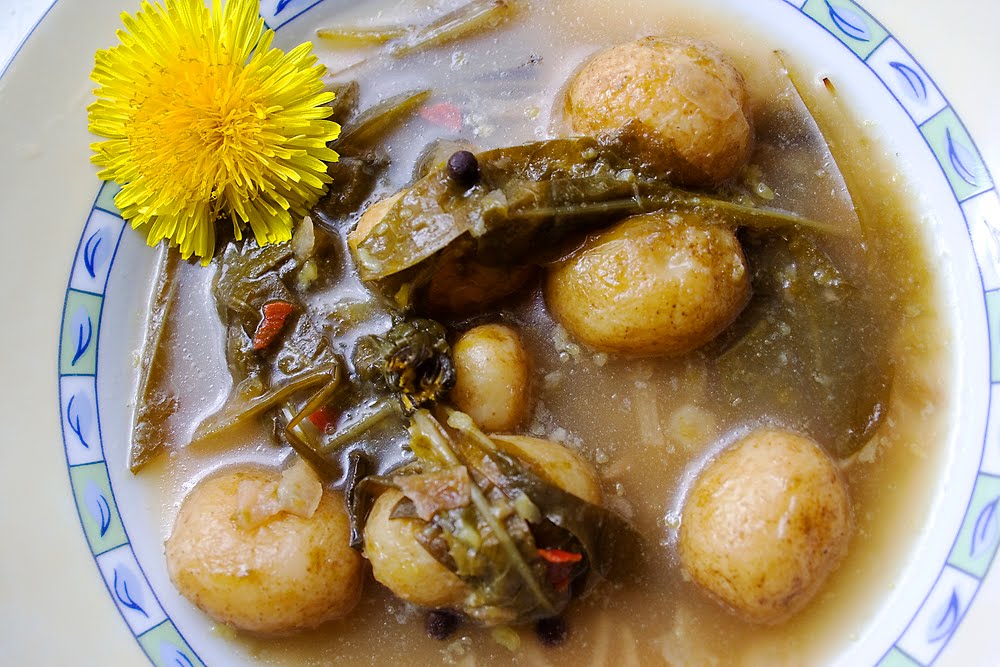
Dandelion Soup ‒ Voikukkakeitto

In case that supikas recipe yesterday sounded appetizing, here's a suggestion for the remaining broth. But if you want the soup only, dice a small rutabaga to cook with the potatoes.

Dandelion is among one of my favourite wild veggies because it's so multifunctional and grows just about everywhere. The leaves and buds for this soup I picked when returning along my jogging path, trying to find my breath that had got lost somewhere on the way.

- 20 unopened dandelion flower buds
- 2 dl young dandelion leaves
- 2 l rutabaga broth
- 5 dl new potatoes (or noodles)
- 0.5 dl seaweed
- 0.5 dl dried onion (or caramelized)
- 1 chili pepper
- whole black peppers or juniper berries

Wash the potatoes and remove the bad parts but don't bother to peel. Cook them in the rutabaga broth until soft. Add the rest of the ingredients and let the soup come to a boil. Eat right away.

In the present form the soup is more like a starter or an evening snack but if you want to turn it into a lunch you might want to add beans or such.

Nutritional values / 2 l:
energy 500 kcal
fat 3 g
protein 27 g
carbohydrates 96 g
fiber 11 g

3.6.10

Rutabaga Supikases ‒ Lanttusupikkaat

Hela is the Finnish equivalent of German Wapurgisnacht or Celtic Beltane, the celebration of spring and rebirth of Lemminkäinen, the boisterous god of fertility and sacred fire. (By the way, here's a nice English introduction to traditional Finnish holidays.) The name comes from Swedish word meaning holy but I believe the original title is either Toukovalkeat ('May Fires') or Suviyöt, roughly translating as 'Summer Nights' and is also very closely connected to Ukonpäivä, celebrated for the honour of the thunder god Ukko. Judging by such relics as Ritvalan Helkajuhla, an occasion where even today young maidens wear white dresses and walk singing around a hill along a path that looks disturbingly like ukonkirves, Hela used to mark hieros gamos, the holy marriage of heaven and earth, where masculine heaven fertilizes the feminine earth with rain.

Since we don't know when exactly our ancestors celebrated Hela (with all likelyhood, there never was a fixed date) we've decided to set it for the weekend closest to the second full moon after Spring Equinox. This year it meant halfway of May. We lighted a bonfire, had a lot of sauna and sang a ton of old poems. I took my friends a double portion of these little pies.

The basic recipe is from here but I also added some fresh coriander into the filling. Even though I tried to make rather chubby pastries with much thinner crust than normally I had to stick so much of the filling into freezer for later purposes I think it would be safe to half the filling amount. This also means that the nutritional values at the end are rather overblown.

The filling:
- 1 kg rutabaga
- 50 g margarine (I used Keiju 70%)
- 1.5 teaspoons salt
- 0.5 dl dark syrup
- white pepper
- 2 tablespoons wheat flour

The crust:
- 1.5 dl water
- 2 dl rye flour
- 1.5 dl wheat flour
- salt

For buttering:
- 1 dl broth from cooking the rutabagas
- 25 g margarine

Cook the rutabagas in salty water. (Don't throw away the tasty broth but use it in a soup for example.) Mash them like potatoes and add the other ingredients.

Mix the crust ingredients together. Divide the paste in 16 parts. Make little balls out of them between your hands. Roll the balls into thin circles. Place a spoonful or two of the filling onto each of them, then fold them into semicircles. Close them by pressing with your (moistured) thumbs.

Put your supikases into a 275°C oven for about 15 minutes. Brush with rutabaga broth and margarine mixture. Cover with a towel.

Nutritional values / 1 supikas / 107 g:
energy 138 kcal
fat 7 g
protein 2 g
carbohydrates 16 g
fiber 3 g

14.4.10

Turnip Porridge ‒ Naurispuuro

I know I just posted a dish combining turnip and barley but they happen to work so well together. Besides, I had to use the rest of the turnips somewhere so one of the numerous Finnish root vegetable porridges felt appropriate. This very same breakfast meal is just as often done with potato but you might also want to try carrot or rutabaga. The relation between turnip and barley varies quite a lot in different recipes; I prefer mine with more turnip and less flour.

- 700 g turnips
- 2 dl barley flour
- 7 dl water
- salt

Peel and chop the turnips. Cook them until soft. Puré with the water. Add more water if the result looks too thick (sometimes beer is used but in that case you should be very careful). Sift in the flour and the salt. Simmer for another 20 minutes. Eat while still hot!

Nutritional values / 1530 g:
energy 575 kcal
fat 5 g
protein 18 g
carbohydrates 113 g
fiber 23 g

14.1.10

Pyttipanna ‒ Pyttipannu

I strongly feel that throwing food away is a sin, almost comparable to pissing on a sauna stove. Of course, sometimes zucchinis start to grow an angora fur and kitchen experiments turn totally inedible. But what kind of people purposely load their plate full if they're not going to finish it? Not only are they being disrespectful towards the cook and nature but essentially, towards food itself.

Well, in a household of two little piggies the problem is usually reversed. No matter how much sauce I make there's never anything left for my breakfast bread. No matter how big a bread I bake there's never enough to dry it for breadcrumbs or croutons. And no matter how big a soup pot, it will never end up into handy freezer portions. This time however, I managed to cook enough potatoes to make the next dinner out of them. Normally I would get this treat only by buying a microwave meal.

Pyttipannu (from Swedish pytt i panna, small things in a pan) is a classic way to use leftovers. Feel free to throw in anything around you. For example tofu, beetroot, sausage, tempeh, peas, rye bread and beanstalks fit here perfectly as well. This time I made it like this:

- 5 potatoes
- 1 onion
- 1 small rutabaga
- 3 dl fava beans
- 1 chili pepper
- smoked paprika (my current favourite spice)
- salt
- 1 tablespoon sunflower oil (I bought a bottle of this for a change)

Dice everything. Throw into a very hot pan. Fry until the little cubes have got deliciously brown. (If you have a large batch or a small pan fry your pyttipannu in small portions and flush the pan between them.) Sprinkle the spices when the food is on your plate. Enjoy with something pickled.

Nutritional values / 1109 g:
energy 666 kcal
fat 15 g
protein 24 g
carbohydrates 110 g
fiber 21 g

7.12.09

Karelian Pasties ‒ Karjalanpiirakat

Yesterday was Finland's Independence Day. In most countries, that's a lively carnival. In Finland it has evolved into a more dignified, even pious day, largely consisting of remembering World War II and honouring the veterans who ‒ as the only nation ‒ managed to fight back against Stalin's invasion. For my generation which doesn't even remember there ever existed a place called Soviet Union it's more about gathering together some friends, burning candles, eating well, talking about new laws that threaten our freedom of speech or right to privacy and of course, laughing at the dresses of the president's ball that YLE broadcasts every year.

While others played a game where you get a point every time you know a name of a ball guest and another one from knowing the reason they're invited I pinched up some Karelian pasties. From numerous hand-size Karelian pie types these are the ones that have an almost iconic status so I thought they'd make an appropriate snack for Independence Day. They have a thin rye crust and just about anything as a filling. Nowadays rice porridge is the filling number one and potato second but barley, talkkuna, buckwheat, carrot or rutabaga would make them a bit more "authentic" (what a terrible word). They can even have a sweet berry porridge inside. This time I used a simple turnip filling and a crust recipe straight from a flour bag.

The crust:
- 5.5 dl sifted rye flour (if you can only find normal kind you should replace some of it with wheat flour)
- 2 dl water
- 2 teaspoons salt

The rest:
- 1 kg turnip
- white pepper
- 100 g margarine
- 1 dl oat milk

Cook the turnips. Peel and mash them together with the pepper and half the margarine. While the filling cools down, mix the crust ingredients together with your hands. Roll the paste into a thin layer (use extra flour generously so it won't stick). Take circular pieces from the layer with the help of a floured water glass.

Now roll each circle into an oval. Lay a spoonful of turnip mash on it and fold the edges with your index finger and thumb, from both sides simultaneously, pinching "wrinkles" on the filling as you go along. Bake about fifteen minutes in a 275ºC oven.

Melt the rest of the margarine and add the milk into it. Butter the oven-fresh pastries from both sides and lay them into a bowl over each other. Cover with a towel and let them soften up for about an hour.

Serve hot or cold, perhaps together with tar syrup.

Nutritional values / 1785 g:
energy 2084 kcal
fat 82 g
protein 48 g
carbohydrates 284 g
fiber 78 g

25.10.09

Pine Nut and Root Vegetable Mash ‒ Männynsiemen-juuressose

Potato mash is one of the standard sidekicks in Finnish cuisine. I often like to tune it with beet or spinach but seeing this I knew I have a sidekick to offer even when Tarja Halonen shows up for a dinner.

The original recipe didn't give any amounts so I tried to document what I used. The oat cream however, wasn't such a good idea since the mash turned a bit too runny. Oh well, the taste is what matters and I already have a long experience of claiming my beet mash is meant to be a puré soup. Next time I'll just replace the cream with some margarine and perhaps roast the pine kernels a bit before marinating them.

EDIT: Yeap, as you can see from the new photo, this turned out just perfect without the cream. Didn't even replace it with anything. Roasting the kernels was also a good idea.

- 2 large carrots
- 4 potatoes
- 1 small rutabaga
- 1 dose of stock
- 1 dl pine nuts
- gin (about 1 dl)
- spruce syrup
- salt
- white pepper
- 0.5 dl oat cream

Put the pine nuts in a mug and pour enough gin on them to cover them. Peel the root vegetables and cook them in water with the stock. Pour the water away and mash them. (If you're really clever you can save the water to make a sauce for example.) Spice with spruce syrup, salt and white pepper. Add the cream, the soaked nuts and as much of the gin as you wish. Let the mash marinate at least for an hour before serving.

Nutritional values / 1080 g:
energy 1197 kcal
fat 61 g
protein 21 g
carbohydrates 99 g
fiber 19 g

15.10.09

Beer Pots with Potato Crust ‒ Olutruukut muusikuorrutteella

To make the best of those awesome colours of the trees right now I tried to imitate them for the perfect autumnal Sunday dinner. I've never really learned how to use pumpkin so I was going to put some into this. However, I only managed to find huge halves that cost about 10 euros a piece. That's a bit more than I'm ready to pay even for domestic veggies. So instead, I bought 3 kilos of rutabaga with one euro. We'll see where I manage to cram them.

Oh, by the way, the colours of these couple of last photos aren't that awesome. That's because I thought I'd just use my camera's inbuilt flash and filter the ugliest direct light with a yellow dishcloth. Getting the white balance even close to natural after that took me longer than preparing this dish. Maybe next time I understand to fetch a real flash even if the Simpsons is about to start.

- 1 small rutabaga
- 1 large carrot
- 1 celeriac
- 10-15 brussels sprouts
- 0.5 l beer, for example Sinebrychoff Porter or Fuller's London Porter
- 2 dl seitan flour
- 0.5 dl rowan berries
- 1 chili
- 1 dl nutritional yeast
- 1 dose of stock
- white pepper
- 4 potatoes
- 1 dl oat cream
- dragon's wort

Squash the rowan berries and the chili. Make a paste of them and the seitan flour. Add some as well water if needed. Cut the seitan and the vegetables into strips and sauté them. Add the stock, the yeast and some white pepper.

Cook the potatoes. Mash them together with the cream and the dragon's wort. Never apply a blender or other sharp blades to potato unless you want to get glue.

Next you'll need four small oven pots. If you're going to use normal mugs, first check that they're meant to last in the oven. Unfortunately, cheapest ones rarely are. Portion the veggie and seitan mixture into the pots. Pour the beer on them. Scoop the mashed potatoes on top. Put the pots into a 175°C oven until the potato mash starts to turn golden from the edges (about half an hour).

Serve with pickles and lingonberries.

Nutritional values / 1 pot:
energy 357 kcal
fat 7 g
protein 24 g
carbohydrates 36 g
fiber 8 g

4.4.09

Potato Soup ‒ Perunasoppa

I often find it easier to make one big portion than several small ones. This is a nourishing basic soup that lasts for a couple of days even in our voracious househould. It's one of my first cooking bravuras and one of the first applications I've learned to use tofu for.

- 8 large potatoes
- 270 g firm tofu (or more)
- 1 onion
- 1 carrot
- 1/2 rutabaga
- 1/2 cauliflower
- 1 chili
- 4 garlic cloves
- 1.2 l water (increase if your soup starts to look like a stew)
- 2 dl stock
- 1 dl red wine (sweet dessert type fits best)
- 1 tbsp miso (dissolved in water)
- 1 tbsp curry
- oil for frying

Chop the tofu and the onion. Fry them with chili and curry. Chop other veggies as well and put them in a cattle with the rest. Cook until potatoes are soft (approximitely for an hour). Enjoy with rye bread.

Nutritional values / 1.5 l:
energy 1159 kcal
fat 39 g
protein 64 g
carbohydrates 119 g
fiber 26 g

1.4.09

Stock ‒ Liemipohja

One characteristic feature in Finnish cuisine is soups. They aren't just appetizers or snacks but quite often very filling main courses of the day. And all the cooks in the world know that the secret of a good soup is the broth, which is why they keep their special stock recipes secret. You should always have couple of different kinds of them available cause otherwies all your foods start to taste the same. Cooking a stock is all very easy but if you make a larger portion at once it quickens things up for busy days.

Some general guidelines:
1. Making a stock is a perfect way to recycle all the vegetable leftovers like peels and heads. If you use whole vegetables wash them normally and remove the clearly rotten parts but don't bother to peel. Remember you're not going to eat them.
2. Try to add something from all the basic tastes (except fat which has also got into this category lately): bitter, salty, sour, sweet and savory (aka umami).
3. Keep fat out of this since it doesn't store well. You can always add margarine or cream to the soup itself to make it richer.
4. Many alcohol drinks like wines or brandies fit this purpose well. But as much as I love beer this isn't the place for it since it turns bitter when boiled (as I learned when trying to make beer soup).
5. Don't exaggerate with any of the ingredients. If you want your broth to taste like white wine add white wine to the broth itself. Try to keep the stock well balanced and multifunctional.
6. Frying the veggies isn't necessary but it adds to the taste. The one you shouldn't fry is garlic since it may turn bitter.
7. If you for some weird reason want to clarify the stock use for example a clay called bentonite which is widely sold for winemaking.
8. When you're using the stock remember to let it come to a boil to get the taste out of it.
9. How much you should use the stock at once depends on your personal likings, the amount of other spices you're going to use and the denseness of your stock (aka how tighly you concentrate it). It may just as well be 2-3 ice cubes or 1 dl at a time.

Just to show you a couple of examples, here are the recipes for three stocks I've made so far. Next time I might try for example yeast pate (for example Tartex), cider, laurel, lovage, juniper berries or birch sap. Perhaps even a hint of strong tastes like salmiakki (Ammonium chloride), tar or horseradish might work.

Hearty stock:
- 0.5 rutabaga plus the skin and the head of the other half
- skins and heads of 500 g carrots
- skins and heads of 500 g beets
- 1 onion
- 1/2 garlic
- 1 punch of dill
- 8 whole black peppers
- 0.5 dl dark syrup
- 0.5 dl miso (dissolved in water)
- 0.5 dl apple wine vinegar (more aromatic than apple cider vinegar)
- 1 tsp monosodium glutamate
- 1 tsp salt

Zesty stock:
- leftovers from 1 white cabbage
- leftovers from 1 cauliflower
- cores and peels of 3 apples
- 1 sheet of algae (nori)
- 2 tsp dried yarrow flowers
- 2 dl white wine
- 0.5 dl lemon juice
- 0.5 dl mustard powder (Remember mustard condiment also contains oil and sugar.)
- 1 tbsp brown sugar
- 1 tsp monosodium glutamate
- 1 tsp salt

Spicy stock:
- 1 leek
- 500 g tomatoes
- 1 bell pepper
- 1 chili pepper
- all the dried herbs I had in the closet but couldn't recognize anymore
- 2 dl red wine
- 0.5 dl mämmi
- 0.5 dl sea buckthorn juice
- 1 tsp monosodium glutamate
- 1 tsp salt

Chop and fry the veggies on a dry pan. Put them in a cattle with the rest of the ingredients and 1.5 litres of water. Let them simmer without a lid. The stock is ready when at least half of the liquid has vaporized and the veggies have turned mashy (after approximitely two hours). Filter the stock, pour it into an ice cube tray (if you've saved plastic soy yoghurt cups or such they're also ideal for this) and freeze. The part that didn't fit there stores a few days in the fridge.

1.3.09

Rutabaga Kukko ‒ Lanttukukko

Kukkos are a Savoyard and Karelian speciality available with any imaginable filling. The most famous ones I believe are kalakukko (filled with fish), lanttukukko (rutabaga) and mustikkakukko or rättänä (bilberries). If you look the dictionary, you'll find that kukko means cock in the official language. This however isn't official language. The name of the dish refers most likely to kukkaro (wallet), cause the rye cover hides (kätkeä) something.

For my very first lanttukukko I looked help mostly from a kalakukko recipe and another lanttukukko recipe that has a lot of helpful photos about the different stages.

The cover:
- 5 dl water
- 1/2 tbsp salt
- 100 g margarine
- 9 dl rye flour
- 3 dl white flour, for example wheat or spelt

The filling:
- 1 kg rutabaga (actually I used turnip which I find tastier)
- salt
- sugar
- tar liqueur (I'm quite certain beer would work as well)
- margarine
- barley grains (about 2 dl)

Peel and slice the rutabagas. Put the slices into a pot and shake with sugar and salt so the slices start to “sweat”. Mix the cover ingredients and spread it on the table to a circle so that it's diameter is about one metre. The edges should be about one centimetre thick, the centre may be thicker. Spread a thin layer of barley grains in the centre and on it a layer of rutabaga. Also sprinkle salt, tar liqueur, barley grains and margarine on them. Then add the next rutabaga layer and keep going until you've finished all your slices. Top with salt, tar liqueur and margarine. Now you can seal the kukko. Even the cover with wet hands so there are no holes or lumps.

Put it in the 250°C oven for half an hour so the cover hardens up and gets some colour. Lower the heat to 125°C. Wrap the kukko in moist parchment paper and after that into folio. Cook four hours more. When you take the kukko out cover it with towels so the cover won't get hard.

There are different schools in how to eat this thing. Some say you should cut the top open and start eating from the insides. I like to slice it like bread. Either way you'll notice it's a very versatile dish.

Nutritional values / 2700 g
energy 3076 kcal
fat 98 g
protein 116 g
carbohydrates 669 g
fiber 141 g
Osta neljä tuotetta ja maksat vain kolmesta - Luomutallin kampanjatuotteet näet täältä


Teekauppa.fi - laadukasta teetä netistä
Ostoskorin loppusummasta vähennetään viisi euroa ja toimitus tapahtuu ilman postikuluja.
Syötä ostoskoriin kuponkikoodi:

syysteet

Tilauksen on oltava vähintään 35 eur, mistä jää maksettavaksi 30 eur.
Related Posts Plugin for WordPress, Blogger...