Showing posts with label potatoes. Show all posts

23.9.13

Yellowfoot Pyttipanna with Carrot Ketchup ‒ Suppispyttis porkkanaketsupilla


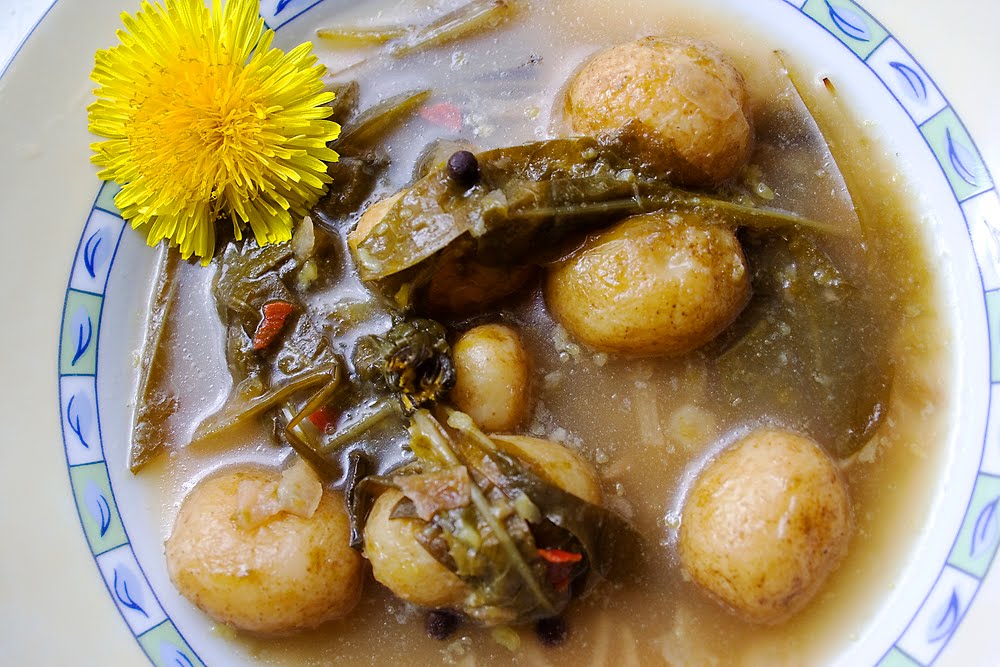
(First of all, sorry about the terrible photo. This is why you should always prepare dinner at noon.) Yellowfoot might just be my favourite mushroom. Partly because hunting them is so full of feelings. First you gaze into the ground, lift trunks and are certain you'll never going to find a single one. But after that one dead leave turned out to be a yellowfoot you have to sit down to pick them. At the end you have to stare at clouds to get out of the forest, because hey, you can't just leave them in the there alone in case you see more of them. They rarely have bad parts or maggots, the whole cute little mushroom is about the curly but sturdy foot which hides half into the ground. The taste and structure are so pleasant they'll fit into pretty much every dish you can think of.

In case you haven't noticed already, I rarely have the patience to follow recipes thoroughly. I use them more for drawing ideas and in case of baking, for proportions. Saara Törmä's recipe's often make important exceptions. They're homestyle and simple but have that certain twist that makes them special. This one is a variation of pyttipannu she's written for the Green party's newspaper. The name sounded fun and so followed it almost literally, only adding a can of beans into it. I even decided to try the recommended condiment too, although it sounded a little odd. A little googling revealed to me that indeed, the word ketchup doesn't imply tomatoes, it's just that we're so used to the tomato version. Somewhat surprisingly ketchup's origins seem to be in 17th century Chinese fish sauce and the tomato version was only developed in the 19th century USA. Anyway, the carrot version here fits pretty great with the rest of the meal, not to mention adds to the foliage colours.

- 1 l yellowfoot
- 1 kg cooked potatoes
- 2 onions
- 0.5 dl rape oil
- 0.5 dl soy sauce
- 2 tsp curry
- 1 tsp thyme
- black pepper
- salt

The ketchup:
- 500 g carrot
- 1 onion
- 1 dl broth
- 1 dl farin sugar
- 0.5 dl rape oil
- 0.5 dl balsam vinegar
- 1 tbsp paprika
- 1 tbsp salt
- 0.5 tsp cayenne

Start with the ketchup if you plan on preparing them both. Peel the carrots and cook them. Save a decilitre of the broth. Chop the onion, heat up the oil and sauté. Combine all the ingredients and purée smooth. Let the ketchup simmer on low heat for half an hour. Cool down.

Fry the mushrooms until the extra liquid has vaporized. Move aside for a moment. Cube the potatoes. No need to peel them unless you want to. Chop the onions too.

Fry the potatoes alone for couple of minutes. Add the onions and the mushrooms. Turn around. Add the spices. Keep frying until the onions are soft and the potatoes have acquired a pretty colour.

Enjoy with the carrot ketchup. The leftover ketchup stores for about a week in the fridge but you can also store it longer by freezing.

Nutritional value / 1835 g (the pyttipanna):
eneergy 1247 kcal
fat 48 g
protein 32 g
carbohydrates 163 g
fiber 29 g

Nutritional value / 850 g (the ketchup):
energy 730 kcal
fat 46 g
protein 5 g
carbohydrates 70 g
fiber 15 g

15.9.13

Pirana


Oops, I managed to miss posting yesterday. But it's halfway already and 14/15 is still something I can feel satisfied with. Perhaps from now on I should still prepare couple of "just in case" -recipes beforehand.

I did cook though. Actually getting to eat just went a bit late. Madeleine.teacup has been doing a really educational series about pre-colonial dishes of the Americas. One of them was called Inca chilcano de pirana, which basically means piranha soup. This kind of reminded me for a totally different Finnish dish also spelled pirana, a traditional South Karelian dish. (There's two of them to be precise. Another one is a lingonberry rye porridge, but I'll get back to that another time.) It's been hanging on my to-do list for years so now I finally got myself to try it.

There are quite many originally vegetarian dishes from Karelia. Of course meat used to be consumed a lot less during the time when it meant slaughtering your perhaps only cow, but this is also due to the orthodox fate where meat isn't even allowed during the fasting. For a modern Finn they may seem a bit anemic since usually the only spice the recipes mention is salt, but I think this aspect can be tweaked if done with respect. So for example here I used some stock base and bear's garlic for more taste.

Pirana is basically a stew consisting of rutabaga, potatoes and dried fava beans or (today more often) peas, which are all used in equal amounts. I thought I'd try this with fresh fava beans now that I have some, as well as those purple potatoes we've gardened, so the stew would get some pretty colours. Potato didn't become common before 19th century, so one modernized version I found even replaced them with sweet potatoes which feels as exotic to us now as potato must've been back then.

In older versions barley, sometimes also rye flour or even talkkuna is used for thickening but modern versions usually shy away from the porridge-like consistency. I kept the flour since I think it's one of the key elements of the dish but scaled the amount down significantly. Only one version I found added cream to the result but I took that too since it seemed like a reasonable way to bring a little some fat into the dish. In another modern version I saw this problem was solved by first sauteing the veggies in a little oil.

- 5 dl fava beans (or peas)
- 500 g rutabaga
- 500 g potato
- 2 dl oat cream
- 1 dl oat flour
- 1 portion of stock
- 1 tbsp dry bear's garlic
- salt
- water (about 1 l)

(I you're using dry beans or peas, first soak them overnight.) Peel and cube the rutabaga. Cover it with water and add some stock base and salt. Set the pot to simmer. When the rutabaga is starting to soften up a bit, also cube and add the potatoes, as well as the beans. Add water if needed.

When things are starting to seem edible enough, add the cream and thicken with flour. Continue cooking for another 15 minutes, while stirring since the stew can burn easily at this point.

Like this recipe instructs, the ready pirana is to be eaten as the main course just like porridge. Margarine "eye" and milk can be added on the plate. The recipe also reminds this can be eaten cold as well!

Nutritional values / 2765 g:
energy 1413 kcal
fat 23 g
protein 60 g
carbohydrates 242 g
fiber 48 g

10.9.13

Warm Harvest Salad ‒ Lämmin sadonkorjuusalaatti


I'm really happy about the fact I've learned to cook many different types of salads. Couple of years ago, basically all my salads contained the same ingredients. And nothing wrong with them still. But variance is the salt in life. This time I took model from this salad, but since the result doesn't really resemble it at all, I thought I'd better change the name too. This one went just for a sidekick, but if you'd like to turn it into a your evening's main course, try frying some smoked tofu cubes or toss horse beans in the oven as well.


- 5 apples
- 5 potatoes
- 1 red onion
- 2 dl gooseberries
- 1 dl pecans
- 1 punch of salad leaves
- 3 tbsp rape oil
- salt

For the sauce:
- 2 tbsp apple wine vinegar
- 1 tbsp mustard
- 1 tbsp spruce syrup
- 2 garlic cloves
- black pepper

Cut the potatoes and the onion in discs. Apply oil and salt. Stick them into a 225°C oven for 15 minutes so they'll soften up.

Cut the apples and the salad a bit smaller. Crush the nuts. Add the gooseberries into the same bowl as well. mix the salad sauce ready.

When the potatoes come out of the oven, toss them and the sauce over the rest. Jump right in.

Nutritional values / 1183 g:
energy 1371 kcal
fat 86 g
protein 17 g
carbohydrates 240 g
fiber 23 g

27.8.13

Blue Lupin and Potato Mash in Bread Cover – Sininen lupiini-perunamuusi leipäkuoressa


Estonia isn't exactly a culinary heaven if you're a vegetarian. It's closer to becoming one than many other ex-Soviet countries though, perhaps thanks to the close cultural connections with Middle Europe and the Nordic countries or perhaps the way things are getting better economically speaking. But one time in Tartu I got this really friendly service. The restaurant we went to didn't have a single vegetarian option, but they prepared the tired travelers a meal from the things they did happen to have. That included a plateful of vegetables and a dip plus this funny bread filled with mashed potatoes. Ever since I've wanted to try replicating the idea at home, only with some protein source added.

I used an oat bread of a local bakery here, but for a self-made one something like rievä would be an excellent choice. The potatoes here are a proof we did manage to grow something after all. The variety is called Blue Congo because of its adorable purple colour even brighter when raw. They're floury so they work best in the mashed form and somehow remind of what potatoes really should taste like. With them I thought I'd pair another blue plant, blue lupin. Weirdly, the tempeh made from it is actually bright yellow though.

The combination tuned out very earthy and filling. This portion is too big to eat all on your own, so cater at least two forks. And forget that spaghetti from candlelight dinners already ‒ you wouldn't eat it without hands anyway. What could be more romantic than a bowl of mashed potatoes, except a bread bowl of mashed blue potatoes?

- 1 bread
- 700 g potatoes
- 150 g tempeh
- 2 dl oat cream
- 1 onion
- 3 garlic cloves
- rape oil for frying
- green peppers
- thyme
- mustard powder
- smoked paprika
- salt

Cook the potatoes, washed well and with their skins on if possible. While they're boiling, cut a hat off the bread and scoop carefully the inner part out, leaving about 2 cm thick wall. (You can use the scooped out bread later in a soup or such.) Chop and sauté the onion. Add the tempeh to the pan in small pieces as well. Spice with mustard and paprika.

When the potatoes are done, pour the water out. Don't throw it away yet, in case the mash should need more liquid than I suggest here. Mash the potatoes together with the cream. Spice up with garlic, thyme and salt. Mix the tempeh and onion with the potatoes.

Scoop the mash into the bread. If everything doesn't fit in, there's no need to overfill like I've done it the photo. Just save the leftovers for tomorrow's lunch. Place the hat on the bread. Lit the candles.

Nutritional values / 1494 g:
energy 1810 kcal
fat 46 g
protein 67 g
carbohydrates 276 g
fiber 26 g

2.8.13

Countryside Bean Salad with Herb Oil ‒ Talonpojan papusalaatti ja yttiöljy


One more part to the salad trilogy. This one is something I've been planning for a long time. I wanted to make a very filling salad with a rustic feel to it. Something I'd like to have sitting by our allotment garden after some physical work. And since this is the time for green beans, they're really the main star of the plate.

The salad
- 250 g green beans
- 230 g giant beans
- 4 slices of rye bread
- 200 g cherry tomatoes
- 125 g radish
- 100 g fresh spinach
- 3 summer potatoes
- 1 red onion
- 0.5 dl sunflower seeds
- 2 garlic cloves
- oil for frying
- salt

The herb oil
- 1 dl flax seed oil
- 1 punch of fresh parsley
- 10 basil leaves
- 2 tbsp black currant juice (unsweetened, without added water)
- black pepper

Cook the potatoes and the green beans in salted water. Roast the sunflower seeds a bit on a dry pan. Move away the seeds, add some oil and minced garlic and place the bread there, cut down into mouth-fitting chunks. Fish out the green beans and place them on the pan as well.

Cut the onion in semi-circles and slice the radishes. When the potatoes are done, slice them as well. Mix everything and serve while still warm.

For the oil, just blend everything together. Serve alongside the salad or mix right into it.

Nutritional values / 1652 g:
energy 1852 kcal
fat 109 g
protein 49 g
carbohydrates 159 g
fiber 55 g

21.6.13

Yogurt Garnish for New Potatoes ‒ Jugurttilisuke uusille perunoille


One of the biggest holidays in Finland, the midsummer or Juhannus, is on the door. As this is the celebration of the Finnish thunder god Ukko, the tradition is to tent or sleep in a cabin by a lake, with lots of friends, do love magic and eat (and especially drink) well. For the first time in years I'm going to spend it in city.  Today we're probably going to see the bonfire in Pispala, a city district known from one of the biggest hippie and artist concentrations in all Europe. On Sunday there's a grill party at a friend's garden, so that still leaves the "official" day open for negotiations. One of the plus sides of a city midsummer is of course being able to use your own kitchen, so I think we're going to take the eating part especially seriously this year.

Usually I belong to the school that thinks new potatoes should have very simple sauces or sidekicks. I usually just eat them with plain margarine or white sauce. When cooking the first batch of the year I add a carton of oat cream, salt and some spring onions to their boiling water ‒ only a step away from summer soup.

This time I wanted to make a use for the fake shrimps I once bought from an Asia store and had been sitting in the freezer for months. I've never quite grasped the urge of Asians to make vegetarian dishes that replicate the look of different meats as perfectly as possible, but oh well, if it tastes good that's all that matters. I've never cooked shrimps in my life but the look kind of lead me to design a dish that uses the same methods I at least imagine would fit with them. I don't know about the (apparently authentic) texture of the "shrimps" themselves, which turned out to be ridiculously low in protein too, but the sauce turned out delicious. It complemented well the sweet taste of new potatoes, but might also be used as a filling for oven potatoes or as a pasta sauce.

- mock shrimps (or simply precooked soy strips)
- 5 dl soy yogurt
- 1 dl white wine (or apple wine)
- 1 rhubarb stalk (or a lemon)
- 1 small punch of fresh dill
- 1 piece of leek
- 2 tbsp margarine
- salt
- white pepper

Chop the leek and the rhubarb. Melt the margarine on a frying pan. Add the "shrimps", the rhubarb and the leek. Turn them around so the "shrimps" get some colour and the rhubarb mashes. Pour the wine on them, stir and let the whole thing simmer for as long as the liquid has reduced.

Mix the shrimp pan with the yogurt. Sprinkle with salt and pepper. Stir. Mince the dill on top. Serve with potatoes or pasta.

Nutritional values / 1145 g:
energy 1780 kcal
fat 40 g
protein 26 g
carbohydrates 67 g
fiber 8 g

21.5.13

Bright New Potato Salad ‒ Kirkas perunasalaatti uusista perunoista


Ground elder has long been on my list of wild vegetables I'd like to take into my repertoire. It's one of those plants that other bloggers into this kind of things seem charmed about. As I've walked around, it's felt as if I see it everywhere, but haven't had the courage to pick. You see, it's a real danger to mix it up with some other vascular plant, which in turn can be quite poisonous. This is especially an issue if you want to pick young shoots which are all wrinkled. The plants should really be recognised on the previous summer and see there isn't other plants between them before returning to the place.

Yesterday I visited a friend who lives in this lovely little cottage by a small forest, but only a ten-minute bus journey away from the city center. She gave me some rhubarb and lovage from her garden but also showed me a dense growth of ground elders and gave me scissors so I could pick them myself and thus learn how they grow. This feels much more assuring than just looking at pictures of them.

Now I should only learn how to best use them. The first thing I tried was as the salad leaves in this seasonal salad. In Finland potato salad usually means potato cubes drowned in mayonnaise or such but I didn't really think that would make right to potatoes at their best.

- 600 g new potatoes
- 1 big punch of young ground elders
- 1  small punch of pea shoots
- 1 small punch of spring onion
- 1 pickle
- 4 tbsp olive oil
- 2 tbsp balsamic or white wine vinegar
- 1 tbsp mustard

Don't peel the potatoes but wash if they're muddy. Cook in salted water. If they're bigger than your mouth, cut them a little. Rinse the ground elders, the pea shoots and the onions. Cut them into convenient pieces and add with the potatoes. Chop the pickle as well.

Mix the salad. Add the sauce ingredients. Mix again. Eat right away or let it marinade for a few hours.

15.5.13

Sailor Steak ‒ Merimiespihvi

I haven't managed to find out the origin of this dish. It used to be quite a common home food, but the name leads to assume it really does originate from ship menus. According to a legend, in the seas it was better known as "One Has Gone from the Lot" ("Yksi on joukosta poissa") as it was usually served right after some crew member had been reported missing. "No land ahoy this week either, but don't worry guys, we did have some meat after all."

Merimiespihvi consists of sliced beef, potato and onion, all simmered in beer (which in some modern versions is unforgivably replaced by regular broth). It doesn't resemble a steak for one bit, so I can only assume this is the closest thing to a steak your average sailors in the old days ever managed to see. Instead of beef I used seitan which we happened to have quite a lot left from this meal. The long preparation time somehow turns these simple ingredients into a rather original tasting dish that wouldn't be the same at all if you just combined them on the plate.

Oh, and by the way: I created a Facebook page for Mämmi  to help some of you to follow what I post and have yet another way for conversation. You're all welcome to join!

- 1 portion of seitan (worth of about 4 dl gluten flour)
- 1 bottle of beer (schwarzbier or smoked beer fit here)
- 8‒10 potatoes
- 4 onions
- oil for frying
- 1 tsp whole black peppers
- thyme or a bay leaf
- stock  in case you need to complement the beer
- salt

Cut and club the seitan into mouth-sized, flat pieces. Fry on a pan. Slice the onions and sauté them a bit as well. Slice the potatoes. Arrange seitan, onion and potatoes in an oven pot layer by layer. Put a potato layer on top. Add the spices. Pour enough beer to just about to cover the upmost layer (and continue with stock in case one beer bottle isn't enough).

Cover the pot. Heat up the oven to 180°C and let the stew simmer there for at least two hours. Add water or broth in case it starts to look terribly dry while cooking. The final Merimiespihvi isn't meant to swim in broth anymore though.

Serve with pickles and/or pickled beet.

Nutritional values / 2295 g:
energy 2316 kcal
fat 49 g
protein 194 g
carbohydrates 226 g
fiber 32 g

23.4.13

Pearl Gruel ‒ Helmiryynivelli


Free school lunches have shaped Finnish food culture since 1948. It tends to give whole generations equal experiences and helps especially the lifes of the poorest families. The cooks actually spend a lot of time planning the menus so for many kids this is the healthiest and most nutritionally sound meal they'll eat all day ‒ something that isn't always as self-evident as you'd like to think.

Every generation also seems to have strong favourites and anti favourites.School food is generally criticised as lacking of taste, in the same way as say, hospital food, but the environment of hurry and lack of aesthetics also gathers critique. Sometimes I've thought you could put together an interesting cook book just by collecting together most hated school foods from different times. I grew up during the depression of the 90's in the Finnish version of Bible Belt, Ostrobothnia, and was one of the only three vegetarian students, so I still have a hard time eating square-shaped dry bread, grated root vegetables or raw cabbage ‒ what an excellent salad projet for the next winter. (Then again, I loved pea soup and spinach pancakes.)

For the generation of my parents, pearl porridge and pearl soup were definitely among the most hard-to-swallow items. And can't blame them, I mean gosh, those things are slimy. They're just potato starch pressed together, something I imagine didn't exist before second world war.

I, on the other hand, came to like pearl soup since it was something my grandmom used to make. Come to think of it, it doesn't actually differ much from the macaroni soup my dad made, so if you have a hard time finding "pearls", try macaronis instead. It might prove difficult since I haven't heard they would be used anywhere else in the world (although this might help). This version gets a bit more taste from fennel seeds and that medieval treat, almond milk, which is usually sold lightly sweetened so I omitted sugar altogether though in my records this is definitely a dish on the more sweet side.

- 1 l almond milk (you can choose any milk you like, I just thought this would give a nice aroma)
- 1.5 dl potato starch pearls
- 1 tbsp fennel seeds
- 1 tbsp margarine
- salt
- sugar to serve

Heat up the milk. (Don't leave it alone as it might come out from the pot if it misses you.) When you start to see bubbles appearing, add the pearls and the fennel seeds. Let them cook for about 8 minutes. Add a pinch of salt and if you wish, a spoonful of margarine. Let the eaters decide if they want to sprinkle sugar on top.

Nutritional values / 1090 g:
energy 611 kcal
fat 22 g
protein 5 g
carbohydrates 306 g
fiber 16 g

10.7.10

Summer Soup ‒ Kesäkeitto

Kesäkeitto, literally 'summer soup', is a dish that all Finns have strong childhood memories about. For me it reminds me of my mum and careless, sunny days. For others it brings in mind school canteen and sadistic teachers forcing them to eat the stuff with tears in their eyes. But if you've never even heard about this soup before, consider yourself lucky: you'll get to base your opinion purely on it's humble taste. Here's how I prepare it:

- 2 l water
- 500 g new potatoes
- 1/4 cauliflower
- 2 carrots
- 1 dl fresh peas
- 3 beanstalks
- 2 dl soy cream (oat cream is probably fine as well)
- salt
- whole black peppers

Wash the potatoes well and remove the bad parts but don't bother to peel. Let them simmer in salty water until soft. Chop the veggies and add everything into the pot. The soup is ready when the carrots are - in less than ten minutes.

Garnish with fresh herbs.

Nutritional values / 3080 g:
energy 831 kcal
fat 36 g
protein 20 g
carbohydrates 98 g
fiber 16 g

4.6.10

Dandelion Soup ‒ Voikukkakeitto

In case that supikas recipe yesterday sounded appetizing, here's a suggestion for the remaining broth. But if you want the soup only, dice a small rutabaga to cook with the potatoes.

Dandelion is among one of my favourite wild veggies because it's so multifunctional and grows just about everywhere. The leaves and buds for this soup I picked when returning along my jogging path, trying to find my breath that had got lost somewhere on the way.

- 20 unopened dandelion flower buds
- 2 dl young dandelion leaves
- 2 l rutabaga broth
- 5 dl new potatoes (or noodles)
- 0.5 dl seaweed
- 0.5 dl dried onion (or caramelized)
- 1 chili pepper
- whole black peppers or juniper berries

Wash the potatoes and remove the bad parts but don't bother to peel. Cook them in the rutabaga broth until soft. Add the rest of the ingredients and let the soup come to a boil. Eat right away.

In the present form the soup is more like a starter or an evening snack but if you want to turn it into a lunch you might want to add beans or such.

Nutritional values / 2 l:
energy 500 kcal
fat 3 g
protein 27 g
carbohydrates 96 g
fiber 11 g

7.5.10

White Sauce ‒ Valkokastike

When writing about the brown sauce I promised to tell you later about the other mother sauce my mum makes, the white sauce. Just like the brown one, this is really simple but can be used as a base for many other sauces. While I tend to associate the brown sauce with winter, the white one is much more summery. It crowns many of those seasonal delights of springtime: new potatoes, asparagus, fireweed and dandelion leaves or artichoke but can also be used for seitan steaks or in lasagna. French cuisine calls it béchamel.

- 3 tablespoons wheat flour
- 2 tablespoons margarine (of good quality!)
- 5 dl soy milk (I find this works better than oat milk but that's naturally only a matter of taste)
- white pepper
- herb salt

Melt the margarine in a sauce pot. Sift in the flour, stirring all the time so it won't get clumpy. Add the milk as a thin strip, stirring all the time. Spice up. The sauce is ready after it has thickened up.

For asparagus and dandelion I like to add some mayonnaise and a teaspoon of vinegar. Dill, garlic and blue-type soy cheese also fit here just perfectly.

Nutritional values / 5 dl:
energy 469 kcal
fat 32 g
protein 24 g
carbohydrates 25 g
fiber 1 g

14.4.10

Turnip Porridge ‒ Naurispuuro

I know I just posted a dish combining turnip and barley but they happen to work so well together. Besides, I had to use the rest of the turnips somewhere so one of the numerous Finnish root vegetable porridges felt appropriate. This very same breakfast meal is just as often done with potato but you might also want to try carrot or rutabaga. The relation between turnip and barley varies quite a lot in different recipes; I prefer mine with more turnip and less flour.

- 700 g turnips
- 2 dl barley flour
- 7 dl water
- salt

Peel and chop the turnips. Cook them until soft. Puré with the water. Add more water if the result looks too thick (sometimes beer is used but in that case you should be very careful). Sift in the flour and the salt. Simmer for another 20 minutes. Eat while still hot!

Nutritional values / 1530 g:
energy 575 kcal
fat 5 g
protein 18 g
carbohydrates 113 g
fiber 23 g

19.2.10

Vatruskas of Ilomantsi ‒ Ilomantsilaiset vatruskat

Vatruskas are a close relative of Karelian pasties. They're usually round and open from the top but the good people of Ilomantsi like to fold them crescent shaped. Again, you can use pretty much anything for the filling. I first thought I'd just make a simple porridge but then I ended up adding mushrooms which North Karelians so dearly love.

These didn't exactly come out right with the first or second try. I managed to make a big bucket of glue several times before understanding to ask help from a friend who happens to be a chef specialized in local and traditional food. (Thank you Päivi, once again!) The most important instruction she gave me was not to use the same potato variety you would normally use for mashed potatoes. Another one was more about relieving my mind. You see, most recipes I've seen don't mention anything about the flour amount and the ones that do tell to use it as little as 1 dl. Luckily, she didn't understand how anyone could make a rollable dough with so little flour either.

The crust:
- 1 kg waxy potatoes
- dark wheat flour (I needed 7 dl)
- salt

The filling:
- 1 dl buckwheat grains
- 1 onion
- 1 dl oat cream
- 2 dl frozen mushroom chunks (for example russulas and milk-caps)
- 1 tablespoon oil for frying
- dill
- parsley

- margarine and oat milk for buttering

Cook and mash the potatoes. Season with salt. Chop and fry the onion. Cook the buckwheat. When it starts to get soft, add the onion, the mushrooms, the cream and the herbs into the same pot.

When the potatoes have cooled down enough for you to stick your hand into them without screaming, start kneading in the flour. Little by little, add as much flour as you need for a rollable dough. For me, the easiest method is to mix only some flour straight into it, then flour my hands well and make small balls out of it. Roll the dough into small, flat circles. (This makes about 15 pieces.)

Portion a tablespoon of filling on each of the circles. (I like to make them quite chubby.) Fold and close by pressing with floured fingers. Bake 10 minutes in a 250°C oven. Butter with melted margarine and oat milk mixture, then cover with a towel.

Nutritional values / 1 vatruska:
energy 177 kcal
fat 3 g
protein 6 g
carbohydrates 32 g
fiber 3 g

1.2.10

Hot Dog Rieska ‒ Nakkikojurieska

The Eurovision Song Contest is always a big event in Finland. Our contestant for this year was selected last weekend here in Tampere. One of my big time favourite bands Eläkeläiset turned out too much for people who haven't followed their entire career but luckily the winner isn't bad either. As a consolation for losing the perfect excuse for going to Oslo I made myself some comfort food.

I understand this may not look that delicious but do trust me for a while. This way of using rieska is actually more popular in Swedish fast food places but I sure hope it would catch fire here as well. If you rather use a simpler rieska version you can do what Swedes do and use mashed potatoes as a filling. Actually, I think that might work better since I had some hard time keeping the whole thing together.

The rieska:
- 1 cooked potato (cold)
- 1 dl barley flour
- 1 dl wheat flour
- 0.5 dl icy water (or oat milk)
- salt

The filling:
- 2 tablespoons sauerkraut (or pickle relish)
- mustard
- ketchup
- 2 wieners (I used store-bought ones with a seitan base but you can also make your own along these lines)

Warm up a frying pan. Mash the potato and mix it with the other rieska ingredients, preferably without using your hand as it's important to keep the paste cold. Form a flat, round bread and throw it on the hot and dry pan. Flip around after a moment. You shouldn't overcook as the structure easily becomes too crumbling for rolling (like mine once again did).

Warm up the wieners. Place the sauerkraut in the middle of the rieska, then the heated dogs on the sauerkraut and decorate with mustard and ketchup. Wrap up the package and enjoy between your hands, together with a fizzy drink and some humppa music (here's a suggestion).

Nutritional values / 385 g:
energy 743 kcal
fat 15 g
protein 44 g
carbohydrates 106 g
fiber 11 g

14.1.10

Pyttipanna ‒ Pyttipannu

I strongly feel that throwing food away is a sin, almost comparable to pissing on a sauna stove. Of course, sometimes zucchinis start to grow an angora fur and kitchen experiments turn totally inedible. But what kind of people purposely load their plate full if they're not going to finish it? Not only are they being disrespectful towards the cook and nature but essentially, towards food itself.

Well, in a household of two little piggies the problem is usually reversed. No matter how much sauce I make there's never anything left for my breakfast bread. No matter how big a bread I bake there's never enough to dry it for breadcrumbs or croutons. And no matter how big a soup pot, it will never end up into handy freezer portions. This time however, I managed to cook enough potatoes to make the next dinner out of them. Normally I would get this treat only by buying a microwave meal.

Pyttipannu (from Swedish pytt i panna, small things in a pan) is a classic way to use leftovers. Feel free to throw in anything around you. For example tofu, beetroot, sausage, tempeh, peas, rye bread and beanstalks fit here perfectly as well. This time I made it like this:

- 5 potatoes
- 1 onion
- 1 small rutabaga
- 3 dl fava beans
- 1 chili pepper
- smoked paprika (my current favourite spice)
- salt
- 1 tablespoon sunflower oil (I bought a bottle of this for a change)

Dice everything. Throw into a very hot pan. Fry until the little cubes have got deliciously brown. (If you have a large batch or a small pan fry your pyttipannu in small portions and flush the pan between them.) Sprinkle the spices when the food is on your plate. Enjoy with something pickled.

Nutritional values / 1109 g:
energy 666 kcal
fat 15 g
protein 24 g
carbohydrates 110 g
fiber 21 g

10.1.10

Garlic Potatoes ‒ Valkosipuliperunat

Sorry the dish in the photo is almost eaten already. I thought I'd photograph the remains during the next day's sunlight but we gobbled up the whole batch in a flush. This dish is always a definite success, at least if you love garlic. The idea is to get a crispy outer layer and soft but garlicky inside. This time I also mixed a few spoonfuls of soft hefu with the yogurt, but that's not really an essential part of the recipe.

- 1 kg potatoes
- 2 whole garlics
- 1 onion
- 3 dl nut yogurt (you can replace this with soy yogurt of course but you'll miss something)
- 2 dl oat milk
- white pepper
- salt
- 1 tablespoon rape oil

Wash the potatoes well but don't peel. Cut them into thick slices, preferably with a knife. Oil a casserole. Lay the potato slices into rows so that they overlap each other. Chop and sauté the onion with some oil. Mince the garlic. Mix the onion, the garlic and the spices with the nut yogurt and spread it on the potatoes. Pour the milk evenly over the rest.

Bake at 200°C until the crust looks a little brown (about 45-60 minutes).

Nutritional values / 1584 g:
energy 1761 kcal
fat 95 g
protein 47 g
carbohydrates 176 g
fiber 44 g

23.12.09

Tuuvinki

There are four standars casseroles in the standing Finnish Yule table: carrot, rutabaga, liver and potato. The idea is to take just couple of spoonfuls of each so they'll form a colourful medley of tastes. They're designed to get better and better when rewarmed again and again during those magical days of night.

My definite favourite of these is the potato version tuuvinki that is sweetened naturally. Some people just use dark syrup or sweet potato instead of waiting but I call that cheating.

- 1 kg potatoes (floury variety)
- 4 dl oat milk
- 2 tablespoons wheat flour
- 2 teaspoons salt
- 2 tablespoons margarine

Cook and mash the potatoes. Add the wheat flour (as well as some water if the potatoes seem dry) and pour the mashed potatoes into a casserole. Leave to sweeten in a warm place for a night. If you don't have one set your oven to the lowest temperature possible and keep the mash there for a few hours.

Taste. If the potatoes haven't sweetened enough on their own (= the place you chose wasn't warm enough) you can pour in a tablespoon of dark syrup at this point. Stir in the other ingredients as well. Top with margarine pieces. Bake 3 hours in a 150°C oven.

Nutritional values / 1451 g (also see Fineli):
energy 1033 kcal
fat 25 g
protein 22 g
carbohydrates 174 g
fiber 20 g

22.12.09

Rosolli

Happy Winter Solstice!
Well, actually that was yesterday but I was celebrating it in Estonia. That's when the holiday starts for me, lasting all the way to Talvennapa (January 13th), supposedly the coldest day of the year. Meanwhile, the Sun is sleeping so we have to light candles instead and feast.

One of those dishes that really make my Joulu is rosolli. Think I could eat a whole bucket of it. Rosolli or sallatti is a simple beetroot salad known in all of northern side of Europe from Netherlands to Russia. The name rosolli comes from Russian rosol, meaning salty. Of course everybody uses a bit different amounts, some leave apple or onion out altogether and some even put salted herring in it. But here's a recipe to start with.

- 4 beetroots
- 3 potatoes
- 3 carrots
- 1 apple
- 1 onion
- 2 pickles

Cook and peel the root vegetables. Cut all the ingredients into cubes. Mix. Serve cold, possibly together with whipped oat cream coloured and spiced with the vinegary pickling juice of beetroots.

Nutritional values / 1350 g:
energy 475 kcal
fat 1 g
protein 13 g
carbohydrates 96 g
fiber 25 g

7.12.09

Karelian Pasties ‒ Karjalanpiirakat

Yesterday was Finland's Independence Day. In most countries, that's a lively carnival. In Finland it has evolved into a more dignified, even pious day, largely consisting of remembering World War II and honouring the veterans who ‒ as the only nation ‒ managed to fight back against Stalin's invasion. For my generation which doesn't even remember there ever existed a place called Soviet Union it's more about gathering together some friends, burning candles, eating well, talking about new laws that threaten our freedom of speech or right to privacy and of course, laughing at the dresses of the president's ball that YLE broadcasts every year.

While others played a game where you get a point every time you know a name of a ball guest and another one from knowing the reason they're invited I pinched up some Karelian pasties. From numerous hand-size Karelian pie types these are the ones that have an almost iconic status so I thought they'd make an appropriate snack for Independence Day. They have a thin rye crust and just about anything as a filling. Nowadays rice porridge is the filling number one and potato second but barley, talkkuna, buckwheat, carrot or rutabaga would make them a bit more "authentic" (what a terrible word). They can even have a sweet berry porridge inside. This time I used a simple turnip filling and a crust recipe straight from a flour bag.

The crust:
- 5.5 dl sifted rye flour (if you can only find normal kind you should replace some of it with wheat flour)
- 2 dl water
- 2 teaspoons salt

The rest:
- 1 kg turnip
- white pepper
- 100 g margarine
- 1 dl oat milk

Cook the turnips. Peel and mash them together with the pepper and half the margarine. While the filling cools down, mix the crust ingredients together with your hands. Roll the paste into a thin layer (use extra flour generously so it won't stick). Take circular pieces from the layer with the help of a floured water glass.

Now roll each circle into an oval. Lay a spoonful of turnip mash on it and fold the edges with your index finger and thumb, from both sides simultaneously, pinching "wrinkles" on the filling as you go along. Bake about fifteen minutes in a 275ºC oven.

Melt the rest of the margarine and add the milk into it. Butter the oven-fresh pastries from both sides and lay them into a bowl over each other. Cover with a towel and let them soften up for about an hour.

Serve hot or cold, perhaps together with tar syrup.

Nutritional values / 1785 g:
energy 2084 kcal
fat 82 g
protein 48 g
carbohydrates 284 g
fiber 78 g
Osta neljä tuotetta ja maksat vain kolmesta - Luomutallin kampanjatuotteet näet täältä


Teekauppa.fi - laadukasta teetä netistä
Ostoskorin loppusummasta vähennetään viisi euroa ja toimitus tapahtuu ilman postikuluja.
Syötä ostoskoriin kuponkikoodi:

syysteet

Tilauksen on oltava vähintään 35 eur, mistä jää maksettavaksi 30 eur.
Related Posts Plugin for WordPress, Blogger...