Showing posts with label autumn. Show all posts

14.9.14

Lingonberry Pie ‒ Puolukkapiirakka


http://www.veganmofo.com/Random facts about Finnish coffee culture #14: Finnish coffee is usually made with automatic drip coffee makers. Some old people (as well as campers) still use simple boiling method. Since 1990's young people have also been interested in different "special coffees" meaning French or Italian type coffee drinks which are often flavoured, but those are still rarely brewed at home. Decaf and quick coffee on the other hand are something that are being laughed at when watching American tv-series.

The pastries I've posted this MoFo haven't been especially seasonal. Considering most of my blog this feels even a bit weird. It's the peak of the harvest season with abundance of apples and mushrooms. So where are all those berry recipes and open-faced pies Finnish cuisine is full of? Some of the treats I've posted already, for example a classic apple pie and bilberry kukko. But most of the classic recipes are created in the time of no freezers, and you have fresh ingredients available only for a small moment every year. This is a fun pie even in mid-winter though, because lingonberries preserve great in their own juice.

Another reason is that recipes centered around berries and fruits rarely have any one proper way of making them. I've learned that it's supposed to have a crumbly crust and some cream viili to balance the sourness of the lingonberries without using so much sugar the sourness is utterly lost. In the version you see in the photo I mixed part of the lingonberries crushed into the yogurt. More typically the colour spreads if it spreads, achieving an equally beautiful marmor of both white and pink spots. This is intended for a whole baking sheet, but in case you want a regular sized pie, half all the amounts.

The crust:
- 200 g margarine
- 3 dl wheat flour
- 3 dl graham flour
- 2 dl sugar
- 1 dl oat or soy milk
- 2 tsp baking powder

The topping:
- 6 dl lingonberries (or 4 dl unsweetened lingonberry cram)
- 400 g oat or soy yogurt
- 0.5 dl sugar
- 1 tbsp vanilla sugar

Combine all the crust ingredients with your hand. Spread on a baking sheet. Spread the lingonberries on the crust. Mix the vanilla sugar and sugar into the yogurt, then spoon on the lingonberries. (It might even be prettier if you spoon it a bit unevenly.)

Bake in 200°C for 45 minutes or until the topping starts to get some colour.

Nutritional values / 1631 g:
energy 4732 kcal
fat 165 g
protein 77 g
carbohydrates 536 g
fiber 39 g

26.9.13

Pumpkin and Yellowfoot Spelt ‒ Kurpitsa-suppilovahverospeltti


Pumpkin isn't exactly a plant I grew up eating. Then again, few veggies are. I usually buy one during the harvest season just because they look so adorable and they're only around once a year. Then I start to scratch my head, wondering how to use it and what kind of dishes would it fit into. They taste so mild I'm afraid I'm going to loose that aroma, but then again it doesn't seem to be at its best just eaten raw either. Somehow everything I try always ends up delicious though.

To combine autumnal flavours, this time I used my pumpkin with yellowfoot mushrooms in a risotto type of dish. For garnishment I also fried some soy flakes and since this has been sort of a hit among Finnish vegans with the title "vegan bacon", I bothered to actually measure the amounts for them as well.

- 1 pumpkin (about 500 g)
- 500 g yellowfoot
- 2 dl pearl spelt
- 4 dl water
- 1 small piece of celeriac
- 1 small punch of fresh parsley
- 4 garlic cloves
- 2 tbsp rape oil
- 1 tbsp apple wine vinegar
- 1 dose of stock
- saffron

Smoky soy flakes:
- 4 dl soy flakes
- 0.5 dl soy sauce
- 1 tbsp dark syrup
- 1 tbsp chipotle sauce or liquid smoke
- 2 tsp rice vinegar
- oil for frying

Peel the pumpkin and the celeriac. Cube both. (Don't throw away the pumpkin seeds. They'll make a nice snack, especially when roasted.) Put them into a pot together with oil and turn around until they've softened up.

Add the spelt. Keep sauteing a couple of minutes more. Then add the water, the stock and the spices. While the spelt is cooking, put the mushrooms on a dry pan. Toss around until the extra liquid has boiled away. Finalize by adding some oil at the end of frying. When the spelt looks done, combine it with the mushrooms and the parsley.

For the soy flakes, measure all the liquid parts into a bowl. Mix. Add the flakes. Let them marinate while you heat up the oil in a pan. Fry until they've acquired some nice colour. Use in a pasta, salad or this spelt right here.

Nutritional values / 1820 g:
energy 1135 kcal
fat 58 g
protein 60 g
carbohydrates 80 g
fiber 33 g

23.9.13

Yellowfoot Pyttipanna with Carrot Ketchup ‒ Suppispyttis porkkanaketsupilla


(First of all, sorry about the terrible photo. This is why you should always prepare dinner at noon.) Yellowfoot might just be my favourite mushroom. Partly because hunting them is so full of feelings. First you gaze into the ground, lift trunks and are certain you'll never going to find a single one. But after that one dead leave turned out to be a yellowfoot you have to sit down to pick them. At the end you have to stare at clouds to get out of the forest, because hey, you can't just leave them in the there alone in case you see more of them. They rarely have bad parts or maggots, the whole cute little mushroom is about the curly but sturdy foot which hides half into the ground. The taste and structure are so pleasant they'll fit into pretty much every dish you can think of.

In case you haven't noticed already, I rarely have the patience to follow recipes thoroughly. I use them more for drawing ideas and in case of baking, for proportions. Saara Törmä's recipe's often make important exceptions. They're homestyle and simple but have that certain twist that makes them special. This one is a variation of pyttipannu she's written for the Green party's newspaper. The name sounded fun and so followed it almost literally, only adding a can of beans into it. I even decided to try the recommended condiment too, although it sounded a little odd. A little googling revealed to me that indeed, the word ketchup doesn't imply tomatoes, it's just that we're so used to the tomato version. Somewhat surprisingly ketchup's origins seem to be in 17th century Chinese fish sauce and the tomato version was only developed in the 19th century USA. Anyway, the carrot version here fits pretty great with the rest of the meal, not to mention adds to the foliage colours.

- 1 l yellowfoot
- 1 kg cooked potatoes
- 2 onions
- 0.5 dl rape oil
- 0.5 dl soy sauce
- 2 tsp curry
- 1 tsp thyme
- black pepper
- salt

The ketchup:
- 500 g carrot
- 1 onion
- 1 dl broth
- 1 dl farin sugar
- 0.5 dl rape oil
- 0.5 dl balsam vinegar
- 1 tbsp paprika
- 1 tbsp salt
- 0.5 tsp cayenne

Start with the ketchup if you plan on preparing them both. Peel the carrots and cook them. Save a decilitre of the broth. Chop the onion, heat up the oil and sauté. Combine all the ingredients and purée smooth. Let the ketchup simmer on low heat for half an hour. Cool down.

Fry the mushrooms until the extra liquid has vaporized. Move aside for a moment. Cube the potatoes. No need to peel them unless you want to. Chop the onions too.

Fry the potatoes alone for couple of minutes. Add the onions and the mushrooms. Turn around. Add the spices. Keep frying until the onions are soft and the potatoes have acquired a pretty colour.

Enjoy with the carrot ketchup. The leftover ketchup stores for about a week in the fridge but you can also store it longer by freezing.

Nutritional value / 1835 g (the pyttipanna):
eneergy 1247 kcal
fat 48 g
protein 32 g
carbohydrates 163 g
fiber 29 g

Nutritional value / 850 g (the ketchup):
energy 730 kcal
fat 46 g
protein 5 g
carbohydrates 70 g
fiber 15 g

19.9.13

Creamy Plum Sauce ‒ Kermainen luumukastike


About a year ago when I had a big bag of freshly picked plums I tried them in a bit of everything. Jams, liqueur, pies and other desserts, as such... One of the best ideas was a sauce I threw together on a spot. Can't remember what an earth I put into it but today I thought I'd try something similar. After licking the plate my spouse announced this just became one of his favourite dishes, which sounded like an indication of me needing to prepare it again. So perhaps this time I ought to write it down.

The important part of this sauce are those small and very, very sour plums. If you can only find sweet ones, try with some other fuits or bring in something else to add sourness and remove the syrup respectively.

- 9 plums
- 4 dl oat cream
- 1 red onion
- 3 garlic cloves
- 1 chili pepper
- 2 tbsp soy sauce
- 1 tbsp rape oil
- 1 tbsp dark syrup
- green pepper
- smoked paprika
- cinnamon

Chop the onion and sauté in oil. When it's turned transparent, add the cream. Remove the stones from the plums, cut smaller if needed and add them into the pot. Spice. Cook with mild heat until the plums have fallen apart and the consistency of the sauce seems nice. Remember to stir.

Serve as the perfecting element of a savory dinner.

Nutritional values / 942 g:
energy 845 kcal
fat 54 g
protein 12 g
carbohydrates 75 g
fiber 11 g

11.9.13

Green Fava Bean Toast ‒ Härkäpapupaahtoleipä tuoreista härkäpavuista


Today I got to taste fresh fava or horse beans for the first time in my life. They're one of those plants traditionally grown in Finland, which have almost been forgotten from the way of imported goodies, along with other such nutritious and tasty plants like hemp, turnip and buckwheat.

I do understand why restaurants don't want to use these fresh. Processing just a small patch like this meant several hours of work - and by work I mean the actual active time I did something with my hands, not just waiting while it cooks. But you never see these sold fresh either. This rare chance was all thanks to us planting and harvesting the beans ourselves in our small allotment garden.

So why is it such a hard work? Well, first you have to peel the beans out of their pods, then boil in water for 3-5 minutes and then individually pop them out of their skins as well before continuing to the actual cooking part. Of course, one way would also be to just serve them with greasy sauce and let the eaters peel the skins off. They're not related to new world beans in any way, so they're not poisonous to eat raw, just a bit unpleasant unless really young and small (in which case it's OK to use the pods as well). It's enough to cook them lightly so the aromas don't get waisted and the structure doesn't go mushy.

I wanted to try a rare treat like this really simply, so I used this recipe from a Swedish book Smakernas återkomst: när maten följer årstiderna (Ordfront förlag 2011) by a reporter Mats-Eric Nilsson. The instructions were a bit vague so I'll just tell how I did them.

- 5 dl precooked fava beans
- 6 slices of white sour bread
- 2 shallots
- 3 tbsp olive oil
- basil (I mostly used dill since we happen to have lots of it fresh)
- salt

Mince the shallots and sauté them in olive oil. Add the beans. Fry a few minutes more. Sprinkle with salt, basil and more oil. Move aside. Toast the bread slices on the pan as well.

Scoop the beans on the bread slices and enjoy on the spot.

Nutritional values / 790 g:
energy 1319 kcal
fat 44 g
protein 56 g
carbohydrates 173 g
fiber 32 g

8.9.13

Mushroom Loaf with Black Currant Jelly ‒ Sienimureke mustaherukkahyytelöllä


The bolete season seems to be closing its end already. Two weeks ago the forest was so full of porcini it was hard to walk without stumbling on them. Now the only one I found was almost eaten by worms. Instead, fly agaric has become the king of the forest. They're pretty but don't make such a good meal. Since there wasn't any clear one species to pick I did what I usually avoid: mixed them in the same dish. There are for example velvet boletes, slimy spike-caps and purple russulas hidden in here.

I couldn't find a loaf recipe only using mushrooms instead of mixing them with lenses, meat, rice or nuts, so I made one up. (If you feel like adding any of the aforementioned, go ahead though.) It worked out wonderfully. The jelly idea came from Sillä sipuli's post about wild food and thought black currant juice would fit here especially well because its colour is the same as the caps of my russulas. I exaggerated a bit with the agar and used twice the amount I recommend here since the result was even too sturdy, but the taste fits here well.

- 1 l  mixed mushrooms
- 2 dl oat cream
- 1 onion
- 1 starchy potato
- 1 dl breadcrumbs
- oil for frying
- tarragon
- green peppers
- salt

For the Jelly:
- 1 dl blackcurrant juice (I used unsweetened but it's your call. Aronia would also fit here well.)
- 4 dl water
- 2 tsp agar

Clean and chop the mushrooms. Mince the onion and sauté until you start to see through it. Add the mushrooms and let them acquire some colour. Mix all the ingredients and pour into a buttered casserole. Set in a 200°C oven for 30-45 minutes.

In the meanwhile, you can also prepare the jelly. Mix the juice and the water. Let it come to a boil. Add the agar. Pour into a flat casserole, preferably of same size as the one containing the loaf.

When both have cooled down, carefully detach the jelly and place it on the loaf. You can cut serving-size pieces to help out the eaters. Serve cold.

Nutritional values / 1389 g:
energy 812 kcal
fat 37 g
protein 21 g
carbohydrates 91 g
fiber 18 g

5.9.13

Plum Liqueur ‒ Luumulikööri

I feel I'm cheating a bit with this post. See, I made this liqueur a year ago already. But it would also feel stupid to post about a recipe if I haven't got to actually taste the result, and almost as stupid to post something you can only prepare during the harvest season just before Yule. So this is as early as possible, really.

Finland has one the highest alcohol taxation in the world, which is of course typical for all well fare states. Also, all consumption is heavily regulated, sometimes to the point of absurdness, and all drinks containing more than 4,7% alcohol can only be sold from bars or a state-owned monopoly store Alko. This has lead to a situation where everyone who possibly can buy their drinks in very large quantities from Estonia or Russia. Since Alko's assortment is rather limited, the traditional beer culture has somewhat withered and drinking is often done with all that you possibly can principle.

So, this drink really isn't ideal for that type of alcohol culture. It takes a few months to brew and the result is more appropriate for a dessert than getting drunk. But the experience of finally being able to open and taste what's inside that long-pampered jar is very rewarding. Plus, playing a home chemist with alcohol gives me this small but satisfying feeling of being on the rebel side. You can prepare this with berries or berry mixtures too, but don't pick holes into them with a needle one by one like a friend of mine did. Those were the most alcohol tasting bilberries I've ever chewed.

- 1 kg plums
- 500 g sugar
- 1 l vodka

See that your plums are washed and healthy looking. Half them and remove the stones. Fill a glass jar with them. Add the sugar and the vodka.

Leave the drink on a sunny window shelf. It makes a beautiful decoration. Turn around every now and then. Don't taste before winter solstice. If you can wait half a year, even better. Use the well marinated plums in a dessert.

Nutritional values / 1 l:
energy 4690 g
fat 3 g
protein 8 g
carbohydrates 577 g
fiber 16 g

3.9.13

Stuffed Parasol Mushrooms ‒ Täytetyt ukonsienet


I've noticed that when seeing a new mushroom, if I instantly recognize what it is, I'm usually right. If I need to ponder, it's better to leave it in the forest. My first two parasol mushrooms clearly fell into the first category.

I haven't been that excited for a while. Parasol mushrooms look majestic. Their Finnish name ukonsieni, Ukko's mushroom, places them in the direct protection of the Finnish thunder god himself. They're huge in size, and the biggest ones can have a cap up to 30 cm in diameter. Their patterns are among the most beautiful ones with a weirdly snake-like features.

I rushed to sit by them. With trembling hands I dug my mushroom guide from my bag to check they match the description before proceeding to actually pick them. At home I drew some spontaneous awes when showing the twins off. And my spouse double checked I'm not mistaking them for royal fly agarics (ruskokärpässieni).

Parasols are thought as one of the finest tasting mushrooms there are. They have this nutty, slightly sweet aroma that often gets to be described as resembling almond. Many people use the caps as steaks in the same way as with sheep polypore. I copied my favourite mushroom recipe writer, Kirsti Eskelinen in her book Sienestäjän suosikit (Gummerus 2012) by turning the caps into cups. The stuffing here is my own adaptation though, so don't blame her in case something goes wrong. Either way, the woodier stalks go well in a soup base or can be dried, ground and used as a spice.

- 2 parasol mushroom caps (or other large enough mushroom caps)
- 2 slices of a big zucchini (or 2 big beet leaves)
- 1 small turnip
- 1 small onion
- 1 dl oat cream
- 2 tbsp rape oil
- 2 tbsp bread crumbs
- lemon pepper
- salt

Mince the onion. Peel and chop the turnip. Sauté both on a pan. Spice with lemon pepper and salt.

Roll the zucchini slices or beat leaves around the mushroom caps so they'll form a bowl. If you have trouble keeping them together, secure with a toothpick.

Scoop the onion and turnip inside the caps. Pour cream on them generously. Stick with a spoon a little to make sure the cream is evenly distributed. Finnish with breadcrumbs.

Set in a 200°C oven for 15-20 minutes. Serve as an appetizer or evening snack.

Nutritional values / mushroom / 320 g :
energy 277 kcal
fat 20 g
protein 5 g
carbohydrates 19 g
fiber 5 g

2.9.13

Boletes, Beet and Buckwheat ‒ Punainen tattitattari


One sure sign of autumn is that dishes start to lean to the east. During summer I find the idea of eating raw curious but but now I my meals already need to be warm and hearty. Of course mushrooms are quite a Karelian thing already by themselves. In Osthrobothnia mushrooms weren't considered edible human food even during famine. The Finnish name of a bolete is tatti, which has the same etymology as Estonian word tatt, meaning slime. However, when 12% of Finland's whole population was evacuated from Karelia, the cultures kind of had to melt together.

At the moment I'm completely nuts about mushrooms. My nearest forest seems to be full of young and firm boletes, especially porcini which the Italians consider the top species. They have a nicely fleshy flavour and just love to get on a frying pan with onions. Most of them I've put in the freezer after quickly showing them a dry frying pan, but obliviously I need to savour the best ones fresh from the bush. First I thought about making ohratto from them, but after deciding to add beet in the dish I realized buckwheat would fit here even better than the more mild-tasting barley.

Buckwheat is a nutritious and traditional domestic grain, but many people seem to avoid it. It does have a very distinctive flavour they perhaps aren't used to. Also, it's easier to cook it wrong than most grains and end up with slimy porridge. To avoid this, it's usually a good idea to roast it before the actual cooking if it's not pre-roasted already, just like with millet. You should also avoid using too much liquid or cooking it longer than needed.

- 400 g boletes
- 4 dl water
- 1.5 dl buckwheat
- 4 beetroots
- 2 onions
- 3 tbsp rape oil
- 2 tbsp black currant juice
- 2 tps dark syrup (leave out if the juice is sweetened)
- fresh parsley
- caraway
- white pepper
- salt

Peel and julienne the beetroots. Marinate the strips in the currant juice, syrup and two tablespoons of oil.

Roast the buckwheat on a dry pan. Move into a pot, add twice the amount of water (3 dl in this case) and salt. Turn the stove on and put a lid on. Remove from heat after 15 minutes. Let it gather itself for another 15 minutes before proceeding.

In the meanwhile, mince the onion and sauté it lightly in oil before adding the boletes, chopped roughly as well. Spice with pepper. When things start to look golden on the pan, combine all the ingredients, including rest of the water. Put the lid on again and let the pot simmer until the beets have softened up.

Nutritional values / 1620 g:
energy 1054 kcal
fat 46 g
protein 29 g
carbohydrates 130 g
fiber 30 g

1.9.13

Waxwing Nectar ‒ Tilhinektari


VeganMoFo 2013


This month is going to be busy in Mämmi. I signed myself to VeganMoFo, which is kind of like NaNoWriMo for foodies. Since we can't write a novel in a month, we instead blog about food every day during the month. I made the decision in a bit whim after I saw Mihl of the wonderful blog Seitan is My Motor planning to participate with the theme of classic German desserts. To the theme question I just wrote "Finnish seasonal dishes", though perhaps I should've thought about that more thoroughly considering that's pretty much the theme of my whole blog, but hopefully it does give some idea for those who haven't visited here before. At least that way I shouldn't be running short of ideas. And if this one goes well I promise to consider following a low-carb diet next year. Or perhaps blog about puréed baby food.

So, you can expect a lot of mushroom and berry recipes, along with root veggies and other new harvest treats. I guess this could be characterized as a budget theme too, unless I decide to drown them in alcohol, since most of my main ingredients are going to be completely free for me. I already made a list of 30 dishes I might post on the upcoming weeks, but some of them involve finding the right ingredient besides the regular not failing epically part, and then again I'll probaly find and thus cook something completely unexpected too. Oh, and I do have a reservation: there's a good chance our child is going to be born during this month. If that happens, you probably understand why you won't here about me for a while. :)

Apples, apples everywhere


As an opener, I'll tell about something that's so simple it really doesn't even need a recipe: juicing. This is the time when many Finns find their apple trees bearing so much fruit they don't know what to do with it all. So a friend of ours invited us to pick as much apples as we can carry from his backyard and told us to come again after couple of weeks. Now, I never buy apples during wintertime. Those imported apple varieties you can find from every store are huge in size, perfectly shaped and don't seem to taste like anything at all. But there are few better things in the world than fresh domestic apples. So we rushed there.

Only after having a sauna and getting back home did we start to wonder what we'd do with all those apples. Pies are great but even with them there's a limit of how much you can eat them. I've had this hope of making cider myself, but right now with the baby coming and all I wouldn't get to drink it myself. So making juice would be good practise and we surely wouldn't have a problem in drinking it all during the winter, if not even before that.

There are juicing stations in the city where they squeeze fresh juice out of the apples with reasonable price. But it would feel a bit stupid to go to those with only one plastic bag. Most Finns make berry juices with a steam-based home juicer called mehumaija, but those things cost and require a lot of space all year long. So I did a bit of googling and realised the oblivious: you can do juice just by boiling the apples on a normal cooking pot and then filtering the result. That worked out quite nicely. I also added some rowan berries I picked from the nearby forest with the apples since they are often mentioned as a well-balanced combination. Plus, rowan gives the drink a fresh orange colour.

How to


Just wash your apples and chop them into chunks. Remove the bad parts but don't bother to peel or remove the seeds since that way you're only going to waste precious apple flesh. Fill your biggest cooking pot and add enough water to just about to cover the apples. Cook for about twenty minutes, mashing the apples after they've got soft enough. Filter the bits and pieces with a cheesecloth, or with a regular sifter like I did to achieve a cloudier result with more fruit flesh. Press the mash until there's only a little bit of it left and discard the rest. Before bottling, make sure your bottles are well cleaned and preferably sterilized.

If you leave the juice untreated you have to freeze it or drink it right away. If you have too many bottles for that like I did, you need to add either sugar or preservative. I don't like my juices too sweet and sugar would also limit the ways I can use it in cooking, so I added some benzoic acid and sodium benzoate mix meant for this purpose. If you'd rather go with the sugar option, use 300–400 grams per litre.

17.8.13

Cucumber Relish ‒ Kurkkupikkelssi


The commonness of this side item is best described by the  many names it is referred by. In my personal vocabulary pikkelssi refers to specifically cucumber relish though basically it means any kind of pickled vegetables. Kurkkurelissi is used though that still sounds a bit foreign to my ears. The most common name I think is kurkkusalaatti, meaning cucumber salad, which is pretty weird nowadays that salad usually refers to fresh things.

Any way, a spoonful of the relish can be an accompaniment in pretty much any Finnish meal. It's especially common with fast food you can buy from small kiosks like hamburgers, french fries, lihapiirakkas, porilainens and such. It's one part of the holy trinity of cucumber relish, mustard and ketchup. Most people just  use store-bought versions but somehow they never actually taste good. I especially hate a certain brand sold in every store which only tastes sugary and where the cucumber pieces are soft as if they had gone rotten or something. Home made ones on the other hand tend to be delicious on their own, and usually contain a lot of onion too. I also added a bell pepper just for the colour, but that's not an important part in any way.

- 1 kg cucumber
- 300 g onion
- 1 bell pepper
- 3 dl water
- 2 dl white vinegar
- 2 dl sugar
- 1 tbsp salt
- 1 tbsp mustard seeds
- dill

Wash and cube the veggies. Combine all the spices in a pot and let it come to a boil. Add the onion pieces there and cook for about five minutes. Add the cucumbers and bell pepper as well. Turn off the stove.

When the relish has cooled down, spoon it into clean and preferably sterilized glass jars. Move into a cool place, except the jar you intend to devour first.

Nutritional values / 2110 g:
energy 1011 kcal
fat 1 g
protein 12 g
carbohydrates 222 g
fiber 15 g

13.8.13

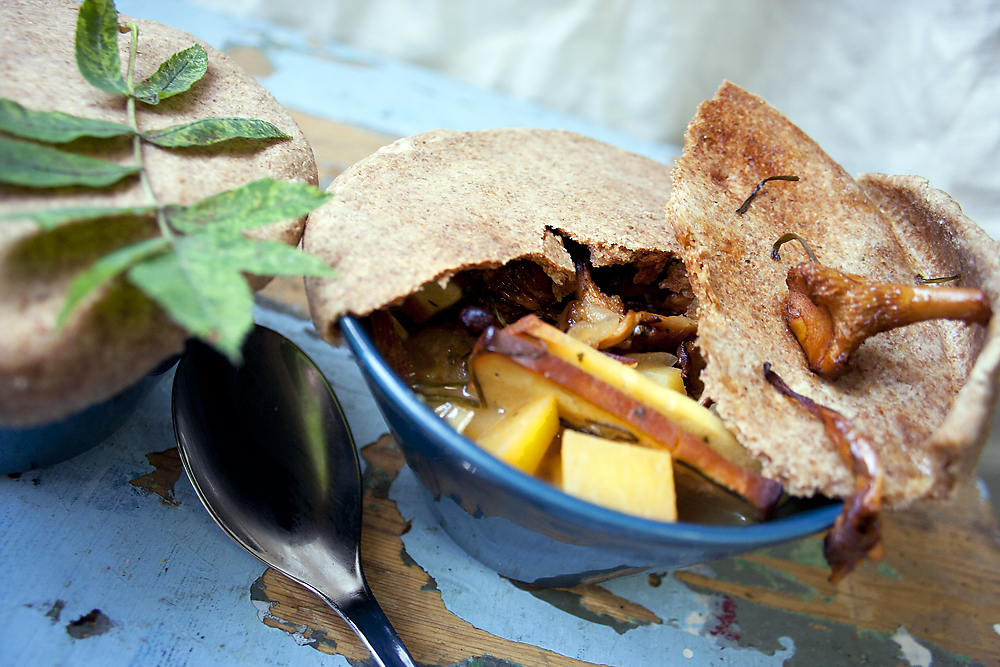
Gold Panner's Pots ‒ Kullanhuuhtojan ruukut


Things are really starting to look like autumn already, or at least like the harvest season. I accidentally emptied the market square in our neighbourhood. Only after that did I actually start to wonder what I could cook from all my beautifully golden turnips and stuff. The idea for this dish came from a bit different recipe, but I kept the name since the idea is still to feature golden-coloured ingredients. The place of gold panning in Finland is in the most northern part of the country, so they have a certain Lapland-theme. If you're serving a dessert, something with cloudberries would fit perfectly.

- 1 l golden chanterelles
- 2 turnips
- 300 g firm smoked tofu
- 4 shallots
- 2 dl oat cream
- 0.5 dl tar liqueur
- 0.5 dl rowan berries (sea buckthorn works as well)
- oil for frying
- pink peppercorn
- fresh chervil (or other mild herb)
- salt

Rye crust:
- 2 dl rye flour
- 1 dl water
- 1 dl wheat flour
- 1 tbsp oil
- 0.5 tsp salt

Start with the crust. Just mix the ingredients together with your hand. Move the chunk into the fridge for a while.

Plane thin slices out of the tofu. Fry on a pan with just a hint of oil until they've dried up a bit and perhaps curved from the edges. Peel the turnips, then chop them along with the onions and the mushrooms. Show them the pan as well, this time with a bit of more oil.

Mince the chervil and crush most of the rowan berries. Combine everything in a bowl. Divide evenly between oven-proof coffee mugs or other such serving-size pots (I got four of them). Add water to fill them up with liquid. Take the crust out of the fridge and divide into as many pieces as you have pots. Roll them into circles wide enough to cover the whole pot.

Move the pots into oven. As a precaution not to break the dishes, don't turn on the oven before this, so they'll get to warm up slowly along with the oven. Turn it to 200°C and leave them there for about half an hour or until the crusts look done.

Nutritional values /  1903 g:
energy 1917 kcal
fat 80 g
protein 89 g
carbohydrates 178 g
fiber 48 g

1.11.11

Hemp Balls ‒ Hamppupyörykät

My blog has been sleeping under all other projects for a long time now. But today I was asked for the recipe of the balls I had prepared for this autumn's kekri table so I thought it would be almost the same to share them with everyone interested.

I've come to love hemp and its versatility more and more. Crushed seeds are something easy to throw into every other pot you happen to be cooking, but this was the first time I tried rolling balls with hemp as the main ingredient. Hemp is an excellent oil plant, which explains pretty well why people said these taste like fish and why they remind me of the oil colours my dad used when I was a child.

This recipe is an adaptation from Jere Nieminen's cook book Vegaanin kotiruokakirja (Kustannusosakeyhtiö moreeni 2010). Originally I made a portion about five times this large since we had 30 people eating them but this amount should be sufficient for about 20 balls.

- 1 mealy potato
- 3 cloves of garlic
- 1 small punch of parsley
- 4 dl crushed hemp seeds
- 1 dl pea flour
- 0.5 dl water
- 0.5 dl tahini
- 0.25 dl rape oil
- 1 tablespoon lime juice
- 1 tablespoon mustard powder
- 1 tablespoon dark syrup
- 1 dried chili pepper
- 1 teaspoon black pepper
- 1 teaspoon salt
- rape oil for frying

Peel and grind the potato. Crush the garlic. Mix all the ingredients. Blend a bit to get a sticky paste. Roll it into balls between your hands and fry with oil. Enjoy with some neutral sidekick like mashed potatoes or barley.

Nutritional values / 720 g:
energy 2851 kcal
fat 228 g
protein 109 g
carbohydrates 111 g
fiber 74 g

5.11.10

Apple Gravy ‒ Omenakastike

Hello! I've been busy with my thesis lately but haven't forgot you. I just haven't cooked much. Think the last new dish I made was a mushroom pie for this autumn's kekri feast (more about here or here). The baking took place during the previous night, after a long workday and even longer drive back home so I just quickly put together something I could find from the closet. The result wasn't all bad but needs some more development before there's anything I want to remember about it. (Now that I think of it, I shoul've just followed the working recipe I already have.)

On the other hand, this apple gravy I made yesterday from the last remaining apples I had in the fridge turned out just the thing my millet and fried veggies needed.

- 3 zesty apples (or 2 large ones)
- 1 onion
- 2 tablespoons apple sauce
- 2 tablespoons apple wine vinegar
- 2 tablespoons brandy
- 2 tablespoons wheat flour (or other thickener)
- 1 tablespoon rape oil
- 4 dl vegetable broth
- 1 teaspoon curry
- white pepper

Chop the onion and one of the apples. Sauté with oil. After they've acquires some nice colour, add the broth and the spices. Chop the remaining apples and add them as well. Shift in the flour, carefully. Let the gravy thicken up a bit. Serve hot.

Nutritional values / 843 g:
energy 408 kcal
fat 14 g
protein 5 g
carbohydrates 43 g
fiber 6 g

30.10.09

Mash Cake ‒ Mäskikakku

It's not that easy to decide what kind of food to make for Kekri. Nearly all of our Kekri traditions and dishes are nowadays known as Christmas traditions and dishes. But somehow malty flavours and food with a lot of grain seem the most appropriate to me.

I'm currently trying to brew some sahti for a 20 person's Kekri feast. (Yikes!) Of course there's always that leftover - a big pot of barley mash - so I've also been trying to make up some uses for it. This cake recipe uses the leftover mash after the wort has been drained from it. I think it'd be pretty safe to replace it with (unknown amount of) non-used malts or mämmi if you just check that the structure seems moist enough.

At first I thought I'd use the mämmi cake recipe The Finnish Mämmi Association gives but that had eggs in it and didn't seem that interesting otherwise either. So instead I kind of combined it with a Christmassy sounding sour milk cake recipe with some additions of my own.

- 3 dl barley mash
- 2 dl soy yogurt (apparently, soy milk thickened and soured with lemon juice should do as well)
- 1 dl potato flour
- 3.5 dl wheat flour
- 100 g margarine (for example Keiju 70%)
- 1.5 dl dark syrup
- 1.5 tsp soda
- 1 dl dried cranberries
- 1 dl dried apple pieces
- 1 dl brandy
- 1 tsp allspice
- 1 tsp cinnamon
- margarine and breadcrumbs for the mold

Pour the brandy on the dried cranberries and apple pieces. Let them soak for a few hours. Mix the ingredients well together. Butter a cake mold and powder with breadcrumbs. Pour the paste in the mold and cook about an hour in a 175°C oven.

The cake is nicely spicy on its own but I decorated it with a mixture of cocoa butter, oat cream, icing sugar and a drop of lemon juice.

Nutritional values / 1100 g:
energy 3513 kcal
fat 74 g
protein 55 g
carbohydrates 495 g
fiber 32 g

28.10.09

Black Trumpet Rolls ‒ Mustatorvirullat

I'd probably love autumn if it didn't foreshadow winter. Just like Sundays would be so much comfier days if they weren't followed by Mondays. Two weeks ago, I went to collect two litres of frozen Cantharellus tubaeformis (suppilovahvero) with a friend, almost froze myself as well and decided the season is off for this year. Some of the mushrooms are now hanging from the kitchen ceiling but some of them I've used for a soup and a new experiment.

The idea of black trumpet roll was actually in strong-tasting mushrooms which these are not. But since I have to wait another year to get my hands on black trumpets I thought I could just as well check if the recipe idea works otherwise.

Seitan part:
- 3 dl seitan flour
- 2 dl graham flour or rye flour
- 1 dl tar liqueur or 2 dl smoked beer
- 0.5 dl rape oil
- 3 garlic cloves
- salt
- water (about 1-2 dl, more than you'd normally use)

Mushroom part:
- 2 dl dried black trumpets
- 2 tablespoons soy-based cream spread (for example tofutti)
- 2 tablespoons vegan mayonnaise
- 1 dl oat cream
- juniper berries
- black pepper
- 1 punch of fresh rosemary

Mix the seitan dough and roll it into a flat rectangle. Mix the cream spread, mayonnaise, cream, rosemary and spices together and then add the dried mushrooms as well.

Now you can spread the mushroom filling on the other long edge of the seitan, as if you were making a Swiss roll. Carefully roll the mushrooms inside the seitan and cut it in six pieces (though I do assume this also makes a nice centre piece for a dinner table if you leave it intact).

Arrange the rolls into a casserole and pour some vegetable broth on the bottom so they won't dry up in the oven. Cover with a folio. Cook about 40 minutes in a 200°C. Serve with some strong tasting sidekick that emphasizes the main dish, for example lingonberry cram or sea buckthorn and carrot sauce.

Nutritional values / 1 roll:
energy 330 kcal
fat 14 g
protein 23 g
carbohydrates 23 g
fiber 3 g

27.10.09

Sea Buckthorn and Carrot Sauce ‒ Tyrni-porkkanakastike

There are some ingredient combinations that are like made to fit together and bring out the best from each other, like turnip and tar, dark chocolate and red wine, strawberries and rhubarb or rye and bilberries. Well, the consort determined for carrots in the beginning of times is apparently sour berries. Sea buckthorn and rowan berries of course have a different taste, but with carrot they work the same way.

An ideal place to take advantage of such unions are often sauces. This one tastes rather sweet-and-sour and needs something with more substance than plain pasta to work, for example this.

- 1 carrot
- 1 onion
- 4 dl water
- 0.5 dl sea buckthorn (or rowan) berries
- 0.5 tablespoon apple wine vinegar
- 2 tablespoons brandy
- 1 tablespoon potato flour (or other thickener)
- 1 tablespoon rape oil
- salt
- aniseed

Mince the onion and sauté it in oil. Slice the carrot and add into the kettle. When the carrot slices have softened, add the rest of the ingredients. Sift the potato flour so it won't clump. The sauce is ready when it thickens up.

Nutritional values / 5 dl :
energy 225 kcal
fat 7 g
protein 2 g
carbohydrates 21 g
fiber 6 g

7.10.09

Salty Mushroom Salad ‒ Suolasienisalaatti

One of the classic ways to pickle mushrooms for the winter is blanching them with salt. And a classic way to use the blanched mushrooms is of course a creamy salad. This recipe starts from fresh mushrooms but is really meant for blanched ones.

- 500 g mushrooms (for example russulas or milk-caps)
- salt
- 1 onion
- 2 tablespoon vegan mayonnaise
- 1 dl soy yogurt
- punch of fresh chives
- black pepper
- sugar (just a pinch to break the sour taste)

Chop the mushrooms and blanch them in salty water. Cut the onion and the chives into lengthy pieces. Put everything into the same bowl and mix up.

Nutritional values / 760 g:
energy 401 kcal
fat 19 g
protein 19 g
carbohydrates 24 g
fiber 9 g

5.10.09

Apple Pie ‒ Omenapiirakka

Here's a weird fact about me: I only eat apples during autumn. This is when you get domestic apples. Every imported one I've ever tried has been just plain watery. Granny Smiths have a nice structure and some sourness but even they seem to lack in taste. And I really haven't found a satisfactory explanation for this. You'd imagine apple trees produce the same apples everywhere. Maybe this has something to do with that EU's ridiculous restriction concerning size and shape of fruits and vegetables (yeap, the infamous cucumber directive) that might prevent selling small (and tasty) apples. Or maybe stores just believe that size is the only thing that matters for the customers. Or maybe it's the climate. Please tell me if you have a clue.

Anyway, apples make a nice pie as well. You'll need rather bitter apples for this. This should come up as a nicely thin and crunchy pie with those juicy apples.

The bottom:
- 100 g margarin
- 3 graham flour
- 1 teaspoon of baking powder
- 2-3 tablespoons of water

The top:
- 5 small apples
- 1/2 dl sugar
- cinnamon
- ginger
- cardamom
- (50 g blue-style soy cheese)

Mix the dough ingredients by hand and spread the result evenly on a buttered pie plate. Cut the apples in chunks and lay them on the pie. Mix the spices the sugar and sprinkle it on the pie. If you want to add some extra twist lay pieces of blue-style soy cheese on top of the rest. Bake in a 200°C oven for half an hour.

Nutritional values / 753 g (with the cheese):
energy 1784 kcal
fat 81 g
protein 35 g
carbohydrates 217 g
fiber 27 g

26.9.09

Autumn Pie ‒ Syyspiiras

When hearing a Finn talk about making a pitsa you might naturally assume it's the same thing as Italian pizza. Wrong. That's where the name comes from, yes, but usually the only thing they have in common is that both are oven-baked breads with a topping. The typical pitsa you get at a coffee table, young people's sauna party or even as a Sunday's family meal is more of a pie with a thick layer of a very cheesy topping. For my generation it's a comfort food.

Since I don't want to add to the confusion I'm just calling this a pie. Usually me and my spouse top these with everything we find from the fridge, ending up with a piece higher than my mouth. For guests however, it could be a bit more balanced and better planned.

The dough:
- 6 dl water
- 1.5 dl rape oil
- 6 dl dark wheat flour
- 6 dl ryemeals
- 1 teaspoon salt
- 3 teaspoons baking powder

The topping:
- 200 g or 0.5 l fresh chanterelles
- 6 dried tomato pieces
- 1 large onion
- 2 dl soy flakes (textured soy protein)
- 3 garlic cloves
- 1 dl tomato sauce
- turmeric
- marjoram
(- 100 g melting soy cheese)
(- 3 dl soy yogurt)

Chop half of the mushrooms and the onion. Fry them with the soy flakes and spices. Mix the dough ingredients. Chop rest of the mushrooms and the dried tomato pieces as well. Put a parchment paper on a baking pan and spread the dough on it evenly. Spread the tomato sauce on the pie, then the fried mushrooms and the fresh mushrooms and dried tomato pieces.

If you want to use soy cheese, ground it into the soy yoghurt. Perfect the pie by spreading the mixture on it. Bake 15-20 minutes in a 250°C oven. Sprinkle some marjoram on the pie when still hot.

Another favourite combination of mine is tempeh slices fried crunchy, lingonberries (or pineapple pieces) and blue-style soy cheese. Weirdly, I don't think I've ever seen fruits and berries used in salty dishes outside Finland. Here it's actually quite common.

Nutritional values / 1825 g :
energy 2818 kcal
fat 97 g
protein 90 g
carbohydrates 244 g
fiber 40 g
Osta neljä tuotetta ja maksat vain kolmesta - Luomutallin kampanjatuotteet näet täältä


Teekauppa.fi - laadukasta teetä netistä
Ostoskorin loppusummasta vähennetään viisi euroa ja toimitus tapahtuu ilman postikuluja.
Syötä ostoskoriin kuponkikoodi:

syysteet

Tilauksen on oltava vähintään 35 eur, mistä jää maksettavaksi 30 eur.
Related Posts Plugin for WordPress, Blogger...