Showing posts with label beans. Show all posts

17.9.13

Kale and Fava Bean Dip ‒ Lehtikaali-härkäpapudippi


I've had this wonderful sounding spinach dip in my bookmarks, waiting for me to do it with fresh nettle. There are some new shoots growing now, but since I have a lot of kale and green fava beans waiting I thought I'd try something similar with them instead. I did add some dry nettle from last year though.

The amounts in the original recipe are in those archaic measures that are a pain to convert into SI-system (I know, you doing the conversions the other way around end up with just as cumbersome fractions). Since this type of dish doesn't really call for specific amounts like, say, cookies would, I just added things with a freehand style. This base I developed would call for more liquid, but I have absolutely no complaints about the taste. It goes best together with rye crisps, corn snacks, veggie sticks or other such stuff with a more flavour and toughness than your average potato chip does.

- 200 g kale
- 200 g soy cheese
- 3 dl cooked fava beans
- 2 dl cashew nuts
- 0.5 dl lemon juice
- 0.5 dl dried nettle
- 0.5 dl  nutritional yeast
- 3 garlic cloves
- 1 tbsp rape oil
- 1 tbsp pesto
- salt and pepper

Soak the nuts overnight or boil for about 20 minutes (this "quick-soaking" must be among the best kitchen tips I've heard for a while) to soften them up. Blend all the ingredients together, but save some of the cheese to sprinkle on top.

Bake for 15 minutes in a temperature of 175°C. Serve as a hot dip sauce or use between sandwiches.

Nutritional values / 969 g:
energy 2105 kcal
fat 139 g
protein 94 g
carbohydrates 119 g
fiber 32 g

15.9.13

Pirana


Oops, I managed to miss posting yesterday. But it's halfway already and 14/15 is still something I can feel satisfied with. Perhaps from now on I should still prepare couple of "just in case" -recipes beforehand.

I did cook though. Actually getting to eat just went a bit late. Madeleine.teacup has been doing a really educational series about pre-colonial dishes of the Americas. One of them was called Inca chilcano de pirana, which basically means piranha soup. This kind of reminded me for a totally different Finnish dish also spelled pirana, a traditional South Karelian dish. (There's two of them to be precise. Another one is a lingonberry rye porridge, but I'll get back to that another time.) It's been hanging on my to-do list for years so now I finally got myself to try it.

There are quite many originally vegetarian dishes from Karelia. Of course meat used to be consumed a lot less during the time when it meant slaughtering your perhaps only cow, but this is also due to the orthodox fate where meat isn't even allowed during the fasting. For a modern Finn they may seem a bit anemic since usually the only spice the recipes mention is salt, but I think this aspect can be tweaked if done with respect. So for example here I used some stock base and bear's garlic for more taste.

Pirana is basically a stew consisting of rutabaga, potatoes and dried fava beans or (today more often) peas, which are all used in equal amounts. I thought I'd try this with fresh fava beans now that I have some, as well as those purple potatoes we've gardened, so the stew would get some pretty colours. Potato didn't become common before 19th century, so one modernized version I found even replaced them with sweet potatoes which feels as exotic to us now as potato must've been back then.

In older versions barley, sometimes also rye flour or even talkkuna is used for thickening but modern versions usually shy away from the porridge-like consistency. I kept the flour since I think it's one of the key elements of the dish but scaled the amount down significantly. Only one version I found added cream to the result but I took that too since it seemed like a reasonable way to bring a little some fat into the dish. In another modern version I saw this problem was solved by first sauteing the veggies in a little oil.

- 5 dl fava beans (or peas)
- 500 g rutabaga
- 500 g potato
- 2 dl oat cream
- 1 dl oat flour
- 1 portion of stock
- 1 tbsp dry bear's garlic
- salt
- water (about 1 l)

(I you're using dry beans or peas, first soak them overnight.) Peel and cube the rutabaga. Cover it with water and add some stock base and salt. Set the pot to simmer. When the rutabaga is starting to soften up a bit, also cube and add the potatoes, as well as the beans. Add water if needed.

When things are starting to seem edible enough, add the cream and thicken with flour. Continue cooking for another 15 minutes, while stirring since the stew can burn easily at this point.

Like this recipe instructs, the ready pirana is to be eaten as the main course just like porridge. Margarine "eye" and milk can be added on the plate. The recipe also reminds this can be eaten cold as well!

Nutritional values / 2765 g:
energy 1413 kcal
fat 23 g
protein 60 g
carbohydrates 242 g
fiber 48 g

11.9.13

Green Fava Bean Toast ‒ Härkäpapupaahtoleipä tuoreista härkäpavuista


Today I got to taste fresh fava or horse beans for the first time in my life. They're one of those plants traditionally grown in Finland, which have almost been forgotten from the way of imported goodies, along with other such nutritious and tasty plants like hemp, turnip and buckwheat.

I do understand why restaurants don't want to use these fresh. Processing just a small patch like this meant several hours of work - and by work I mean the actual active time I did something with my hands, not just waiting while it cooks. But you never see these sold fresh either. This rare chance was all thanks to us planting and harvesting the beans ourselves in our small allotment garden.

So why is it such a hard work? Well, first you have to peel the beans out of their pods, then boil in water for 3-5 minutes and then individually pop them out of their skins as well before continuing to the actual cooking part. Of course, one way would also be to just serve them with greasy sauce and let the eaters peel the skins off. They're not related to new world beans in any way, so they're not poisonous to eat raw, just a bit unpleasant unless really young and small (in which case it's OK to use the pods as well). It's enough to cook them lightly so the aromas don't get waisted and the structure doesn't go mushy.

I wanted to try a rare treat like this really simply, so I used this recipe from a Swedish book Smakernas återkomst: när maten följer årstiderna (Ordfront förlag 2011) by a reporter Mats-Eric Nilsson. The instructions were a bit vague so I'll just tell how I did them.

- 5 dl precooked fava beans
- 6 slices of white sour bread
- 2 shallots
- 3 tbsp olive oil
- basil (I mostly used dill since we happen to have lots of it fresh)
- salt

Mince the shallots and sauté them in olive oil. Add the beans. Fry a few minutes more. Sprinkle with salt, basil and more oil. Move aside. Toast the bread slices on the pan as well.

Scoop the beans on the bread slices and enjoy on the spot.

Nutritional values / 790 g:
energy 1319 kcal
fat 44 g
protein 56 g
carbohydrates 173 g
fiber 32 g

4.9.13

Zucchini Lasagna ‒ Kesäkurpitsalasagne


I've been planning to do lasagna to get rid of the spinach lasagna noodles that have been sitting in the closet for almost a year now. But then I decided that instead, I'd make the zucchini version that all low-carbers hype about, now that the zucchini season is still on.

Zucchini doesn't need softening like pasta or rye crisps in rye lasagna, one of my favourite dishes to date. So you can discard the white sauce and just sprinkle some soy cheese instead. Also, the tomato sauce should be a bit sturdier than the one you'd normally make.

Even with these precautions the end result reminded more of a stew than a layered dish. There was absolutely no way of holding it together on a plate long enough to take a pretty photo. This one here I've taken on the next morning. You can clearly see how it's the sauce that holds the piece together, not the actual "pasta". But the main thing, the actual taste was just yummy.

- 1 portion of marinated horse beans
- 1 portion of basic brown sauce
- 1 zucchini
- 400 g tomato sauce
- 200 g melting soy cheese
- 0.5 dl sun-dried cherry tomatoes
- 4 garlic cloves- basil
- marjoram or oregano

Set the horse beans to marinate on the day before if possible. Prepare the brown sauce. When it starts to thicken, add the tomato sauce in it. Spice with herbs and garlic. Cook a little to reduce the liquid, then add the horse beans and cherry tomatoes along.

Slice the zucchini length-wise. Try to cut as thin strips as you can. Scoop a generous amount of the sauce in the bottom of your oven casserole. Layer with zucchini slices. Sprinkle some cheese on them. Continue by making another sauce layer and so on, until you've used everything. Aim to finish with the cheese layer. A few pieces of margarine or some breadcrumbs aren't a bad idea either.

Set in a 200°C oven for 45 minutes.

Nutritional values / 1818 g:
energy 2380 kcal
fat 126 g
protein 97 g
carbohydrates 206 g
fiber 73 g

2.8.13

Countryside Bean Salad with Herb Oil ‒ Talonpojan papusalaatti ja yttiöljy


One more part to the salad trilogy. This one is something I've been planning for a long time. I wanted to make a very filling salad with a rustic feel to it. Something I'd like to have sitting by our allotment garden after some physical work. And since this is the time for green beans, they're really the main star of the plate.

The salad
- 250 g green beans
- 230 g giant beans
- 4 slices of rye bread
- 200 g cherry tomatoes
- 125 g radish
- 100 g fresh spinach
- 3 summer potatoes
- 1 red onion
- 0.5 dl sunflower seeds
- 2 garlic cloves
- oil for frying
- salt

The herb oil
- 1 dl flax seed oil
- 1 punch of fresh parsley
- 10 basil leaves
- 2 tbsp black currant juice (unsweetened, without added water)
- black pepper

Cook the potatoes and the green beans in salted water. Roast the sunflower seeds a bit on a dry pan. Move away the seeds, add some oil and minced garlic and place the bread there, cut down into mouth-fitting chunks. Fish out the green beans and place them on the pan as well.

Cut the onion in semi-circles and slice the radishes. When the potatoes are done, slice them as well. Mix everything and serve while still warm.

For the oil, just blend everything together. Serve alongside the salad or mix right into it.

Nutritional values / 1652 g:
energy 1852 kcal
fat 109 g
protein 49 g
carbohydrates 159 g
fiber 55 g

17.6.13

Fresh Tomato Sauce with Ground Elder and Horse Bean ‒ Tomaattikastike tuoreista tomaateista, vuohenputkesta ja härkäpavuista


This is quite likely the ugliest photo I've posted all year. The actual dish I promise is definitely worth a try though. It was one of those nights it got late before we had time to cook and feeling hungry we had to put up something quick. So I took the punch of fresh tomatoes that really start to taste their best this time of the year and put them in the pot. With them I wanted to use ground elder which is said to be on its best in tomato-based dishes. When the sauce was ready, I took the extra time to take couple of fast shots and then it was suddenly gone with even plates licked. Forever gone. No remains for morning. I may have to prepare it again.

- 5‒6 well riped tomatoes (let them go over ripe by all means)
- 1 big punch of ground elder leaves
- 2 dl horsebean crush
- 1 lovage sprig
- 1 small punch of fresh basil (or 2 tbsp pesto)
- 2 garlic cloves
- 1 tbsp rape oil
- black pepper
- salt

Pour the oil into a sauce pan. Quarter the tomatoes and sauté them on a mild temperature until they've turned into mash. Add the rest of the ingredients (greenies chopped, garlic minced) and let the sauce simmer for about half an hour. Serve with good quality, nutritious pasta.

Nutritional values / 770 g:
energy 714 kcal
fat 18 g
protein 47 g
carbohydrates 88 g
fiber 48 g

26.5.13

Beggar's Nettle Purses ‒ Kerjäläisen nokkosnyytit


My spouse loves making crepes although I need to watch his back since he can get quite picky on which ones looks absolutely perfect and which ones he tries to dump into bio waste bucket. It usually falls into my responsibility to decide how to top them. This time the fresh nettle leaves I had just been picking  were the oblivious choice.

I do fully admit using nettle inside crepes is really just another variation of making classic nettle pancakes. But it's a nice one, no way around it. And wrapping the crepe around the filling into a surprise package does give it a whole new touch. Somehow wrapping thing inside each other always feels more exciting than just placing them next to each other on the plate. The original beggar's purses are mini-size appetizers filled with caviar so for these more filling versions, I came up with the idea of using beluga lenses which are sometimes called "vegetarian's caviar".

The crepes:
- 1 litre oat milk
- 3 dl barley flour
- 3 dl wheat flour
- 1.5 dl melted margarine
- 1 tbsp sugar
- 1 tsp salt
- oil or margarine for frying

The filling:
- 1 l fresh nettle leaves (or 150 g blanched and frozen)
- 2 dl beluga lenses
- 2 dl oat cream
- 2 tbsp tar liqueur (or 1 tbsp dark syrup and 1 tsp liquid smoke)
- salt

For decoration:
- Spring onion stalks

Whisk the flours into the cold milk little by little. Add the rest of the crepe batter. You can also sprinkle a little bit of turmeric Leave alone for an hour or so. Heat up the frying pan and make sure you're using enough oil to keep the crepes from sticking. Pour a ladleful of batter evenly on the pan. Tilt the pan to make sure it spreads evenly but thinly. When the edges start look golden and the center also holds together. Loosen with a spatula and turn around. When the other side is done as well, move aside and add more oil before continuing with the next crepe.


Rinse the lenses. Wash the nettles, cut out bad parts or stalks and chop the rest into smaller pieces. Put all the filling ingredients into the same pot and add enough water to almost cover them. Cook until the liquid has absorbed and the lenses are done. About 30‒40 minutes should do.

For the serving, place a spoonful of the filling on the crepe. Collect the edges into a perfect looking package.and tie carefully together with a string or a spring onion stalk.

Nutritional values / 2337 g (without the frying oil):
energy 3671 kcal
fat 149 g
protein 114 g
carbohydrates 452 g
fiber 68 g

2.4.13

Cabbage and Horse Bean Soup ‒ Kaali-härkäpapukeitto


Recently we moved into a bit bigger appartement. The migration itself felt like a complete chaos and we had to sleep the first night on friends' couch since we simply couln't fit in with all the junk, but there were some positive things in the day too. For one, the soup a friend of my flatmate's prepared for all our wonderful helpers. That version contained several types of beans and chili sauce, but I thought I'd stick more with the version she wrote down here. The twist is in combining two separetely prepared food items, which of course, you can use individually too. I couldn't find kale so I just replaced it with more red cabbage and nettle.

Cabbage Soup
- 1/4 red cabbage
- 1 1/2 onions
- 0.5 dl kale
- 2 tbsp thyme
- 2 tsp dill
- salt
- black pepper
- olive oil
- 1 tl dry nettle
- 3 l  water

Marinated horse beans
- 3 dl dry horse beans
- cayenne
- tomato paste (3 tbsp)
- olive oil (2 tbsp)
- salt
- (apple) wine vinegar
- (smoked) paprika
- black pepper
- dry basil
(sugar or in my case, a tablespoon of dark syrup)

Let the beans soke in water overnight. Rinse and cook until soft. (Remember to peel off the foam.) Rinse again. Mix the marinade ingredients with the beans. Try to make strong enough to actually give taste to the beans. Leave in the fridge for the next day.

Chop most of the onion as well as the kale and cabbage, leaving bot big and small parts. Sauté separetaly. Let the water come to a boil. Add thyme, dill, nettle, salt and pepper. Let it all simme for 10‒20 minutes. Combine the soup ingredients except kale and simmer for another 30‒60 minutes. Check the taste and add the kale about 5 minutes before the soup is ready.

Serve the soup with marinated beans and uncooked onion circles.

Nutritional values / 3852 g
energy 1217 kcal
fat 44 g
protein 66 g
carbohydrates 129 g
fiber 65 g

14.9.10

Pumpkin Soup ‒ Kurpitsakeitto

Couple of weeks ago I accidentally got a huge, home-grown pumpkin. Some of it I stuck into a rye lasagna, some of it I used as an extra spice in my signature tar turnips but most of it was still left. People often make a soup out of it so I decided to try one as well. Now pumpkin is an odd vegetable to me and its taste seems rather faint so I spiced it with exotic spices which I rarely use otherwise, in the same manner as I've previously done to a carrot soup.

- 1 kg pumpkin (or carrots)
- 1 leek
- 1 l water
- 1 tablespoon rape oil
- 2 dl coconut milk (or oat cream)
- 200 g red lentils (or horse beans)
- 1 lime
- 1 tablespoon dark syrup
- 1 dose of stock
- 1 chili
- ginger
- salt

Peel and chop the pumpkin. Don't remove the seeds. Cut the leek into circles. Soften the veggies on a frying pan with the oil. Put them into a pot with the water, the lime and the spices. Cook for about ten minutes. Blend smooth. Add the lentils. The soup is ready when the lentils are done.

Nutritional values / l:
energy 1429 kcal
fat 54 g
protein 67 g
carbohydrates 173 g
fiber 48 g

20.7.10

Sandwich Cake ‒ Voileipäkakku

Sandwich cakes are a very Scandinavian thing. They're just like normal cakes except salty and usually the dish in formal occasions that disappears the quickest. In Finland they typically contain many layers but especially Swedish-speakers seem to prefer them resembling one large sandwich with a single layer and a pile of toppings.

You can use any soft bread together with bread spreads you like, for example hummus, guacamole or thick mayonnaise. It's not even rare to see several flavour options in the same coffee table if there are a lot of guests (and coffee table culture is a serious business for Finns - something you shouldn't play around with). Here's one model to tweak.

- 1 loaf that fits into a loaf tin (white, dark or slices from both)
- 200 g cherry tomatoes
- 125 g radish
- 1 bunch of fresh parsley
- vegetable broth for moistening (or oat milk)

1. filling:
- 2 dl cooked horse beans
- 2 tablespoons tahini
- 1 bell pepper
- 1 onion
- 1 tablespoon rape oil
- basil

2. filling (and frosting):
- 1 portion of cold cucumber soup, only with the yogurt drained first and the cider replaced with two tablespoons of white wine to make it thicker.

3. filling:
- 100 g soft tofu
- 1 dl hazelnuts
- 1 artichoke (or a young cabbage head)
- 2 tablespoons of mustard

Cut the bread lengthwise in four pieces (and remove the crust if it feels hard). Moisten the pieces by sprinkling vegetable broth on them.

Chop the bell pepper, the onion and the artichoke. Oil them and roast in a 200C oven for about half an hour. Remember to turn them around every now and then. Prepare the fillings by mashing together the ingredients. It's ok to leave clumps.

Slice the radishes and half the cherry tomatoes. Now you're ready to put the whole beauty together. Place the top bread slice into your loaf. Spread with the first filling and add some radish slices. Place the second and the bottom layer in the same manner. Flip the whole thing over onto your serving plate and remove the loaf. Cover with the middle filling. Decorate with cherry tomatoes and parsley.

Nutritional values / 3574 g:
energy 5516 kcal
fat 126 g
protein 219 g
carbohydrates 806 g
fiber 168 g

12.7.10

Cherry Sage Sausage ‒ Kirsikka-salviamakkara

As a kid I used to climb in the two cherry trees of my family's front yard all the time. They have those famous white flowers that only last a moment and later during the summer, sour berries with a wonderful aroma. Cherries don't occur naturally in Finland but in my heart there will always be a certain place for them with rowans and poplars (after one of which I cried bitterly when my parents decided they have to cut it down before the roots take over the house). Finns are often called the people of trees so maybe this explains my fascination for Japanese culture as well.

The cherries sold in stores here are never like those I've come to love. They're sweet instead of sour and taste watery instead of, well, cherries. And yet, once again I bought Creek cherries when I saw them sold on a pedestrian street. After a few disappointing bites I decided to dry them in the oven and use in the recipe I had seen in the lovely cookbook Vegan Brunch (by Isa Chandra Moskowitz, Da Capo Press 2009). It sounded plain weird but then again, after initial disgust, I've come to love even a sausage brand that uses orange and melon as spices. These too came out pretty great, though next time I'd like to try them with sour cherries.

I followed Isa's instructions more than my usual sausage recipe and ended up doing it like this:

- 1 dl dried cherries
- 2 dl cooked white beans
- 4 dl gluten flour
- 0.5 dl nutritional yeast
- 2 tablespoons tar liqueur (that is, all I had left)
- 2 tablespoons soy sauce
- 1 tablespoon rape oil
- 2 garlic cloves
- 1 small punch of fresh sage
- ginger
- allspice
- black pepper
- vegetable broth (approximately 2 dl)

Mash the beans with a fork. Throw all the ingredients together, adding just enough broth to make a dough. Divide the dough into four parts. Mold into phallic symbols (don't worry too much about the shaping part since they'll snap into shape) and wrap inside a tin foil. Steam for 40 minutes.

Enjoy right away or even better, grilled over a campfire.

Nutritional values / 1 sausage / 188 g :
energy 371 kcal
fat 5 g
protein 50 g
carbohydrates 28 g
fiber 10 g

10.7.10

Summer Soup ‒ Kesäkeitto

Kesäkeitto, literally 'summer soup', is a dish that all Finns have strong childhood memories about. For me it reminds me of my mum and careless, sunny days. For others it brings in mind school canteen and sadistic teachers forcing them to eat the stuff with tears in their eyes. But if you've never even heard about this soup before, consider yourself lucky: you'll get to base your opinion purely on it's humble taste. Here's how I prepare it:

- 2 l water
- 500 g new potatoes
- 1/4 cauliflower
- 2 carrots
- 1 dl fresh peas
- 3 beanstalks
- 2 dl soy cream (oat cream is probably fine as well)
- salt
- whole black peppers

Wash the potatoes well and remove the bad parts but don't bother to peel. Let them simmer in salty water until soft. Chop the veggies and add everything into the pot. The soup is ready when the carrots are - in less than ten minutes.

Garnish with fresh herbs.

Nutritional values / 3080 g:
energy 831 kcal
fat 36 g
protein 20 g
carbohydrates 98 g
fiber 16 g

4.6.10

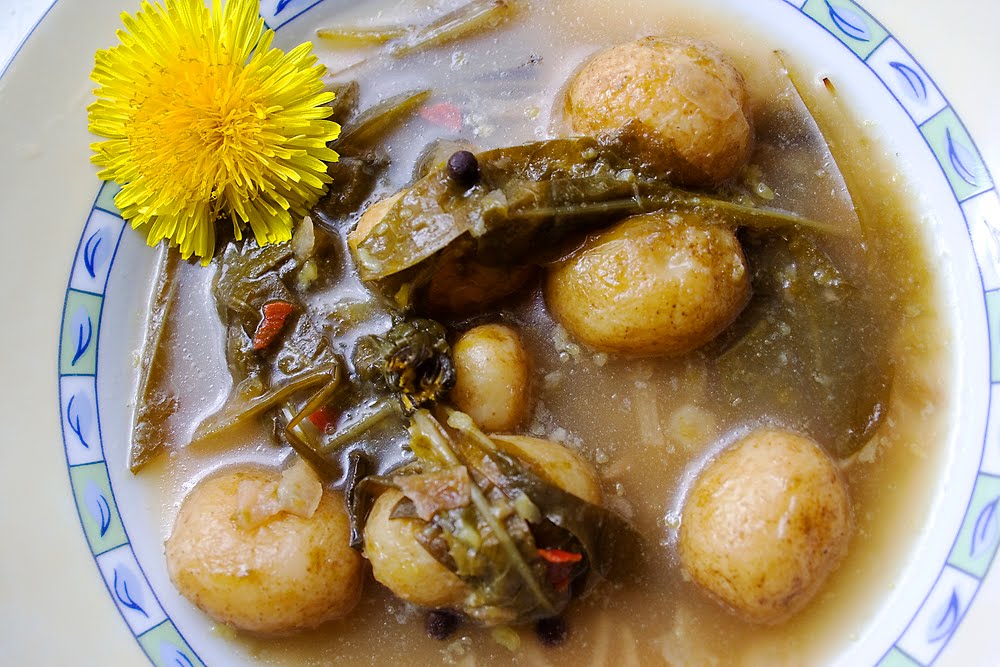
Dandelion Soup ‒ Voikukkakeitto

In case that supikas recipe yesterday sounded appetizing, here's a suggestion for the remaining broth. But if you want the soup only, dice a small rutabaga to cook with the potatoes.

Dandelion is among one of my favourite wild veggies because it's so multifunctional and grows just about everywhere. The leaves and buds for this soup I picked when returning along my jogging path, trying to find my breath that had got lost somewhere on the way.

- 20 unopened dandelion flower buds
- 2 dl young dandelion leaves
- 2 l rutabaga broth
- 5 dl new potatoes (or noodles)
- 0.5 dl seaweed
- 0.5 dl dried onion (or caramelized)
- 1 chili pepper
- whole black peppers or juniper berries

Wash the potatoes and remove the bad parts but don't bother to peel. Cook them in the rutabaga broth until soft. Add the rest of the ingredients and let the soup come to a boil. Eat right away.

In the present form the soup is more like a starter or an evening snack but if you want to turn it into a lunch you might want to add beans or such.

Nutritional values / 2 l:
energy 500 kcal
fat 3 g
protein 27 g
carbohydrates 96 g
fiber 11 g

27.2.10

Chocolaty Sauerkraut Stew ‒ Suklainen hapankaalipata

My favourite food is called mush. Others have invented flashier names for it though I think they're only designed to hide the truer essence. You hardly need a recipe for them since their very idea is to take a pot and stuff it with anything you find from the closet or the refrigerator. This can sometimes lead into quite dubious looking concoctions. I'm still sincerely wondering if I should divide this ingredient list into two, just for the sake of people with further developed taste buds than me. But then again, perhaps there are some other twisted minds out there.

If you can't stand sauerkraut but would like to give this a try nonetheless, flush the sharpest taste out of your kraut with water ‒ or just use freshly shredded cabbage instead. One warning: I've never run into this problem myself but little birds told me that using vanilla-flavoured chocolate in salty dishes may result in even weirder taste results.

- 300 g seitan strips
- 5 dl sauerkraut
- 2 dl beans
- 2 large apples
- 40 g dark chocolate (semi-sweet, at least 70 %)
- 1 tablespoon rape oil
- 1 tablespoon tar syrup
- 1 teaspoon coriander seeds
- 1 teaspoon caraway seeds
- 4 dl beer (I only had dark lager this time but I imagine stout or thick porter would fit even better)

In a large pot, heat up the oil. Fry the seitan and the beans until they've acquired some colour. Drain the sauerkraut and add it into the pot. Add the spices as well. While they warm up, peel (or just wash if you're using organic) and cut the apples. Mix in the apple chunks, the beer and finally, the chocolate. Let the stew simmer for few more minutes so everything becomes just one big mess.

Decorate with pickled onions.

Nutritional values / 1510 g:
energy 1778 kcal
fat 45 g
protein 126 g
carbohydrates 182 g
fiber 52 g

14.1.10

Pyttipanna ‒ Pyttipannu

I strongly feel that throwing food away is a sin, almost comparable to pissing on a sauna stove. Of course, sometimes zucchinis start to grow an angora fur and kitchen experiments turn totally inedible. But what kind of people purposely load their plate full if they're not going to finish it? Not only are they being disrespectful towards the cook and nature but essentially, towards food itself.

Well, in a household of two little piggies the problem is usually reversed. No matter how much sauce I make there's never anything left for my breakfast bread. No matter how big a bread I bake there's never enough to dry it for breadcrumbs or croutons. And no matter how big a soup pot, it will never end up into handy freezer portions. This time however, I managed to cook enough potatoes to make the next dinner out of them. Normally I would get this treat only by buying a microwave meal.

Pyttipannu (from Swedish pytt i panna, small things in a pan) is a classic way to use leftovers. Feel free to throw in anything around you. For example tofu, beetroot, sausage, tempeh, peas, rye bread and beanstalks fit here perfectly as well. This time I made it like this:

- 5 potatoes
- 1 onion
- 1 small rutabaga
- 3 dl fava beans
- 1 chili pepper
- smoked paprika (my current favourite spice)
- salt
- 1 tablespoon sunflower oil (I bought a bottle of this for a change)

Dice everything. Throw into a very hot pan. Fry until the little cubes have got deliciously brown. (If you have a large batch or a small pan fry your pyttipannu in small portions and flush the pan between them.) Sprinkle the spices when the food is on your plate. Enjoy with something pickled.

Nutritional values / 1109 g:
energy 666 kcal
fat 15 g
protein 24 g
carbohydrates 110 g
fiber 21 g

2.1.10

Vodka Sauce ‒ Votkakastike

Happy this year! Quite many people in Finland have a habit of going totally teetotal for January. This questionnaire even suggests that during 2008 as many as a quarter of the whole population stuck to tipaton tammikuu, "dropless January". I've never heard of anything like that happening in any other country. The rest of us on the other hand are persistent alcohol people. That means alcoholics as much as outdoors people means homeless.

Those who aren't alcohol people often think that such delicate drink as vodka doesn't have any other taste besides alcohol. Sure, most vodkas are made by distilling it almost to pure alcohol and then diluted down to about 38 percent (the ideal volume according to Dmitri Mendeleev who worked several happy years for the Russian Tsar to find this out). But that 2 percent of impurity or possibly the water lead into significant results in character. If you're not used to spirits, try comparing them mixed with water. The differences should become quite oblivious.

Why am I jabbering about this? Because the key to success in the following recipe is to select a quality vodka with a smooth taste. Most of these are made in the traditional Vodka Belt of Northern and Eastern Europe. I prefer Russkiy Standart, Finlandia or Smirnoff, you may like something else. The point is it should be something you could enjoy on its own. And of course, your homemade moonshine can only be called vodka if it's made exclusively out of grain or potato, although EU has some twisted ideas about this definition.

As you may have noticed, I like to use alcohol beverages in cooking. I don't do it only to bring a whip of their own aged flavours into the food but also to release some of the alcohol soluble components (which tomato has quite a lot). Alcohol acts as a flavour enhancer. Sorry to crush your hopes but most of the alcohol content burns off when heated so it won't get you drunk, unless you pour the lion's share of it directly into the chef. I got the idea for this sauce from Veganomicon (Isa Chandra Moskowitz & Terry Hope Romero, Perseus Books Group 2007) and decided to add raspberries that pair nicely with tomato. Besides pasta, it fits for example with seitan or simple fried veggies. This time I went for the easy way and added some beans to call it a full supper.

- 1 dl vodka
- 400 g canned, crushed tomatoes (If you absolutely insist to start with fresh ones you'll first have to roast them or simmer them for about an hour.)
- 100 g frozen rasberries
- 1 dl soaked almonds
- 2 dl cooked fava beans
- 1 tablespoon rape oil
- 1 dose of stock
- 3 cloves of garlic
- basil
- dragon's wort
- marjoram

Sauté the beans in the oil to get some colour on them. Add the raspberries, the tomatoes and the spices. Simmer until the sauce has a nice, thick structure. Add the vodka. Cook a few minutes more until the stinginess of ethanol has given way to caramel-like sweetness, with just a hint of that wonderful burning bite left. Make a smooth paste out of the almonds and add to the sauce. Sprinkle some nutritional yeast flakes on your pasta portion.

Nutritional values / 834 g:
energy 1076 kcal
fat 53 g
protein 32 g
carbohydrates 60 g
fiber 22 g

17.11.09

Pepper Boats ‒ Paprikaveneet

Some kind of stuffed veggies are probably prepared all over the world and Finland is no exception. Previously I've posted about such classics as stuffed turnips and cabbage rolls. Stuffed bell peppers or tomatoes are also a typical thing on a dinner table when the host wants offer something a bit fancier and colourful than normally, yet avoiding too exotic and odd tastes. I've heard some people in their 30's even suffer traumas from making these in the school cooking classes.

- 3 large bell peppers
- 2 dl fava beans
- 1 dl nuts
- 1 dl tomato sauce
- 6 dried tomato pieces
- 2 garlic cloves
- 2 chili peppers
- basil
- margarine or such for topping

Cut the bell peppers in half and scoop out the seeds. Crush the nuts and the garlic, mince the dried tomato pieces and the chili peppers. Mix everything but the bell peppers and the margarine together. This becomes even better if you bother to precook the stuffing before stuffing. Spoon into the pepper halves. Top with margarine. Place in a 200°C oven for 30-45 minutes.

Of course it's also possible to use whole bell peppers by just cutting the hat off. The hat can even make a pretty decoration. I personally think they turn out better this way but that's just a matter of taste. Oh, and before someone asks, those cubes in the photo are nut pate.

Nutritional values / 1 boat:
energy 162 kcal
fat 11 g
protein 5 g
carbohydrates 11 g
fiber 5 g

11.6.09

Nettle Pancakes ‒ Nokkoslätyt

Stinging nettle is often said to be the healthiest plant in Finland due to its richness in vitamins and minerals. There's for example seven times as much iron in it than in its cultivated comrade you can use the same way, spinach. My plan is to collect and precook many bags of it in the freezer for winter. Besides food you can use it for fiber, cosmetics (especially hair), herbal medicine, dyeing and as a fertilizer.

Remember, nettle leaves are at their best when young. Use plants that haven't flowered yet, after a sunny period when the nitrate concentration is at its lowest. Cooking or drying completely destroys the stinging toxic. And of course, you should never eat anything that grows close to a road or such. The taste flavours many kinds of soups, sauces, fillings, beverages and breads. And of course nettle pancakes, a comfort food that even every health food hater loves:

- 1 l young nettle leaves (or 150 g frozen spinach)
- 3 dl wheat or spelt flour
- 1 dl potato flour
- 1.5 dl oat milk or water
- 1.5 dl cider (made from real apples, not those disgusting fake ciders)
- salt
- rape oil for frying

Lingonberry cram is a must have with these. I also made a quick sidekick from fava beans, soy yoghurt, mustard and black pepper.

Nutritional values / 742 g:
energy 1322 kcal
fat 34 g
protein 36 g
carbohydrates 205 g
fiber 16 g

8.6.09

Vagabond's Dulcet Fire Salad ‒ Rentun suloinen tulisalaatti

Fireweed is known in Finland as the vagabond's rose (rentun ruusu). A famous song for example tells about a boozer who crawls up from a ditch in the morning and takes fireweed flowers to his loved one as a sign of remorse for being lost for the whole week again. Much fewer people seem to remember fireweed also makes an excellent tea or salad. This one got its inspiration from the English name. It's sweet and burning for your heart just like a vagabond. Think I got a bit carried away with decorating it but I promise that for once the taste is worth the looks.

- 0.5 l young fireweed leaves
- 100 g strawberries
- 1 dl cooked fava beans
- 10-15 lemon balm leaves
- a handful of wood violets (or some other edible viola)
- 2 tbsp spruce syrup
- your favourite chili sauce

Wash the fireweed leaves and lay them on a plate. Sprinkle syrup and chili sauce on them. Slice the strawberries. Lay everything on the fireweed bed as beautifully as you want. Sprinkle some more syrup and chili on the beans and the lemon balm if you wish.

Nutritional values / 300 g:
energy 257 kcal
fat 3 g
protein 6 g
carbohydrates 54 g
fiber 13 g

29.5.09

Sausages ‒ Makkarat

According to a common saying the most popular vegetable in Finland is sausage. Well, our little household certainly proves the point as we always have soy sausages in the fridge. I never thought about making them myself before I found VeganDad's recipes. And you know what? It turned out to be quite easy. The only real problem with them is that they're too good and I end up eating them all on their own without any veggies or other sidekicks ‒ not such a great idea to fill your stomach with protein only. Ouch.

- 1.5 dl fava beans (or peas)
- 3 dl seitan flour
- 270 g extra firm tofu (or hefu)
- 1 dl tar liqueur
- 0.5 dl nutritional yeast
- 1 dose of stock
- 0.5 dl mustard
- 5 red and green chili peppers
- onion powder
- caraway
- salt
- folio
(- rape oil)

Mash the beans. Chop the chili. Crumble the tofu. Mix everything together with your hand. Divide in six pieces and shape into phallic symbols. Wrap them tightly into folio and steam for 45 minutes.

Nutritional values / 1 sausage / 158 g (without the oil and once again, liqueur):
energy 291 kcal
fat 6 g
protein 34 g
carbohydrates 18 g
fiber 6 g
Osta neljä tuotetta ja maksat vain kolmesta - Luomutallin kampanjatuotteet näet täältä


Teekauppa.fi - laadukasta teetä netistä
Ostoskorin loppusummasta vähennetään viisi euroa ja toimitus tapahtuu ilman postikuluja.
Syötä ostoskoriin kuponkikoodi:

syysteet

Tilauksen on oltava vähintään 35 eur, mistä jää maksettavaksi 30 eur.
Related Posts Plugin for WordPress, Blogger...