Showing posts with label on the bread. Show all posts

25.9.13

Mushroom Hunter's Bread ‒ Sienestäjänleipä


At some point this morning I noticed I had accidentally published a completely empty draft with this headline. That was embarrassing. Apparently it had gained 30 views before I noticed anything. Sorry if you were one those people who clicked in vein. Here's the real post.

In the 70's cafés and bars served warm sandwiches instead of hamburgers. To modern reader those classic recipes may sound somewhat dull or not-so-nutritious but then again, that does apply to most hamburgers too. They can be rather filling evening snacks or lunches even today, especially if served with a side salad. Mushroom hunter's bread is my adaptation from a classic called metsästäjänleipä or hunter's bread, consisting of a meat steak or patty and mushroom sauce.

- 4 rye bread pieces
- 4 basic soy or pea patties
- 0.5 l mushrooms of your choice (I used sheep polypore)
- 2 dl oat cream
- 1 onion
- 1 small punch of fresh parsley
- 2 tbsp rape oil
- black pepper
- salt

Chop the mushrooms and sauté on a dry pan until the extra juice has vaporized and they've even caught some colour. Add the oil and the onion, chopped as well. When the onion has become translucent, add the cream and the spices. Let the sauce simmer until it seems thick enough. Finalize with parsley.

Toast the bread slices. Place a soy pattie on each of them. Pour the sauce generously over them all.

Nutritional values / 1 bread / 343 g:
energy 379 kcal
fat 16 g
protein 19 g
carbohydrates 41 g
fiber 10 g

17.9.13

Kale and Fava Bean Dip ‒ Lehtikaali-härkäpapudippi


I've had this wonderful sounding spinach dip in my bookmarks, waiting for me to do it with fresh nettle. There are some new shoots growing now, but since I have a lot of kale and green fava beans waiting I thought I'd try something similar with them instead. I did add some dry nettle from last year though.

The amounts in the original recipe are in those archaic measures that are a pain to convert into SI-system (I know, you doing the conversions the other way around end up with just as cumbersome fractions). Since this type of dish doesn't really call for specific amounts like, say, cookies would, I just added things with a freehand style. This base I developed would call for more liquid, but I have absolutely no complaints about the taste. It goes best together with rye crisps, corn snacks, veggie sticks or other such stuff with a more flavour and toughness than your average potato chip does.

- 200 g kale
- 200 g soy cheese
- 3 dl cooked fava beans
- 2 dl cashew nuts
- 0.5 dl lemon juice
- 0.5 dl dried nettle
- 0.5 dl  nutritional yeast
- 3 garlic cloves
- 1 tbsp rape oil
- 1 tbsp pesto
- salt and pepper

Soak the nuts overnight or boil for about 20 minutes (this "quick-soaking" must be among the best kitchen tips I've heard for a while) to soften them up. Blend all the ingredients together, but save some of the cheese to sprinkle on top.

Bake for 15 minutes in a temperature of 175°C. Serve as a hot dip sauce or use between sandwiches.

Nutritional values / 969 g:
energy 2105 kcal
fat 139 g
protein 94 g
carbohydrates 119 g
fiber 32 g

11.9.13

Green Fava Bean Toast ‒ Härkäpapupaahtoleipä tuoreista härkäpavuista


Today I got to taste fresh fava or horse beans for the first time in my life. They're one of those plants traditionally grown in Finland, which have almost been forgotten from the way of imported goodies, along with other such nutritious and tasty plants like hemp, turnip and buckwheat.

I do understand why restaurants don't want to use these fresh. Processing just a small patch like this meant several hours of work - and by work I mean the actual active time I did something with my hands, not just waiting while it cooks. But you never see these sold fresh either. This rare chance was all thanks to us planting and harvesting the beans ourselves in our small allotment garden.

So why is it such a hard work? Well, first you have to peel the beans out of their pods, then boil in water for 3-5 minutes and then individually pop them out of their skins as well before continuing to the actual cooking part. Of course, one way would also be to just serve them with greasy sauce and let the eaters peel the skins off. They're not related to new world beans in any way, so they're not poisonous to eat raw, just a bit unpleasant unless really young and small (in which case it's OK to use the pods as well). It's enough to cook them lightly so the aromas don't get waisted and the structure doesn't go mushy.

I wanted to try a rare treat like this really simply, so I used this recipe from a Swedish book Smakernas återkomst: när maten följer årstiderna (Ordfront förlag 2011) by a reporter Mats-Eric Nilsson. The instructions were a bit vague so I'll just tell how I did them.

- 5 dl precooked fava beans
- 6 slices of white sour bread
- 2 shallots
- 3 tbsp olive oil
- basil (I mostly used dill since we happen to have lots of it fresh)
- salt

Mince the shallots and sauté them in olive oil. Add the beans. Fry a few minutes more. Sprinkle with salt, basil and more oil. Move aside. Toast the bread slices on the pan as well.

Scoop the beans on the bread slices and enjoy on the spot.

Nutritional values / 790 g:
energy 1319 kcal
fat 44 g
protein 56 g
carbohydrates 173 g
fiber 32 g

1.1.11

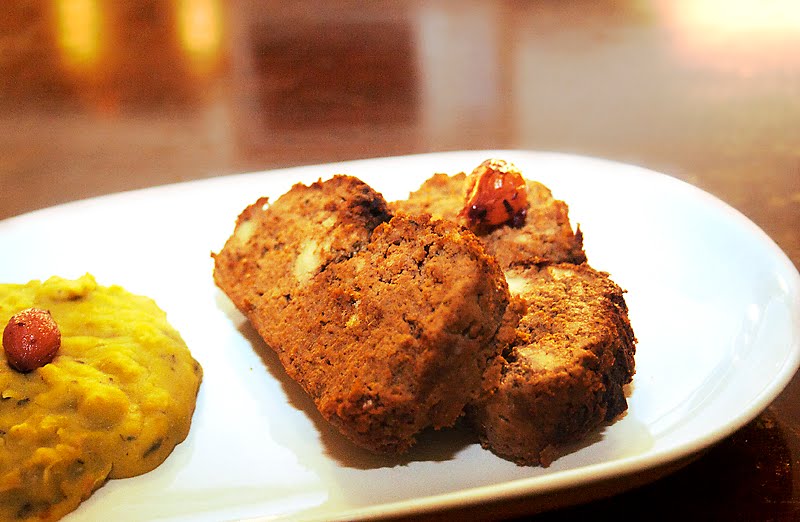
Tofu and Nut Loaf ‒ Tofu-pähkinämureke

Have a happy year 2011! I guess most Finns were shooting fireworks and throwing wild parties last night but to be quite honest, I've never really understood the fuss over a changing number or why Gregorian calendar even places the New Year to the middle of winter in the first place. After all, I already cast my new year tin during Kekri. So yesterday evening we just took a nap after an exhaustive work week, ate a nice meal, drunk some cider and watched a surprisingly boring movie about the French revolution.

Anyway, here's a loaf recipe on the fancier side for such occasions. I've originally taken it from the Finnish animal rights forum and usually prepare it for the Yule table as the poster suggests (among my non-traditional food traditons). It's quite salty, because it's meant to be eaten together with several other standing table dishes (and fits excellently on toasted bread on the next morning). If you'd rather have it as the star of the table, you may want to replace some of the soy sauce with plain water or saltless vegetable stock.

- 75 g hazelnuts
- 90 g almonds
- 165 g cashew nuts
- 540 g firm tofu (I like it best smoked but plain goes just fine)
- 4 toasted white bread slices
- 1 punch of fresh parsley
- 1 small punch of fresh salvia
- 1 dl soy sauce
- 2 tablespoons Dijon mustard
- 1 teaspoon paprika
- basil
- thyme
- black pepper

Add the ingredients into a mixer one by one. Keep mixing until you have a paste. Butter a casserole or and spread evenly into it. Garnish with bread crumbs if you wish and make some wrinkles with your fingers. Bake in 175°C for about an hour or until beautifully brownish.

Nutritional values / 1200 g:
energy 3152 kcal
fat 224 g
protein 177 g
carbohydrates 115 g
fiber 37 g

30.8.10

Pickles ‒ Suolakurkut

Hey who took the summer away? Didn't August used to be the most summery month or is my memory playing tricks on me?

Though I already opened the mushroom season yesterday I thought that before mushroom recipes I ought to post you something I got started two weeks ago: pickles. Finns love them on rye bread, as a sidekick and especially with fast food. There are basically four common variations that can of course be seasoned creatively.

1. Suolakurkku is pickled in salty brine. This is what I prepared after I got to watch some example from a certain lady from Eastern Karelia and realized how simple it really is.
2. Etikkakurkku is preserved in sweet vinegar brine. A common mistake is using way too much vinegar. Think this is the most common variation in the rest of Scandinavia.
3. Maustekurkku or herkkukurkku may contain both salt and vinegar but instead of them the taste should be ruled by spices. These tend to be on the sweet side as well.
4. Hapankurkku aka Russian suolakurkku is also pickled in salty brine but the pickles are turned sour, for example with a sour bread piece or some yogurt as a starter. I've never seen these sold in your average supermarket.

- garden cucumbers (as many as you can cram into your largest glass jar)
- enough water to fill the jar
- 25 g salt for every water litre
- for seasoning black currant leaves, mustard seeds, whole black peppers, garlic cloves, dill flowers and/or horseradish

Wash the cucumbers and let them soak in water overnight. In the morning, arrange the cucumbers into your jar together with the spices ‒ whole or sliced. If you're using black currant leaves wrap them around the cucumbers. Boil up the water and dissolve the salt. Pour the hot water on the cucumbers. Make sure that all the cucumbers are fully covered underneath the water since contact with air makes them rotten. Close the lid and move into a cool place. The pickles should be ready in about two weeks.

If you replace about ten percent of the water with vodka the pickles should better hold on to their beautiful green colour. For less traditional versions ginger and cinnamon also make nice spices. After you've eaten the pickles, the brine itself is an excellent basis for many soups.

20.7.10

Sandwich Cake ‒ Voileipäkakku

Sandwich cakes are a very Scandinavian thing. They're just like normal cakes except salty and usually the dish in formal occasions that disappears the quickest. In Finland they typically contain many layers but especially Swedish-speakers seem to prefer them resembling one large sandwich with a single layer and a pile of toppings.

You can use any soft bread together with bread spreads you like, for example hummus, guacamole or thick mayonnaise. It's not even rare to see several flavour options in the same coffee table if there are a lot of guests (and coffee table culture is a serious business for Finns - something you shouldn't play around with). Here's one model to tweak.

- 1 loaf that fits into a loaf tin (white, dark or slices from both)
- 200 g cherry tomatoes
- 125 g radish
- 1 bunch of fresh parsley
- vegetable broth for moistening (or oat milk)

1. filling:
- 2 dl cooked horse beans
- 2 tablespoons tahini
- 1 bell pepper
- 1 onion
- 1 tablespoon rape oil
- basil

2. filling (and frosting):
- 1 portion of cold cucumber soup, only with the yogurt drained first and the cider replaced with two tablespoons of white wine to make it thicker.

3. filling:
- 100 g soft tofu
- 1 dl hazelnuts
- 1 artichoke (or a young cabbage head)
- 2 tablespoons of mustard

Cut the bread lengthwise in four pieces (and remove the crust if it feels hard). Moisten the pieces by sprinkling vegetable broth on them.

Chop the bell pepper, the onion and the artichoke. Oil them and roast in a 200C oven for about half an hour. Remember to turn them around every now and then. Prepare the fillings by mashing together the ingredients. It's ok to leave clumps.

Slice the radishes and half the cherry tomatoes. Now you're ready to put the whole beauty together. Place the top bread slice into your loaf. Spread with the first filling and add some radish slices. Place the second and the bottom layer in the same manner. Flip the whole thing over onto your serving plate and remove the loaf. Cover with the middle filling. Decorate with cherry tomatoes and parsley.

Nutritional values / 3574 g:
energy 5516 kcal
fat 126 g
protein 219 g
carbohydrates 806 g
fiber 168 g

7.7.10

Grilled Vegetable Sandwich ‒ Grillikasvisleipä

This time of the year summer veggies are at their best and I keep going nuts in a food store. I just have to buy little bit of everything and then I have to hurry to put everything in use before they go bad. Since they tend to get even tastier when grilled, here's one solution.

- 10 cm piece of a zucchini
- 10 cm piece of an eggplant
- 1 tomato
- 0.5 bell pepper
- 0.5 red onion
- 0.5 dl marinated pea pods
- 4 rye bread slices
- 1 tablespoon rape oil
- 2 tablespoon ketchup (or your favourite chili sauce)
- basil
- black pepper

Dice or slice all the veggies but the pea pods. Put them in folio packages with the oil and the spices or spear with skewers and oil and spice. Grill until soft.

Mix the pea pods with the rest so they'll warm up but stay crunchy. Warm up the bread slices, spread with ketchup and portion the veggies between the slices. Notice they disappeared in a matter of minutes and you just got to have more.

Nutritional values / 1 sandwich:
energy 234 kcal
fat 8 g
protein 7 g
carbohydrates 33 g
fiber 9 g

6.7.10

Rhubarb Sandwiches ‒ Raparperileivät

It's too hot to cook or stay inside. But when I come home I need something easy to prepare. This combination is one of the results of me trying to find new ways to utilize rhubarb. It's a surprisingly new species. It didn't become wide-spread before 19th century in Finland and wasn't even considered edible at first. Most Finns still don't like the overwhelming sourness as such but it's perfectly possible to prepare it in ways that don't ruin the characteristic taste and this doesn't always mean sweet dishes.

- 1 small rhubarb stalk or a piece from a bigger one
- 2 rye bread slices
- 2 slices blue-style soy cheese
- 0.5 tablespoons margarine
- 1 teaspoon dark syrup

Cut the rhubarb in pieces. Toast the bread slices and butter them. Arrange the rhubarb on the slices, pour the syrup on them and top with soy cheese. Heat just enough to warm the toppings.

Nutritional values / 132,5 g:
energy 253 kcal
fat 12 g
protein 7 g
carbohydrates 27 g
fiber 6 g

14.5.10

Nettle Pesto ‒ Nokkoslevite

They say young nettles won't sting. "They" couldn't be more wrong. It's starting to be the best time to pick those delicious and nutritious shoots and leaves but don't do it like I do. Wear gloves. Can't believe I forget it each and every year.

Another thing you might want to learn from my mistakes is to check what you're foraging exactly. Once again I fished out some grass, a few brown leaves and two dead larvae (that probably weren't dead to begin with) from my nettle pot. Nettles can be eaten raw as well but you do understand why I prefer to leach them.

- 2 dl young stinging nettle leaves
- 1 dl pine nuts (or sunflower seeds)
- 0.5 dl rape oil
- 2 tablespoons nutritional yeast
- 2 garlic cloves
- fresh coriander (or herb of your choice)
- black pepper

See that all your nettle leaves look healthy and free from insects. Leach them for ten minutes or so. Puré with all the other ingredients. Use as a pasta sauce or spread on your bread.

Nutritional values / 205 g:
energy 852 kcal
fat 87 g
protein 18 g
carbohydrates 13 g
fiber 8 g

25.2.10

Seitan

I was going to write a stew recipe using seitan but then I realized I've never posted any basic directions on making the stuff so I could just easily link to it. Of course, in some countries you can just buy seitan on a reasonable prize, here in Finland it's usually a better idea to use gluten flour. Some extra trouble perhaps, but that way you'll also get to flavour it the way you want to, tweak the structure and shape it creatively.

Seitan flour is the closest thing to pure protein. It contains over 70 % of the stuff (for comparison). When making white bread it's a terrific way to improve the structure. If you just add water into it you'll get a rubbery clump that has almost no taste. To make it chewier you want to add something extra, for example mashed beans, soy flour, pea flour or hemp flour. When making roasts I even use normal wheat flour. And to give it some taste you'll need to add spices. Lots of them.

Here's one basic combination I use. Try playing with your favourite spices. Instead of red wine and maple syrup I often use tar liqueur and a teaspoon of vinegar for a smoky result. And to get a zesty sea-flavour I might apply apple juice plus some seaweed in the broth. But of course, you won't necessarily need any of them.

The seitan:
- 4 dl seitan flour
- 1 dl pea flour
- 0.5 dl red wine
- 0.5 dl nutritional yeast
- 2 garlic cloves
- 1 dried chili
- 2 tablespoon rape oil
- 1 teaspoon maple syrup
- smoked paprika
- salt
- water (approximately 2.5 dl)

The broth:
- 1 dose of stock
- piece of ginger
- dried yarrow
- 0.5 dl soy sauce
- 2 l water

Combine all the dry seitan ingredients. Mix in the wine, the oil and the syrup. Start adding water little by little, kneading all the time. Be careful not to use more water than you necessarily need unless you really do want your seitan soft. Knead for at least five minutes.

Combine the broth ingredients and let it come to a boil. Cut seitan into pieces, flatten with your hands and drop one by one into the boiling broth. Let them simmer for half an hour. Notice that seitan will swell quite a bit so use a big pot.

Some people bother to fish the seitan pieces out of the broth and cover them into an oily marinade. I'm usually so lazy I just leave them stand there overnight. What ever you do, don't throw the tasty broth away. It's a terrific base for a soup.

Next day, fry on a pan with plenty of oil. Or proceed to make something else.

If you can't find gluten flour you can also use normal wheat flour. It takes some work and flavouring can only be done through marinating but the good thing is that it's hard to fail. You'll first have to knead 11 dl flour and 4 dl water for about half an hour to achieve a tight ball. Let it stand in cold water for a moment. Then start flushing the carbohydrates away, changing the water turned white every now and then. (It helps to keep changing between cold and hot water.) This should take about half an hour. When the water just keeps looking clear no matter how much you knead you can proceed to the boiling part.

Nutritional values / 661 g:
energy 1345 kcal
fat 36 g
protein 174 g
carbohydrates 76 g
fiber 12 g

13.1.10

Hemp Pancakes ‒ Hamppuletut

In Finnish, January is called Oak Month (tammikuu). Most Finns won't be able to tell you why since the school system generally teaches very little about our cultural heritage. And still, it's quite an oblivious thing if you know anything about the mythology or traditional holidays. Even our national epic Kalevala tells one version of the story. On the day of Talvennapa ("the navel of winter"), the Great Oak that blocks the Sun is symbolically cut down. Yule time ends, weather starts to warm up again and the days grow visibly longer.

My calendar says this is the so-called official day. But for practical reasons, couple of my friends are coming over next Saturday for the occasion. And of course, I'm already nervous about the food part. We'll see about that.

In the meanwhile, I stumbled across a recipe for hemp pockets. The original directions are very vague so I followed them just as vaguely. They never explained how these are supposed to be pockets so I just made small pancakes. Even though I ended up using more wheat flour than the original called for and adding some water instead of a massive amount of oil they can't be folded into pockets without breaking them. I haven't decided yet whether I like these or not. The taste is nutty, very robust and down-to-earth. But I ate them with a dip sauce I can most certainly recommend for anyone.

The pancakes:
- 1 dl hemp flour
- 2 dl wheat flour
- 0.5 dl rape oil (or to be consistent, hemp oil)
- 1 dl water

Mix the ingredients. Mold into small balls and then into thin discs between your fingers. Fry on a dry pan from both sides.

The dip:
- 1 dl soft tofu (or if you're a fan of hemp seeds, 1 dl of them roasted and crushed)
- 100 g pickled bell pepper (or 1 roasted)
- 3 tablespoon nutritional yeast
- 2 cloves of garlic
- 2 sun dried tomato pieces

Blend all the ingredients into a smooth sauce.

Nutritional values / 350 g and 227 g:
energy 1066 kcal and 238 g
fat 54 g and 10 g
protein 41 g and 24 g
carbohydrates 103 g and 13 g
fiber 12 g and 6 g

7.1.10

Onion Soup ‒ Sipulikeitto

Hot soups are exactly what I need when it's freezing outside. Onion soup is cheap, light and simple to make yet extremely savory.

This alone will hardly fill your stomach so I did what the French do: oven sandwiches. For some reason they also like to set the bread floating in the soup (well, actually they put the whole soup in the oven) but have to say I personally prefer them separated. On the next day you can use this soup as the basis for a bit more filling meal by adding potatoes, veggies and tofu.

The soup:
- 8 onions (it looks nice if you mix yellow and red ones)
- 1 l water
- 2 dl apple wine
- 1 large dose of stock
- 2 tablespoons rape oil for frying
- whole black peppers
- salt
- sugar
- thyme
- yarrow flowers

The bread:
- 6 toasted bread slices
- 2 dl soy yogurt
- 100 g melting soy cheese
- 0.5 dl nutritional yeast
- 2 tablespoons mustard powder
- 3 garlic cloves

Slice the onions and caramelize them by frying in a low heat for an extended period (half an hour should do). Add the wine at the end of the caramelization to deglaze the pan. Be careful not to burn the onions cause that makes the soup bitter. When the onions have turned sweet, add the rest of the soup ingredients. Let the soup simmer for half an hour under a lid.

Grind the soy cheese, mince the garlic and mix them with the yogurt, the yeast and the mustard. Spread the mixture on the bread slices and place in a 200°C oven until they look crunchy and golden (about ten minutes).

Nutritional values / 2190 g soup and 1 bread:
energy 633 kcal and 235 kcal
fat 27 g and 8 g
protein 12 g and 8 g
carbohydrates 46 g and 15 g
fiber 16 g and 2 g

22.11.09

Warmer Röstis ‒ Lämmitysröstit


This time of the year I tend to long for all kinds of things that warm my bones. Therefore this challenge for hot recipes circulating in Finnish food blogs seemed to come straight from heaven. I've never taken part of these before but as you may have noticed already, I use chili in everything but strawberry cake (well there's an idea), even though my own babies never seem to grow old enough to bare fruit. And so I thought I'd post a dish where chili is truly essential part and not just my personal soft spot.

Röstis are fried root vegetable patties most often made of potato. For some reason I've most found of the beet version, perhaps cause the colour won't reveal whether I've managed to grate some of my fingers in them as well. (You wouldn't believe if I told you how good I am in that. At the moment I've got a plaster in my right index finger and two smaller cuts in my left hand.)

A must spice with any beet dish is chili. The amount of course depends on your choose of species and how used you are to capsaicin. The ideal dosage should give that heavenly endorphin stimuli but not block all the taste which is what happens if there's more chili than your tongue buds can handle. In my household a good balance means about 4-5 small rawits or 1 habanero.

- 1 kg beetroot
- 3 dl soy crumbles (TSP)
- 3 dl rye flour
- 1 onion
- chili peppers
- 1 tablespoon dark syrup
- 1 teaspoon salt
- white pepper
- dragon's wort
- rape oil for frying (about 0.5 dl)

Peel and grate the beets. Chop and sauté the onion. Mix all the ingredients except the oil together. Pat the mush into thin discs.

Fry the röstis from both sides on a hot pan to get both a crispy surface and a soft inside. Beet turns dark when fried but don't mistake that as scorched. If you're hosting a dinner party or posting to your food blog, cut the röstis into heart shapes. Otherwise, enjoy as such.

Warmer Röstis are best accompanied by a sour sauce that softens the burning sensation a bit and emphasizes the sweetness. The next day they're terrific on a rye bread.

Nutritional values / 1659 g:
energy 1833 kcal
fat 66 g
protein 68 g
carbohydrates 238 g
fiber 71 g

29.5.09

Sausages ‒ Makkarat

According to a common saying the most popular vegetable in Finland is sausage. Well, our little household certainly proves the point as we always have soy sausages in the fridge. I never thought about making them myself before I found VeganDad's recipes. And you know what? It turned out to be quite easy. The only real problem with them is that they're too good and I end up eating them all on their own without any veggies or other sidekicks ‒ not such a great idea to fill your stomach with protein only. Ouch.

- 1.5 dl fava beans (or peas)
- 3 dl seitan flour
- 270 g extra firm tofu (or hefu)
- 1 dl tar liqueur
- 0.5 dl nutritional yeast
- 1 dose of stock
- 0.5 dl mustard
- 5 red and green chili peppers
- onion powder
- caraway
- salt
- folio
(- rape oil)

Mash the beans. Chop the chili. Crumble the tofu. Mix everything together with your hand. Divide in six pieces and shape into phallic symbols. Wrap them tightly into folio and steam for 45 minutes.

Nutritional values / 1 sausage / 158 g (without the oil and once again, liqueur):
energy 291 kcal
fat 6 g
protein 34 g
carbohydrates 18 g
fiber 6 g

5.5.09

Nut Pate ‒ Pähkinäpatee

This recipe is mostly "brie" from The Ultimate Uncheese Cookbook (Jo Stepaniak, Book Publishing Company 2003). It hasn't got a thing to do with brie (Still don't understand why nearly every new vegan dish has to be named after a non-vegan one even when there's no resemblance.) but it's still a tasty fresh cheese, especially great on crackers or other toppings or as a starters of a fancy dinner together with some vegetable pâté. (Or are they terrines or timbals? I don't really understand the French terms.) In the oven it gets a nice crunchy surface.

- 3.5 dl water
- 3 tbsp agar
- 1.5 dl nuts (I've only tried this with cashews so far but can't imagine why it wouldn't work with Finnish hazels as well.)
- 100 g firm tofu
- 0.5 dl nutritional yeast flakes
- 0.5 dl lemon juice
- 2 tbsp hemp butter (or tahini)
- 1.5 tsp onion powder
- 1 tsp salt
- 0.5 tsp garlic powder
- 0.5 ground dill seed or coriander
- 2 tbsp wheat gem (or toasted sliced almonds)
- rape oil

Oil a round cake tin and dust it with the wheat gem. Mix the agar with the water in a saucepan and boil for five minutes. Combine this with the remaining ingredients and blend until completely smooth. Pour the result in the cake tin. Stick it in the freezer overnight.

Nutritional values / 655 g:
energy 974 kcal
fat 76 g
protein 46 g
carbohydrates 32 g
fiber 12 g

4.5.09

Mustard Eggplant ‒ Sinappikoiso

A little while ago I found a recipe for vegan mustard herring from this Swedish page. I used to love the marinad herring is usually sold in so I thought I have to try this thing out. Well, this didn't go even near that one but it's still really good on rye bread, with mashed potatoes or used in cooking. So here's my English version of it:

- 1 eggplant
- 1 tbsp mustard powder (or non-sweet mustard)
- 2 tbsp sugar
- 1/2 tbsp apple wine vinegar
- 3 tbsp rape oil
- 1 dl oat cream
- salt
- (1 red onion)
- (1/2 pickle)

Slice the eggplant into strips. Boil the strips in salty water until they soften up just a bit (for about five minutes). Spread them on a towel for a moment. Meanwhile, combine the sauce ingredients (mustard, sugar, vinegar, oil and cream). If you're making this for the dinner table (that is, not for cooking) chop the onion and the pickle into small cubes. Mix everything together.

Nutritional values / 600 g:
energy 719 kcal
fat 57 g
protein 9 g
carbohydrates 42 g
fiber 11 g

3.4.09

Carrot Spread ‒ Porkkanalevite

Another tweaked spread idea from Monipuolinen kasvisravinto (Kaarina Virtanen, WSOY 2006). Although this sounds suspiciously healthy it got a lot of praise.

- 500 g carrots
- 100 g margarine
- fresh leek
- fresh thyme

Cook and mash the carrots. (I cooked them in the stock pot to add a little flavour.) Whip the margarine until it foams. Chop the others. Combine all.

Nutritional values / 650 g:
energy 695 kcal
fat 61 g
protein 4 g
carbohydrates 28 g
fiber 14 g

2.4.09

Horse's Cutlets ‒ Härän pihvit

Wee, I found some dried organic horse beans. They used to be a common ingredient in Finnish food before Christian invaders brought peas here. Ketunleipä had this patty idea which is apparently originally from a book called Veganomicon. That sounded like an ideal way to use the beans and make cutlets without lots of the costy gluten flour. (Moreover, these don't look quite as much like fried pieces of someone's bottom, which was a bit of a problem the first time I tried seitan.)

The stucture turned out nicely chewy but the taste was a little stale. Either I haven't familiarized myself into the flavour of horse beans yet or there was something wrong with my standard spicing. Maybe I should settle for just some apple cider, cranberries and herbs next time?

- 3 dl cooked horse beans (fava beans)
- 2 tbsp rape oil
- 2 dl gluten flour
- 1 dl breadcrumbs
- 0.5 dl water
- 0.5 dl smooth tomato sauce
- 1 tbsp hemp butter
- 1 tbsp apple vinegar
- 1 tbsp soy sauce
- 1 tbsp nutritional yeast
- 1 chili
- 2 garlic cloves
- oil for frying

Mash the beans and the oil into a paste. Throw in the rest of the ingredients. Shape into cutlets and fry. (I got 8 rather large ones from this portion.)

Enjoy with mashed potatoes. Or place between two toasts with onion, mustard and ketchup and voilá ‒ you've got yourself a hamburger.

In case I'll find the right way to spice these I just might make some for the freezer. They seem like something to take for a picnic or a grill evening.

Nutritional values / 1 cutlet / 73 g:
energy 150 kcal
fat 5 g
protein 13 g
carbohydrates 14 g
fiber 2 g

18.3.09

Mustard ‒ Sinappi

Some people will tell you to first read your recipes several times and then follow them rigorously. For me, this sounds very boring and lacking of personality. On the other hand, if you're making some dish for the very first time, it's easy to do a thing or two wrong and thus ruin the whole dish. I've solved the dilemma by always trying to find several recipes for the same thing. This way I can compare them, understand what are the essential parts and create food that best serves my own taste.

For example, yesterday I made my virgin flight for mustard, all Finn's favourite sauce. Borrowing from several sources I came up with a sweet mustard that mostly resembles the flavour of this company's mustards.

- 1,5 dl mustard powder (freshly grinded from seeds if you manage to find them)
- 1,5 dl brown sugar (which can be substituted with dark syrup)
- 2 dl oat cream (half of which can be substituted with coffee)
- 1 empty shampoo bottle

Those were the essentials. The following ingredients are only meant to add to the flavour and structure. Commercial mustards may also use chili or garlic.

- 1 tbsp potato flour
- 1/2 dl rape oil
- 1/2 dl vinegar (Some recipes only use as little as 1 tablespoon.)
- 1 tbsp brandy (Wonder if tar liqueur would do the trick?)

Mix the dry ingredients in a pot and combine with the liquids. Let the gunk come to a boil so it thickens up a bit, stirring the whole time. Take off from the stove. The mustard should thicken more as it cools down. A well-washed shampoo bottle makes an appropriate container.

Use on a soy sausage, with pea soup or in hamburger. Mustard also gives a nice flavour to sauces but that can be done with the powder.

Nutritional values / 500 g (without the brandy)
energy 1624 kcal
fat 91 g
protein 30 g
carbohydrates 170 g
fiber 3 g

12.3.09

Hemp butter ‒ Hamppuvoi

Nowadays it is possible to find domestic hemp seeds from a grocery store. The world's probably most multifunctional and one of Finland's oldest cultivated plants is slowly starting to gain back the wide-used position it had a hundred years ago. Which is great, since it has the potential to solve all mankind's energy and hunger problems plus be used to make better paper, fabric and medicine. Maybe the drug police isn't allowed do anything they come up with after all.

Happy for this discovery I thought I'd try out some of the different dishes you can prepare of hamppu or liina. There are some basic recipes in the pages of the local vegan organisation. Following their instructions I managed to make hemp butter or hempini (named after tahini, a sesame seed paste). Here's what I did:

2 dl hemp seeds
3/4 dl rape oil
4 garlic cloves
1,5 tbsp basil
1/2 tsp salt
1 dl water (more or less, depending on the structure you want)

Roast the seeds on a dry frying pan enough for them to start smell and get some colour. Blend them smooth with the rest of the ingridients. Be sure not to leave those crunchy seed bits there.

The basil part made me suspicious since so far I've only found it useful with tomato soup, (And I'm not saying an Italian cook couldn't make excellent things with it.) but for once I did what I was told. And they were right, it doesn't taste too much, perhaps cause I also used a lot of garlic. (Still, next time I think I'll try a bit more Finnish type of spices.) Mine is rather strong and meant to be used for cooking in the same way as for example Italian pesto sauce is. This is mostly cause I roasted the seeds rather well. If you want to use this on the bread, roast them only lightly and use spices in a more conservative manner.

Nutritional values / 420 g (This varies quite a bit from one hemp breed to another. The one I used is particulary oily and therefore relatively lower than most in protein.)
energy 1814 kcal
fat 150 g
protein 58 g
carbohydrates 80 g
fiber 59 g
Osta neljä tuotetta ja maksat vain kolmesta - Luomutallin kampanjatuotteet näet täältä


Teekauppa.fi - laadukasta teetä netistä
Ostoskorin loppusummasta vähennetään viisi euroa ja toimitus tapahtuu ilman postikuluja.
Syötä ostoskoriin kuponkikoodi:

syysteet

Tilauksen on oltava vähintään 35 eur, mistä jää maksettavaksi 30 eur.
Related Posts Plugin for WordPress, Blogger...