Showing posts with label sidekicks. Show all posts

17.12.13

Beet Temptation ‒ Punajuurikiusaus

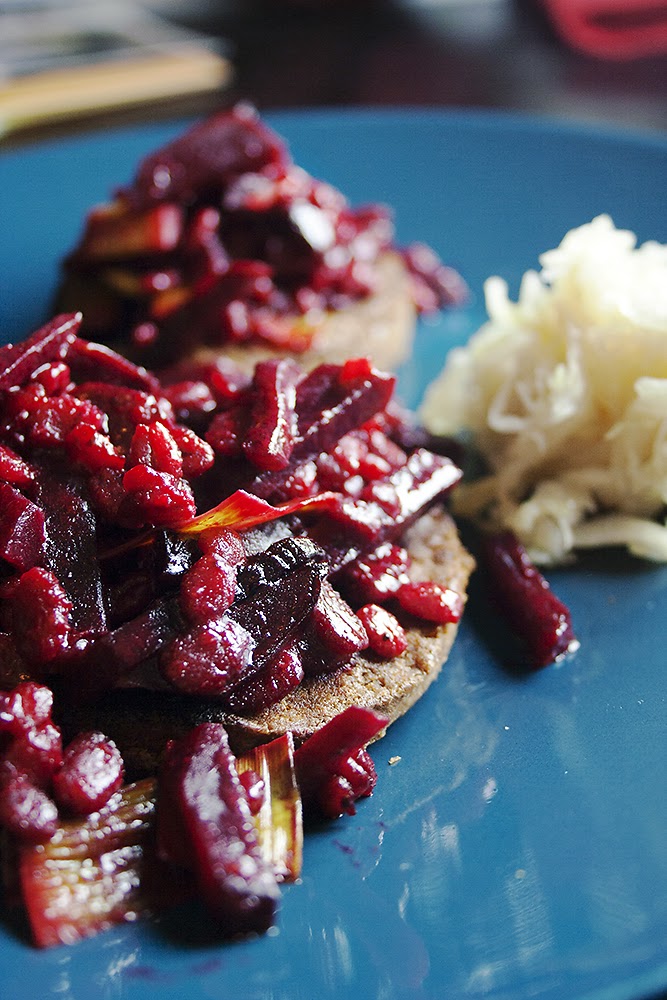
I've talked before about the wonderful casserole type of dish called temptations.They usually involve potatoes cut into strips but it being December and all, this time I wanted to use beets. Their colour is so wonderfully dark and Christmassy, though this is still quite an everyday dish.

This makes a creamy and fruity accompaniment for a more humble main course.

- 1 kg beetroot
- 4 dl oat cream
- 1 leek
- 1 dl barley
- 1 chili (I personally think habanero gives a nice fruity aroma. But if hotness isn't your thing, try a winter apple instead.)
- thyme
- green pepper
- bread crumbs and margarine to top with

Peel and julienne the beets. Cut the leek and chili too. Mix all the ingredients in a casserole. Bake for half an hour in a 175°C oven.

Mix things a bit with a spoon. Sprinkle bread crumbs on the casserole. Top with a few margarine pieces. Bake for another half an hour.

Nutritional values / 1765 g:
energy 1297 kcal
fat 54 g
protein 30 g
carbohydrates 169 g
fiber 45 g

18.9.13

Stuffed Black Currant Leaves ‒ Viinimarjanlehtikääryleet

I'm a bit of a fan of making "Finnishized" versions of dishes normally attributed to whole different nations. You take the basic idea of the dish but swap the main ingredients into some local ones. Often the result is closer to the original idea than the hardcore versions that count on finding preserved but hard-to-acquire ingredients in the place of fresh ones.

Last summer I got a packet of grape leaves so we made a large pot of dolmades, a Greek dish where rice is wrapped inside the leaves. They were great though I still don't know what grape leaves really taste like since those were heavily preserved in tartaric acid.

This year I thought I'd localize the recipe. Black currant leaves are very aromatic and currants in general are called "wine berries" or viinimarja in Finnish so I thought they'd work great in this type of a dish. Seems I'm not exactly the first person who's used them this way so I took some model from this recipe which also uses rice as the stuffing. Whenever a recipe calls for rice I usually apply oat but it tastes a bit mild. So this time I thought I'd try processed spelt for a slightly nuttier flavour. Most recipes seem to call for a really long list of spices which to me sounds like they're not sure to what direction they want to take it, so I went with a fairly simple list instead.

- 40 large black currant leaves
- 2 dl pearl spelt
- 0.5 dl pine nuts
- 1 small punch of fresh mint
- 3 garlic cloves
- 2 tbsp rape oil
- cinnamon
- clove
- salt

For the broth
- 1 dl rape oil
- 0.5 dl lemon juice
- 1 dose of stock
- 2 tsp brown sugar
- salt

Cook the spelt in salty water for about 20 minutes. Roast the nuts on a dry pan a bit so they'll get colour on their cheeks. Mince the garlic and the mint. Mix the stuffing ingredients together.

Cook the currant leaves in plenty of water for about five minutes to soften them up. Take two leaves at a time. Cut their stems off and place them on each other so they'll overlap in the middle. Scoop a teaspoonful of the stuffing in the middle. Fold the edges of the leaves on the stuffing and roll them into small cigars. Place each cigar carefully but tightly into a casserole.

Mix the broth ingredients and pour over the casserole. (Add some water too if the amount of liquid doesn't seem enough.) Place in a 150°C oven for about an hour. You can eat them right away, but if you have the patience you can wait a day or two for them to juice up in the fridge. This is also the reason why it's a great idea to make a big portion of them while you're at it.

Nutritional values / 628 g:
energy 2371 kcal
fat 192 g
protein 43 g
carbohydrates 149 g
fiber 30 g

12.9.13

Cloudy Brussels Sprouts ‒ Lakatut ruusukaalit

It's usually the protein on the plate that gets the most attention, while the sidekick is some quickly tossed salad or potatoes. Thought I'd turn this upside down for a change and learn to use my imagination on sidekicks as well. So I took some store-bought tofu steaks, smeared them with smoky chili sauce and fried on the pan. Then I turned my attention towards the sidekick, which today was all about those small but sweet cabbages that so many people seem to mistake as bitter and bland after they've met badly cooked individuals one or two times too many.

Brussels sprouts are often combined with smoky flavours and nuts but orange and sweet things also seem like common pairings. I thought I'd replace orange with something more appropriate for autumn, and so cloudberries happened to match the colour. These came out really quickly but seem fancier than you'd expect for a regular Thursday meal.

- 400 g Brussels sprouts
- 0.5 dl cloudberry jam
- 50 g margarine
- 2 tsp apple wine vinegar
- mint

Set the sprouts to steam for about ten minutes. In the meanwhile, whisk all the other ingredients together. If your sprouts are really big you can half them after they've softened up. Otherwise, just mix them with the sauce. Spoon on your plate. Try not to lick your plate like I did.

Nutritional values / 518 g:
energy 505 kcal
fat 37 g
protein 6 g
carbohydrates 34 g
fiber 17 g

10.9.13

Warm Harvest Salad ‒ Lämmin sadonkorjuusalaatti


I'm really happy about the fact I've learned to cook many different types of salads. Couple of years ago, basically all my salads contained the same ingredients. And nothing wrong with them still. But variance is the salt in life. This time I took model from this salad, but since the result doesn't really resemble it at all, I thought I'd better change the name too. This one went just for a sidekick, but if you'd like to turn it into a your evening's main course, try frying some smoked tofu cubes or toss horse beans in the oven as well.


- 5 apples
- 5 potatoes
- 1 red onion
- 2 dl gooseberries
- 1 dl pecans
- 1 punch of salad leaves
- 3 tbsp rape oil
- salt

For the sauce:
- 2 tbsp apple wine vinegar
- 1 tbsp mustard
- 1 tbsp spruce syrup
- 2 garlic cloves
- black pepper

Cut the potatoes and the onion in discs. Apply oil and salt. Stick them into a 225°C oven for 15 minutes so they'll soften up.

Cut the apples and the salad a bit smaller. Crush the nuts. Add the gooseberries into the same bowl as well. mix the salad sauce ready.

When the potatoes come out of the oven, toss them and the sauce over the rest. Jump right in.

Nutritional values / 1183 g:
energy 1371 kcal
fat 86 g
protein 17 g
carbohydrates 240 g
fiber 23 g

3.9.13

Stuffed Parasol Mushrooms ‒ Täytetyt ukonsienet


I've noticed that when seeing a new mushroom, if I instantly recognize what it is, I'm usually right. If I need to ponder, it's better to leave it in the forest. My first two parasol mushrooms clearly fell into the first category.

I haven't been that excited for a while. Parasol mushrooms look majestic. Their Finnish name ukonsieni, Ukko's mushroom, places them in the direct protection of the Finnish thunder god himself. They're huge in size, and the biggest ones can have a cap up to 30 cm in diameter. Their patterns are among the most beautiful ones with a weirdly snake-like features.

I rushed to sit by them. With trembling hands I dug my mushroom guide from my bag to check they match the description before proceeding to actually pick them. At home I drew some spontaneous awes when showing the twins off. And my spouse double checked I'm not mistaking them for royal fly agarics (ruskokärpässieni).

Parasols are thought as one of the finest tasting mushrooms there are. They have this nutty, slightly sweet aroma that often gets to be described as resembling almond. Many people use the caps as steaks in the same way as with sheep polypore. I copied my favourite mushroom recipe writer, Kirsti Eskelinen in her book Sienestäjän suosikit (Gummerus 2012) by turning the caps into cups. The stuffing here is my own adaptation though, so don't blame her in case something goes wrong. Either way, the woodier stalks go well in a soup base or can be dried, ground and used as a spice.

- 2 parasol mushroom caps (or other large enough mushroom caps)
- 2 slices of a big zucchini (or 2 big beet leaves)
- 1 small turnip
- 1 small onion
- 1 dl oat cream
- 2 tbsp rape oil
- 2 tbsp bread crumbs
- lemon pepper
- salt

Mince the onion. Peel and chop the turnip. Sauté both on a pan. Spice with lemon pepper and salt.

Roll the zucchini slices or beat leaves around the mushroom caps so they'll form a bowl. If you have trouble keeping them together, secure with a toothpick.

Scoop the onion and turnip inside the caps. Pour cream on them generously. Stick with a spoon a little to make sure the cream is evenly distributed. Finnish with breadcrumbs.

Set in a 200°C oven for 15-20 minutes. Serve as an appetizer or evening snack.

Nutritional values / mushroom / 320 g :
energy 277 kcal
fat 20 g
protein 5 g
carbohydrates 19 g
fiber 5 g

12.7.13

Cauliflower Purée ‒ Kukkakaalipyre


Yesterday I mentioned cauliflower purée. It's really just a variant of the mashed cabbage I posted earlier but thought I'd make a separate posting of it since this can give you an idea of how to turn tune a bit for a finer dinner. And when I say a variant I say it because cauliflower is a type of cabbage, in Finnish it's even called "flower cabbage". Guess you might try something similar with broccoli or kohlrabi too, but I'd save Brussels sprouts and romanesco broccoli for something where they marvelous outlooks don't get lost.

- 1 cauliflower
- 2 dl oat cream
- 1 dl white wine
- white pepper
- salt

Pour the cream and the wine in a cooking pot. Chop the cauliflower and add in. Let it simmer for as long as the cauliflower has softened up. Blend the cauliflower. (In the photo I've left it quite chunky but you can make it really smooth as well and even add a dollop of water if it seems too stiff for your purpose.) Serve right away.

Nutritional values / 900  g:
energy 441 kcal
fat 22 g
protein 12 g
carbohydrates 24 g
fiber 16 g

30.6.13

Sauna Bundles ‒ Saunanyytit


Having a sauna is such an integral part of Finnish culture in general and such a self-evident part of any informal gathering of people I don't normally even think about it.Within the past week I've bathed twice in a sauna. On Friday with my spouse we had our weekly turn in the housing cooperative's communal electric sauna. A week ago we ended up to a friend's wood stove sauna together with all the other guests that came to the party. During the midsummer weekend we also thought about trying out a public tent sauna but unfortunately the keepers had already rolled it up by the time we got to the happening.

It's not anymore the place where every Finn is born and dies, but you still can't fully understand Finnish culture separate from it. Sauna is a sacred place that I hounour for making everyone equal and stripped from titles at least for that small moment, as well as keeping away that shame and over-sexualization of our own and others' bodies.

So you understand I was a bit shocked when I read about an Internet questionnaire by Finland's largest newspaper Helsingin Sanomat, the result of which was that 38% of all answerers have never been to a normal mixed sauna in their life and only 57% sees them natural. Guess this explains why all public saunas either split the groups of friends in half according to their sex organs or make you wear a swimsuit, which kind of ruins the idea of cleansing oneself. The top example of this is the longest worked public sauna Rajaportti, where the original design was altered by building a sex segregation wall through the whole building when mixed saunas were banned in 1931. Up today, I don't know a single public sauna I could go together with my friends in the manner we do in home circumstances. But somehow, there's something very Finnish in that when one half of people likes something and the other half doesn't, everyone has to work on the terms set by the dissaprovers.

To get to the actual point, meaning food, I've never really got used to the idea of it being appropriate to eat in a sauna, rather afterwards. But since the sauna stove is hot anyway, you can also use it for cooking. Here's a simple vegetable snack you can cook in a tin foil. You can of course use pretty much anything you wish or happen to have in bundles like these. Sweet potato and champignons as well as rutabaga and smoked tofu pair nicely for example. The thing in these is that the moist veggies and their condiments together form a lot of sauce which was described as "Chinese take-out" to me, so you can easily plan a whole meal around them.

- 1 zucchini
- 1 eggplant
- 1 bell pepper
- 1 onion
- 1 garlic (yes, a whole garlic)
- 1 chili
- 2 tbsp rape oil
- 2 tbsp soy sauce
- 1 tbsp vinegar
- 200 g melting soy cheese

Chop the veggies and mix with the oil, the soy sauce and the vinegar. Divide evenly on foil sheets. Sprinkle with soy cheese.

Leave on a sauna stove (or grill or 200°C oven) until everything has softened up (this should take about half an hour). Enjoy together with your after sauna beer!

Nutritional values / 1393 g:
energy 1278 kcal
fat 90 g
protein 42 g
carbohydrates 70 g
fiber 24 g

21.6.13

Yogurt Garnish for New Potatoes ‒ Jugurttilisuke uusille perunoille


One of the biggest holidays in Finland, the midsummer or Juhannus, is on the door. As this is the celebration of the Finnish thunder god Ukko, the tradition is to tent or sleep in a cabin by a lake, with lots of friends, do love magic and eat (and especially drink) well. For the first time in years I'm going to spend it in city.  Today we're probably going to see the bonfire in Pispala, a city district known from one of the biggest hippie and artist concentrations in all Europe. On Sunday there's a grill party at a friend's garden, so that still leaves the "official" day open for negotiations. One of the plus sides of a city midsummer is of course being able to use your own kitchen, so I think we're going to take the eating part especially seriously this year.

Usually I belong to the school that thinks new potatoes should have very simple sauces or sidekicks. I usually just eat them with plain margarine or white sauce. When cooking the first batch of the year I add a carton of oat cream, salt and some spring onions to their boiling water ‒ only a step away from summer soup.

This time I wanted to make a use for the fake shrimps I once bought from an Asia store and had been sitting in the freezer for months. I've never quite grasped the urge of Asians to make vegetarian dishes that replicate the look of different meats as perfectly as possible, but oh well, if it tastes good that's all that matters. I've never cooked shrimps in my life but the look kind of lead me to design a dish that uses the same methods I at least imagine would fit with them. I don't know about the (apparently authentic) texture of the "shrimps" themselves, which turned out to be ridiculously low in protein too, but the sauce turned out delicious. It complemented well the sweet taste of new potatoes, but might also be used as a filling for oven potatoes or as a pasta sauce.

- mock shrimps (or simply precooked soy strips)
- 5 dl soy yogurt
- 1 dl white wine (or apple wine)
- 1 rhubarb stalk (or a lemon)
- 1 small punch of fresh dill
- 1 piece of leek
- 2 tbsp margarine
- salt
- white pepper

Chop the leek and the rhubarb. Melt the margarine on a frying pan. Add the "shrimps", the rhubarb and the leek. Turn them around so the "shrimps" get some colour and the rhubarb mashes. Pour the wine on them, stir and let the whole thing simmer for as long as the liquid has reduced.

Mix the shrimp pan with the yogurt. Sprinkle with salt and pepper. Stir. Mince the dill on top. Serve with potatoes or pasta.

Nutritional values / 1145 g:
energy 1780 kcal
fat 40 g
protein 26 g
carbohydrates 67 g
fiber 8 g

14.6.13

Rhubarb Chutney with Chili ‒ Chilinen raparperihilloke


Before 18th century Finns usually acquired sourness to food by using levain. Then vinegar was introduced and eventually it became really popular. In restaurants and higher class families it used to be a basic table condiment along with salt and pepper. But in Finland vinegar usually meant white vinegar made from barley spirits whereas in Southern Europe vinegar used in food is nearly always made from different wines.

I have a small collection of different vinegars in the kitchen closet, but my most trustworthy bottle lives in the bathroom. I tend to use apple wine vinegar in everything from cooking to cleaning to hair and fabric conditioner. It's a different thing than apple cider vinegar which the English speaking world seems to be most attracted to and which I don't believe I've ever even seen. From what I can gather, apparently their acidity is about the same but apple wine vinegar has a mellower and perhaps fruitier taste from the two.

This recipe however uses the classic white vinegar which has as high as 10% amount of ethanolic acid but is otherwise rather odorless and colourless. In case you want to replace it with some other type, you probably need a bit more and you'll also get yet another taste in the mix. The rhubarb itself is also sour of course, so I used sugar to round the taste a bit. It became a wonderful condiment for the first barbecue of this summer, together with cherry tomato, tempeh and zucchini skewers as well as this year's last asparagus rolled in seitan.

- 800 g rhubarb stalks
- 1 onion
- 1 bell pepper
- 3 chili peppers (I used aji benitos)
- 2 garlic cloves
- 2 dl farine sugar (or muscovada)
- 0.5 dl white vinegar
- 1 tsp salt
- cinnamon
- cardamom

Chop the veggies. Put everything in the same pot. Cook about half an hour and stir every now and then. Let the chutney cool down. Pour it in clean glass jars. Let it rest for couple of days.

Serve as a condiment with any dish. Works especially well on any grilled or deep fried dishes.

Nutritional values / 1422 g:
energy 1069 kcal
fat 1 g
protein 12 g
carbohydrates 239 g
fiber 18 g

11.5.13

Garlic Sautéd Fireweed Shoots ‒ Valkosipulissa kuullotetut horsmanversot


We're finally getting to enjoy the first wild veggies. On Thursday we picked some fireweed and nettle from a nearby forest. Fireweed is at its best when the young shoots haven't grown leaves yet and get often compared to asparagus. (It seems like most of the veggies with an edible stalk get compared to asparagus but it's useful in that looking at asparagus recipes gives you good ideas about how to cook fireweed shoots too.) The smallest ones are great  for salads since they still have the sweetness the plant has been hiding in its roots all winter. A bit longer ones, less than 20 cm long, taste mild but delicious and fit in pretty much any cooked dish. The thing why you're not likely to see them sold in stores is that they tend to droop very quickly and lose their wonderful snappiness after you cut them and should be eaten on the same day.

Lightly roasting with oil and salt is usually what I find the best way to enjoy a veggie's aromas. And that felt like the best way to cook these delicacies since this was the first tasting of them this year. They're a nice warm sidekick to any meal but we (after the initial gnawing) had them with pasta and basic soy crumble sauce.

- 1 handful of fireweed shoots
- 3 garlic cloves
- 1 tbsp rape oil (or other vegetable oil that doesn't have a strong taste)
- salt

See the fireweeds look alright. Rinse or cut the stalks a little if it seems they need it. Mince the garlic. Heat up the oil on a pan and toss in the garlic. Lay the fireweeds on them. Turn around until they look done but haven't completely lost their green colour. Sprinkle with salt. Enjoy on the spot.

Nutritional values / 74 g:
energy 152 kcal
fat 14 g
protein 16 g
carbohydrates 5 g
fiber 3 g

6.4.13

Mashed Cabbage ‒ Kaalimuusi

Reading my father's autopsy report I learned that in the time of the death his arteries were already so clogged his life expectancy wasn't terribly long anyway. Knowing how good old daddy ate and how much he loved butter that didn't really surprise me much. But considering coronary disease is still the most common death reason in Finland (accounting to a whole quarter of all the deaths) and especially wide-spread among men, the low-carb craze occuring here for the last couple of years has seemed a bit worrying. Or to be more precise, at least the way most people seem to carry the it out in practise.

All this of course, should be no reason to disapprove every principle that comes from low-carb communities, say cutting down on so called fast carbohydrates or favouring home cooking from fresh ingredients. Nor a reason not to read their forums in search of good ideas. One of the brightest ones I've encountered is mashing cabbage just like potatoes. A extremely simple idea, helps to include more veggies in your meal during the cold season and most importantly, delicious as hell. During the past couple of weeks this is the third time already we've prepared this. Bear in mind that this isn't as filling as mashed potatoes, so remember it's going to vanish from the table much quicker.

- 1 small cabbage
- 50 g margarine
- green pepper
- nutmeg
- salt

Chop the cabbage and cook it until soft. Pour the water away (and save for tomorrow's soup). Add the rest of the ingredients. Mash until smooth.

Nutritional values /  850 g:
energy 507 kcal
fat 37 g
protein 10 g
carbohydrates 33 g
fiber 17 g 

2.4.13

Cabbage and Horse Bean Soup ‒ Kaali-härkäpapukeitto


Recently we moved into a bit bigger appartement. The migration itself felt like a complete chaos and we had to sleep the first night on friends' couch since we simply couln't fit in with all the junk, but there were some positive things in the day too. For one, the soup a friend of my flatmate's prepared for all our wonderful helpers. That version contained several types of beans and chili sauce, but I thought I'd stick more with the version she wrote down here. The twist is in combining two separetely prepared food items, which of course, you can use individually too. I couldn't find kale so I just replaced it with more red cabbage and nettle.

Cabbage Soup
- 1/4 red cabbage
- 1 1/2 onions
- 0.5 dl kale
- 2 tbsp thyme
- 2 tsp dill
- salt
- black pepper
- olive oil
- 1 tl dry nettle
- 3 l  water

Marinated horse beans
- 3 dl dry horse beans
- cayenne
- tomato paste (3 tbsp)
- olive oil (2 tbsp)
- salt
- (apple) wine vinegar
- (smoked) paprika
- black pepper
- dry basil
(sugar or in my case, a tablespoon of dark syrup)

Let the beans soke in water overnight. Rinse and cook until soft. (Remember to peel off the foam.) Rinse again. Mix the marinade ingredients with the beans. Try to make strong enough to actually give taste to the beans. Leave in the fridge for the next day.

Chop most of the onion as well as the kale and cabbage, leaving bot big and small parts. Sauté separetaly. Let the water come to a boil. Add thyme, dill, nettle, salt and pepper. Let it all simme for 10‒20 minutes. Combine the soup ingredients except kale and simmer for another 30‒60 minutes. Check the taste and add the kale about 5 minutes before the soup is ready.

Serve the soup with marinated beans and uncooked onion circles.

Nutritional values / 3852 g
energy 1217 kcal
fat 44 g
protein 66 g
carbohydrates 129 g
fiber 65 g

23.3.13

Roasted Root Vegetables with Herbs ‒ Yrttijuurekset


Root vegetables are perfect seasonal food. They're cheap, healthy, filling and easy to prepare. During the deepest winter I might've used chili and liquid smoke, but now that daytime is already as long as darkness I'm starting to prefer fresh tastes again and therefore spiced these up with dried herbs. The fresh ones are growing with speed too. Can't wait to be able to snip them while cooking.

- 500 g beetroot (I used a striped variety)
- 500 g rutabaga
- 500 g sunroot
- 1 parsnip
- 1 whole garlic (rest assured, the taste softens in the oven)
- 0.5 dl rape oil
- 1 tsp rosemary
- 1 tsp tarragon
- 1 tsp dill
- salt

Oil a casserole. Peel and cut the vegetables into mouth-size chunks. Free the garlic cloves from their skin. Mix the veggies, the herbs and rest of the oil in the casserole. Put in a 175°C oven. Remember to turn them around every now and then. They should be ready in about an hour.

Nutritional values /  1705 g:
energy 1000 kcal
fat 49 g
protein 18 g
carbohydrates 120 g
fiber 47 g

2.1.11

Rutabaga Cubes in Syrup ‒ Siirappiset lanttukuutiot

Instead of rutabaga casserole I made what my mum used to cook on Yule. Simple fried rutabaga cubes with syrup. The basic idea was to re-fry them every day as long as there was something left. They just got softer and better each time. But it didn't work like that now. Almost all of them were gone after the first meal and then I ate the remains cold next day when I got hungry,

- 1 kg rutabagas
- 2 tablespoons dark syrup
- 1 tablespoon rape oil
- salt

Peel the rutabagas and cube them. Fry on a hot pan with oil. Season with syrup and a pinch of salt.

Nutritional values / 1054 g:
energy 490 kcal
fat 17 g
protein 10 g
carbohydrates 76 g
fiber 18 g

Carrot Casserole ‒ Porkkanalaatikko

A year ago I posted two of the four essential casseroles of Finnish Yule table: potato and raisin. This time I thought I'd continue with the carrot version. Like so many traditional dishes, this is most often made with rice which at some point was though fancier than home-grown grains, mostly barley. Some like it plain carrot, without any grains. As a halfway solution I use just enough semolina to keep it nicely together.

- 1 kg carrots
- 1.5 dl oat cream
- 2 tbsp dark syrup
- 1 dl semolina
- 1 tsp salt
- 1 tsp ginger
- 0.5 tsp nutmeg
- breadcrumbs and margarine

Peel, cook in small amount of water and puré the carrots. Save 1 dl of the broth you used for cooking. Add it as well as all the other ingredients with the carrot mash. Butter a casserole (or six oven-proof coffee mugs as I did) and pour the carrot mixture in it. Top with breadcrumbs and margarine pieces. Put into a 175°C oven for an hour.

Nutritional values / 1300 g:
energy 993 kcal
fat 30 g
protein 19 g
carbohydrates 158 g
fiber 32 g

30.8.10

Pickles ‒ Suolakurkut

Hey who took the summer away? Didn't August used to be the most summery month or is my memory playing tricks on me?

Though I already opened the mushroom season yesterday I thought that before mushroom recipes I ought to post you something I got started two weeks ago: pickles. Finns love them on rye bread, as a sidekick and especially with fast food. There are basically four common variations that can of course be seasoned creatively.

1. Suolakurkku is pickled in salty brine. This is what I prepared after I got to watch some example from a certain lady from Eastern Karelia and realized how simple it really is.
2. Etikkakurkku is preserved in sweet vinegar brine. A common mistake is using way too much vinegar. Think this is the most common variation in the rest of Scandinavia.
3. Maustekurkku or herkkukurkku may contain both salt and vinegar but instead of them the taste should be ruled by spices. These tend to be on the sweet side as well.
4. Hapankurkku aka Russian suolakurkku is also pickled in salty brine but the pickles are turned sour, for example with a sour bread piece or some yogurt as a starter. I've never seen these sold in your average supermarket.

- garden cucumbers (as many as you can cram into your largest glass jar)
- enough water to fill the jar
- 25 g salt for every water litre
- for seasoning black currant leaves, mustard seeds, whole black peppers, garlic cloves, dill flowers and/or horseradish

Wash the cucumbers and let them soak in water overnight. In the morning, arrange the cucumbers into your jar together with the spices ‒ whole or sliced. If you're using black currant leaves wrap them around the cucumbers. Boil up the water and dissolve the salt. Pour the hot water on the cucumbers. Make sure that all the cucumbers are fully covered underneath the water since contact with air makes them rotten. Close the lid and move into a cool place. The pickles should be ready in about two weeks.

If you replace about ten percent of the water with vodka the pickles should better hold on to their beautiful green colour. For less traditional versions ginger and cinnamon also make nice spices. After you've eaten the pickles, the brine itself is an excellent basis for many soups.

4.8.10

Gratin for Four Brassicas ‒ Neljän kaalin gratiini

Once again I had some problem with translating the title. Technically, the Brassica genus covers a rather wide sounding range of plants from mustard to turnips. To my understanding you can't just use 'cabbage' as an umbrella term for the varieties of the species Brassica oleracea as with the Finnish equivalent kaali, so I thought it better to label the dish with the whole genus' name. Maybe mustard would work as a nice spice here.

If you ever have the misfortune of attending to a Finnish funeral you'll almost certainly find some form of this gratin in the menu. And yet, these are all veggies that seem to divide opinions among Finns. My theory is that haters have only eaten them poorly prepared and covered with cheese so no one would taste the bland stuff underneath. (Cheese is an almost certain sign that there's something severely wrong with any given gratin. And I'm not alone with this opinion.) Most recipes tell to precook the kraut but I prefer to save some of the crunchiness.

- 1 cauliflower
- 1 broccoli
- half a white cabbage head
- half a red cabbage head
- 1 portion of white sauce
- yarrow
- white pepper
- rape oil for buttering
(- bread crumbles on top)

Prepare the sauce. Chop the veggies and mix them with the spices. Butter an oven casserole and lay the brassicas into it. Pour the sauce evenly on them. Cook in a 225°C for 25 minutes. Turn them a bit in the middle of the cooking.

Brussels sprouts and German turnips would also fit here perfectly. With some fried soy flakes it turns into a main course.

Nutritional values / 2780 g:
energy 1165 kcal
fat 51 g
protein 69 g
carbohydrates 95 g
fiber 50 g

14.4.10

Turnip Porridge ‒ Naurispuuro

I know I just posted a dish combining turnip and barley but they happen to work so well together. Besides, I had to use the rest of the turnips somewhere so one of the numerous Finnish root vegetable porridges felt appropriate. This very same breakfast meal is just as often done with potato but you might also want to try carrot or rutabaga. The relation between turnip and barley varies quite a lot in different recipes; I prefer mine with more turnip and less flour.

- 700 g turnips
- 2 dl barley flour
- 7 dl water
- salt

Peel and chop the turnips. Cook them until soft. Puré with the water. Add more water if the result looks too thick (sometimes beer is used but in that case you should be very careful). Sift in the flour and the salt. Simmer for another 20 minutes. Eat while still hot!

Nutritional values / 1530 g:
energy 575 kcal
fat 5 g
protein 18 g
carbohydrates 113 g
fiber 23 g

10.1.10

Garlic Potatoes ‒ Valkosipuliperunat

Sorry the dish in the photo is almost eaten already. I thought I'd photograph the remains during the next day's sunlight but we gobbled up the whole batch in a flush. This dish is always a definite success, at least if you love garlic. The idea is to get a crispy outer layer and soft but garlicky inside. This time I also mixed a few spoonfuls of soft hefu with the yogurt, but that's not really an essential part of the recipe.

- 1 kg potatoes
- 2 whole garlics
- 1 onion
- 3 dl nut yogurt (you can replace this with soy yogurt of course but you'll miss something)
- 2 dl oat milk
- white pepper
- salt
- 1 tablespoon rape oil

Wash the potatoes well but don't peel. Cut them into thick slices, preferably with a knife. Oil a casserole. Lay the potato slices into rows so that they overlap each other. Chop and sauté the onion with some oil. Mince the garlic. Mix the onion, the garlic and the spices with the nut yogurt and spread it on the potatoes. Pour the milk evenly over the rest.

Bake at 200°C until the crust looks a little brown (about 45-60 minutes).

Nutritional values / 1584 g:
energy 1761 kcal
fat 95 g
protein 47 g
carbohydrates 176 g
fiber 44 g

3.1.10

Turnip Discs ‒ Nauriskiekot

Every now and then I manage to find real swidden turnips (kaskinauris, the earliest turnip variety cultivated by Finno-Ugric peoples). Since it's a rare pleasure I want to savor them on their own, cooked in a simple and humble way.

- 500 g turnips
- about 0.5 dl spruce syrup (plus some water if it looks too thick)
- 2 dl bread crumbs (preferably rye)
- 0.5 dl nutritional yeast
- 2 tablespoons mustard powder
- herb salt
- powdered orange zest or ginger
- rape oil for frying (about 2 tablespoons)

Wash the turnips carefully and remove the bad parts. Cut thick slices out of them with a good knife. Mix the bread crumbs, the nutritional yeast and the spices. Pat the discs with spruce syrup (I find this easiest to do with fingers). Dip the discs in the bread crumb mixture and throw on a hot and oiled frying pan. Turn them over a few times to get them evenly cooked. The discs are ready to eat as soon as they've acquired that beautiful golden colour.

Nutritional values / 702 g:
energy 981 kcal
fat 39 g
protein 27 g
carbohydrates 129 g
fiber 14 g
Osta neljä tuotetta ja maksat vain kolmesta - Luomutallin kampanjatuotteet näet täältä


Teekauppa.fi - laadukasta teetä netistä
Ostoskorin loppusummasta vähennetään viisi euroa ja toimitus tapahtuu ilman postikuluja.
Syötä ostoskoriin kuponkikoodi:

syysteet

Tilauksen on oltava vähintään 35 eur, mistä jää maksettavaksi 30 eur.
Related Posts Plugin for WordPress, Blogger...