Showing posts with label oven dishes. Show all posts
26.1.14
Green Lasagna ‒ Vihreä lasagne
This is already the third lasagna recipe in this so-called Finnish-style food blog. None of my lasagnas have been exactly traditional though, and my personal twist is using more Finnish ingredients in the place of those typical to Italian kitchen. So before, I've replaced your average white wheat noodles with something as imaginary as finncrisps and zucchini. In the version at hand I used what I had at hand and ended up doing a green sauce instead of the tomato-based red one. Next time I thought to try making the white sauce too a bit differently, from nuts. That was even better but ended up too dry, especially on the surface, so this final recipe I'm posting now is the third incarnation in the development process. Feel free to substitute the dark green veggies according to availability and season.
- 12 spinach lasagna noodles (or regular full corn noodles)
- 3 dl lupin seeds or lentils
- 200 g cashew nuts
- 150 g frozen spinach
-1.5 dl dry and crunched nettle
- 1 broccoli or 150 g kale
- 1 onion
- 100 g pesto (or a bunch of fresh basil if you're growing a window garden, plus some extra oil and salt)
- 100 g melting soy cheese
- 3 garlic cloves
- 1 tbsp canola oil
- nutmeg
- black pepper
- white pepper
- salt
If possible, put the cashews in water during the previous night so they'll soften up. Soaked nuts are easier to blend with your average kitchen equipment. Use the water as well, so the consistency is on the runny side. Spice with garlic, white pepper, nutmeg and salt.
Chop the onion and sauté it lightly in oil. Add the broccoli and then the frozen spinach too. When the spinach has melted, add the lupins and half a litre of water. Crumble in the nettle, spoon in the pesto and sprinkle with black pepper. When the lupins are done, check the consistency of the sauce. You probably need to add water, but don't make it so runny it doesn't stick on the noodles.
Cover the bottom of an oven casserole with the lupin sauce. Layer with noodles. Cover the noodles with the cashew sauce. Repeat the process three to four times. See that the white layer is the top one. Sprinkle with soy cheese. Bake in the lowest shelve of a a 175°C oven for about 45 minutes. Let the lasagna rest for a moment before cutting so the layers hold together nicer.
Nutritional values / 1556 g:
energy 3263 kcal
fat 201 g
protein 151 g
carbohydrates 219 g
fiber 47 g
Tunnisteet:
broccoli,
Italian,
kale,
lentils,
lupin,
main courses,
nuts and seeds,
oven dishes,
spinach/nettle
27.12.13
Rutabaga Casserole ‒ Räätikkäloora
Somehow I've managed to forget posting one of the four classic casseroles of the Finnish Christmas table. The others are of course carrot casserole, potato casserole and liver or in my case, raisin casserole. As a replacement of some sort I have remembered rutabaga cubes in syrup though. Nothing wrong with that, but here's the true classic, too. While potato and carrot only became common relatively recently, rutabaga is something you might call original part of the standing table, after all.
- 1 kg rutabaga
- 2 dl oat cream
- 1 tbsp dark syrup
- cinnamon
- clove
- allspice
- breadcrumbs and margarine to top with
Peel and cube the rutabagas. Steam them soft. Mash smooth and mix together with the cream and the spices. Spread in a casserole and finalize by sprinkling breadcrumbs and margarine pieces. Bake for an hour in a 175°C oven.
Nutritional values / 1283 g:
energy 849 kcal
fat 45 g
protein 16 g
carbohydrates 96 g
fiber 21 g
Tunnisteet:
childhood,
oven dishes,
rutabaga,
Yule
17.12.13
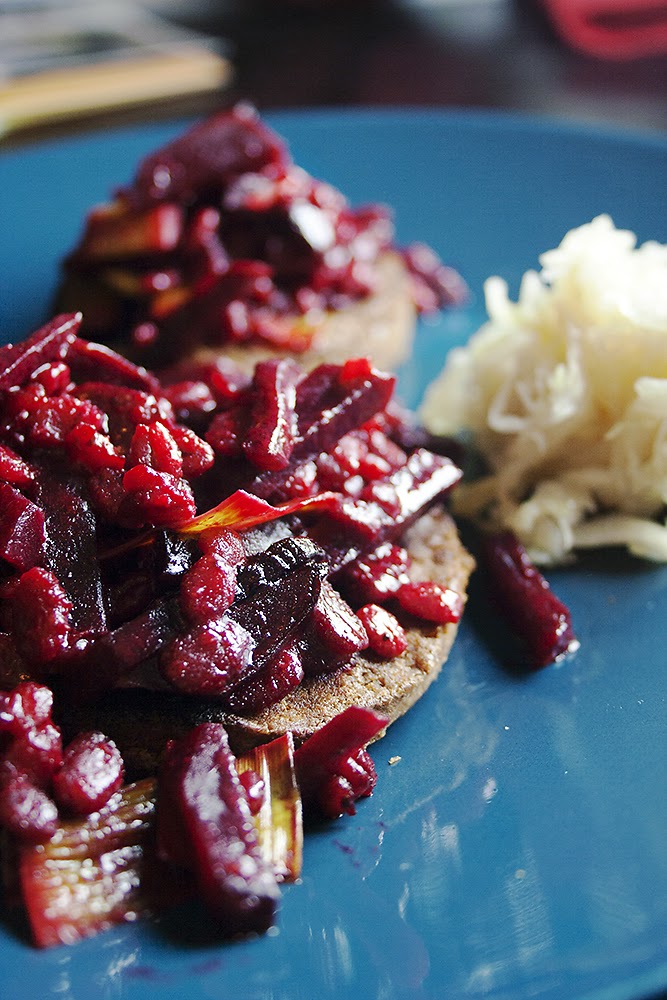
Beet Temptation ‒ Punajuurikiusaus
I've talked before about the wonderful casserole type of dish called temptations.They usually involve potatoes cut into strips but it being December and all, this time I wanted to use beets. Their colour is so wonderfully dark and Christmassy, though this is still quite an everyday dish.This makes a creamy and fruity accompaniment for a more humble main course.
- 1 kg beetroot
- 4 dl oat cream
- 1 leek
- 1 dl barley
- 1 chili (I personally think habanero gives a nice fruity aroma. But if hotness isn't your thing, try a winter apple instead.)
- thyme
- green pepper
- bread crumbs and margarine to top with
Peel and julienne the beets. Cut the leek and chili too. Mix all the ingredients in a casserole. Bake for half an hour in a 175°C oven.
Mix things a bit with a spoon. Sprinkle bread crumbs on the casserole. Top with a few margarine pieces. Bake for another half an hour.
Nutritional values / 1765 g:
energy 1297 kcal
fat 54 g
protein 30 g
carbohydrates 169 g
fiber 45 g
18.9.13
Stuffed Black Currant Leaves ‒ Viinimarjanlehtikääryleet
I'm a bit of a fan of making "Finnishized" versions of dishes normally attributed to whole different nations. You take the basic idea of the dish but swap the main ingredients into some local ones. Often the result is closer to the original idea than the hardcore versions that count on finding preserved but hard-to-acquire ingredients in the place of fresh ones.
Last summer I got a packet of grape leaves so we made a large pot of dolmades, a Greek dish where rice is wrapped inside the leaves. They were great though I still don't know what grape leaves really taste like since those were heavily preserved in tartaric acid.
This year I thought I'd localize the recipe. Black currant leaves are very aromatic and currants in general are called "wine berries" or viinimarja in Finnish so I thought they'd work great in this type of a dish. Seems I'm not exactly the first person who's used them this way so I took some model from this recipe which also uses rice as the stuffing. Whenever a recipe calls for rice I usually apply oat but it tastes a bit mild. So this time I thought I'd try processed spelt for a slightly nuttier flavour. Most recipes seem to call for a really long list of spices which to me sounds like they're not sure to what direction they want to take it, so I went with a fairly simple list instead.
- 40 large black currant leaves
- 2 dl pearl spelt
- 0.5 dl pine nuts
- 1 small punch of fresh mint
- 3 garlic cloves
- 2 tbsp rape oil
- cinnamon
- clove
- salt
For the broth
- 1 dl rape oil
- 0.5 dl lemon juice
- 1 dose of stock
- 2 tsp brown sugar
- salt
Cook the spelt in salty water for about 20 minutes. Roast the nuts on a dry pan a bit so they'll get colour on their cheeks. Mince the garlic and the mint. Mix the stuffing ingredients together.
Cook the currant leaves in plenty of water for about five minutes to soften them up. Take two leaves at a time. Cut their stems off and place them on each other so they'll overlap in the middle. Scoop a teaspoonful of the stuffing in the middle. Fold the edges of the leaves on the stuffing and roll them into small cigars. Place each cigar carefully but tightly into a casserole.
Mix the broth ingredients and pour over the casserole. (Add some water too if the amount of liquid doesn't seem enough.) Place in a 150°C oven for about an hour. You can eat them right away, but if you have the patience you can wait a day or two for them to juice up in the fridge. This is also the reason why it's a great idea to make a big portion of them while you're at it.
Nutritional values / 628 g:
energy 2371 kcal
fat 192 g
protein 43 g
carbohydrates 149 g
fiber 30 g
Tunnisteet:
black currant,
cold dishes,
Greek,
nuts and seeds,
oven dishes,
sidekicks,
snacks,
spelt,
veganmofo
8.9.13
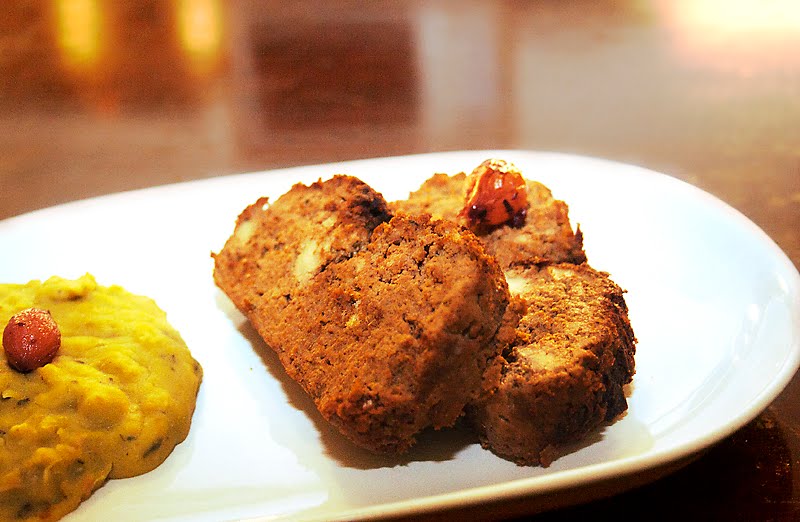
Mushroom Loaf with Black Currant Jelly ‒ Sienimureke mustaherukkahyytelöllä
The bolete season seems to be closing its end already. Two weeks ago the forest was so full of porcini it was hard to walk without stumbling on them. Now the only one I found was almost eaten by worms. Instead, fly agaric has become the king of the forest. They're pretty but don't make such a good meal. Since there wasn't any clear one species to pick I did what I usually avoid: mixed them in the same dish. There are for example velvet boletes, slimy spike-caps and purple russulas hidden in here.
I couldn't find a loaf recipe only using mushrooms instead of mixing them with lenses, meat, rice or nuts, so I made one up. (If you feel like adding any of the aforementioned, go ahead though.) It worked out wonderfully. The jelly idea came from Sillä sipuli's post about wild food and thought black currant juice would fit here especially well because its colour is the same as the caps of my russulas. I exaggerated a bit with the agar and used twice the amount I recommend here since the result was even too sturdy, but the taste fits here well.
- 1 l mixed mushrooms
- 2 dl oat cream
- 1 onion
- 1 starchy potato
- 1 dl breadcrumbs
- oil for frying
- tarragon
- green peppers
- salt
For the Jelly:
- 1 dl blackcurrant juice (I used unsweetened but it's your call. Aronia would also fit here well.)
- 4 dl water
- 2 tsp agar
Clean and chop the mushrooms. Mince the onion and sauté until you start to see through it. Add the mushrooms and let them acquire some colour. Mix all the ingredients and pour into a buttered casserole. Set in a 200°C oven for 30-45 minutes.
In the meanwhile, you can also prepare the jelly. Mix the juice and the water. Let it come to a boil. Add the agar. Pour into a flat casserole, preferably of same size as the one containing the loaf.
When both have cooled down, carefully detach the jelly and place it on the loaf. You can cut serving-size pieces to help out the eaters. Serve cold.
Nutritional values / 1389 g:
energy 812 kcal
fat 37 g
protein 21 g
carbohydrates 91 g
fiber 18 g
Tunnisteet:
autumn,
black currant,
cold dishes,
main courses,
mushrooms,
oven dishes,
veganmofo
4.9.13
Zucchini Lasagna ‒ Kesäkurpitsalasagne
I've been planning to do lasagna to get rid of the spinach lasagna noodles that have been sitting in the closet for almost a year now. But then I decided that instead, I'd make the zucchini version that all low-carbers hype about, now that the zucchini season is still on.
Zucchini doesn't need softening like pasta or rye crisps in rye lasagna, one of my favourite dishes to date. So you can discard the white sauce and just sprinkle some soy cheese instead. Also, the tomato sauce should be a bit sturdier than the one you'd normally make.
Even with these precautions the end result reminded more of a stew than a layered dish. There was absolutely no way of holding it together on a plate long enough to take a pretty photo. This one here I've taken on the next morning. You can clearly see how it's the sauce that holds the piece together, not the actual "pasta". But the main thing, the actual taste was just yummy.
- 1 portion of marinated horse beans
- 1 portion of basic brown sauce
- 1 zucchini
- 400 g tomato sauce
- 200 g melting soy cheese
- 0.5 dl sun-dried cherry tomatoes
- 4 garlic cloves- basil
- marjoram or oregano
Set the horse beans to marinate on the day before if possible. Prepare the brown sauce. When it starts to thicken, add the tomato sauce in it. Spice with herbs and garlic. Cook a little to reduce the liquid, then add the horse beans and cherry tomatoes along.
Slice the zucchini length-wise. Try to cut as thin strips as you can. Scoop a generous amount of the sauce in the bottom of your oven casserole. Layer with zucchini slices. Sprinkle some cheese on them. Continue by making another sauce layer and so on, until you've used everything. Aim to finish with the cheese layer. A few pieces of margarine or some breadcrumbs aren't a bad idea either.
Set in a 200°C oven for 45 minutes.
Nutritional values / 1818 g:
energy 2380 kcal
fat 126 g
protein 97 g
carbohydrates 206 g
fiber 73 g
Tunnisteet:
beans,
Italian,
main courses,
oven dishes,
veganmofo,
zucchini
3.9.13
Stuffed Parasol Mushrooms ‒ Täytetyt ukonsienet
I've noticed that when seeing a new mushroom, if I instantly recognize what it is, I'm usually right. If I need to ponder, it's better to leave it in the forest. My first two parasol mushrooms clearly fell into the first category.
I haven't been that excited for a while. Parasol mushrooms look majestic. Their Finnish name ukonsieni, Ukko's mushroom, places them in the direct protection of the Finnish thunder god himself. They're huge in size, and the biggest ones can have a cap up to 30 cm in diameter. Their patterns are among the most beautiful ones with a weirdly snake-like features.
I rushed to sit by them. With trembling hands I dug my mushroom guide from my bag to check they match the description before proceeding to actually pick them. At home I drew some spontaneous awes when showing the twins off. And my spouse double checked I'm not mistaking them for royal fly agarics (ruskokärpässieni).
Parasols are thought as one of the finest tasting mushrooms there are. They have this nutty, slightly sweet aroma that often gets to be described as resembling almond. Many people use the caps as steaks in the same way as with sheep polypore. I copied my favourite mushroom recipe writer, Kirsti Eskelinen in her book Sienestäjän suosikit (Gummerus 2012) by turning the caps into cups. The stuffing here is my own adaptation though, so don't blame her in case something goes wrong. Either way, the woodier stalks go well in a soup base or can be dried, ground and used as a spice.
- 2 parasol mushroom caps (or other large enough mushroom caps)
- 2 slices of a big zucchini (or 2 big beet leaves)
- 1 small turnip
- 1 small onion
- 1 dl oat cream
- 2 tbsp rape oil
- 2 tbsp bread crumbs
- lemon pepper
- salt
Mince the onion. Peel and chop the turnip. Sauté both on a pan. Spice with lemon pepper and salt.
Roll the zucchini slices or beat leaves around the mushroom caps so they'll form a bowl. If you have trouble keeping them together, secure with a toothpick.
Scoop the onion and turnip inside the caps. Pour cream on them generously. Stick with a spoon a little to make sure the cream is evenly distributed. Finnish with breadcrumbs.
Set in a 200°C oven for 15-20 minutes. Serve as an appetizer or evening snack.
Nutritional values / mushroom / 320 g :
energy 277 kcal
fat 20 g
protein 5 g
carbohydrates 19 g
fiber 5 g
Tunnisteet:
autumn,
main courses,
mushrooms,
oven dishes,
sidekicks,
turnip,
veganmofo,
zucchini
24.8.13
Dill Yogurt Covered Sea Buckthorn Cutlets – Tilli-jugurttikuorrutteiset tyrnileikkeet
Seems like we're better herb farmers than anything else. Our small field seems to be full of wild mint though we never seeded it there. I really need to get my imagination running if we're going to use it in anything else than tea. And the only plant we did seed and has grown better than we hoped is dill. So now every other dish is spiced up with it. So far I'm not complaining though.
Recipes on how to use dry soy cutlets always sound the same. First they're boiled in vegetable stock and then fried, which means that if you use the same store-bought bouillon cubes you always end up with the similar tasting chunks. Now that's a bit boring, isn't it? So I thought it almost my responsibility to start creating more creative ideas. The idea for a yogurt sauce came from some salmon recipe I happened to see. Originally I used lemons for the marinade, but since berries make such an essential part of Northern cuisine, I thought this sounded a bit classier choice.
For the cutlets:
- 100 g dry soy cutlets
- 1.5 dl sea buckthorn juice
- 1 dl rape oil
- 2 tbsp dark syrup
- salt
For the sauce:
- 2.5 dl oat yogurt (or soy, as long as it's au naturel)
- 1 small punch of dill
- 1 small punch of chives
- black pepper
Place the cutlets with the marinade ingredients in a plastic bag. Leave in the fridge overnight but turn around a little every time you go to find snack.
When starting to get hungry, place the cutlets with their liquid in a casserole and move around a little to make sure they're marinated evenly. Mince the herbs and mix the yogurt sauce. Spoon the yogurt on the cutlets.
Move into 200°C oven for half an hour. Enjoy with barley or potatoes and some nice sidekick salad.
Nutritional values / 720 g:
energy 1625 kcal
fat 104 g
protein 72 g
carbohydrates 95 g
fiber 20 g
Tunnisteet:
main courses,
oven dishes,
sea buckthorn,
textured soy protein
13.8.13
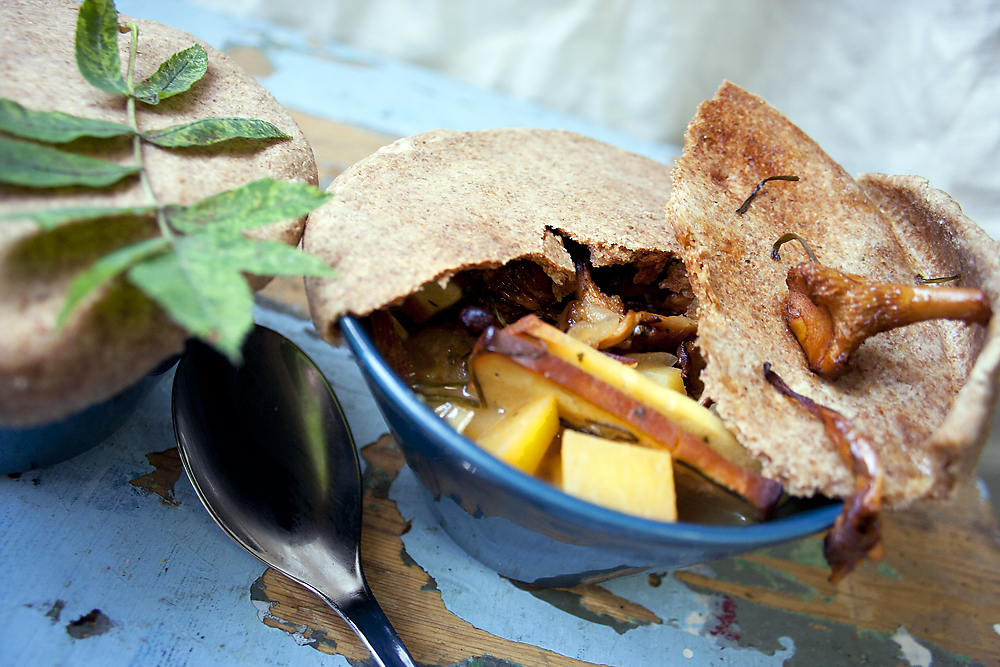
Gold Panner's Pots ‒ Kullanhuuhtojan ruukut
Things are really starting to look like autumn already, or at least like the harvest season. I accidentally emptied the market square in our neighbourhood. Only after that did I actually start to wonder what I could cook from all my beautifully golden turnips and stuff. The idea for this dish came from a bit different recipe, but I kept the name since the idea is still to feature golden-coloured ingredients. The place of gold panning in Finland is in the most northern part of the country, so they have a certain Lapland-theme. If you're serving a dessert, something with cloudberries would fit perfectly.
- 1 l golden chanterelles
- 2 turnips
- 300 g firm smoked tofu
- 4 shallots
- 2 dl oat cream
- 0.5 dl tar liqueur
- 0.5 dl rowan berries (sea buckthorn works as well)
- oil for frying
- pink peppercorn
- fresh chervil (or other mild herb)
- salt
Rye crust:
- 2 dl rye flour
- 1 dl water
- 1 dl wheat flour
- 1 tbsp oil
- 0.5 tsp salt
Start with the crust. Just mix the ingredients together with your hand. Move the chunk into the fridge for a while.
Plane thin slices out of the tofu. Fry on a pan with just a hint of oil until they've dried up a bit and perhaps curved from the edges. Peel the turnips, then chop them along with the onions and the mushrooms. Show them the pan as well, this time with a bit of more oil.
Mince the chervil and crush most of the rowan berries. Combine everything in a bowl. Divide evenly between oven-proof coffee mugs or other such serving-size pots (I got four of them). Add water to fill them up with liquid. Take the crust out of the fridge and divide into as many pieces as you have pots. Roll them into circles wide enough to cover the whole pot.
Move the pots into oven. As a precaution not to break the dishes, don't turn on the oven before this, so they'll get to warm up slowly along with the oven. Turn it to 200°C and leave them there for about half an hour or until the crusts look done.
Nutritional values / 1903 g:
energy 1917 kcal
fat 80 g
protein 89 g
carbohydrates 178 g
fiber 48 g
Tunnisteet:
autumn,
Lapland,
main courses,
mushrooms,
oven dishes,
rowan,
stews,
tofu/hefu,
turnip
15.5.13
Sailor Steak ‒ Merimiespihvi
I haven't managed to find out the origin of this dish. It used to be quite a common home food, but the name leads to assume it really does originate from ship menus. According to a legend, in the seas it was better known as "One Has Gone from the Lot" ("Yksi on joukosta poissa") as it was usually served right after some crew member had been reported missing. "No land ahoy this week either, but don't worry guys, we did have some meat after all."
Merimiespihvi consists of sliced beef, potato and onion, all simmered in beer (which in some modern versions is unforgivably replaced by regular broth). It doesn't resemble a steak for one bit, so I can only assume this is the closest thing to a steak your average sailors in the old days ever managed to see. Instead of beef I used seitan which we happened to have quite a lot left from this meal. The long preparation time somehow turns these simple ingredients into a rather original tasting dish that wouldn't be the same at all if you just combined them on the plate.
Oh, and by the way: I created a Facebook page for Mämmi to help some of you to follow what I post and have yet another way for conversation. You're all welcome to join!
- 1 portion of seitan (worth of about 4 dl gluten flour)
- 1 bottle of beer (schwarzbier or smoked beer fit here)
- 8‒10 potatoes
- 4 onions
- oil for frying
- 1 tsp whole black peppers
- thyme or a bay leaf
- stock in case you need to complement the beer
- salt
Cut and club the seitan into mouth-sized, flat pieces. Fry on a pan. Slice the onions and sauté them a bit as well. Slice the potatoes. Arrange seitan, onion and potatoes in an oven pot layer by layer. Put a potato layer on top. Add the spices. Pour enough beer to just about to cover the upmost layer (and continue with stock in case one beer bottle isn't enough).
Cover the pot. Heat up the oven to 180°C and let the stew simmer there for at least two hours. Add water or broth in case it starts to look terribly dry while cooking. The final Merimiespihvi isn't meant to swim in broth anymore though.
Serve with pickles and/or pickled beet.
Nutritional values / 2295 g:
energy 2316 kcal
fat 49 g
protein 194 g
carbohydrates 226 g
fiber 32 g
Tunnisteet:
beer,
main courses,
onion,
oven dishes,
potatoes,
Scandinavian,
seitan,
stews,
winter
2.1.11
Carrot Casserole ‒ Porkkanalaatikko
A year ago I posted two of the four essential casseroles of Finnish Yule table: potato and raisin. This time I thought I'd continue with the carrot version. Like so many traditional dishes, this is most often made with rice which at some point was though fancier than home-grown grains, mostly barley. Some like it plain carrot, without any grains. As a halfway solution I use just enough semolina to keep it nicely together.- 1 kg carrots
- 1.5 dl oat cream
- 2 tbsp dark syrup
- 1 dl semolina
- 1 tsp salt
- 1 tsp ginger
- 0.5 tsp nutmeg
- breadcrumbs and margarine
Peel, cook in small amount of water and puré the carrots. Save 1 dl of the broth you used for cooking. Add it as well as all the other ingredients with the carrot mash. Butter a casserole (or six oven-proof coffee mugs as I did) and pour the carrot mixture in it. Top with breadcrumbs and margarine pieces. Put into a 175°C oven for an hour.
Nutritional values / 1300 g:
energy 993 kcal
fat 30 g
protein 19 g
carbohydrates 158 g
fiber 32 g
Tunnisteet:
carrot,
oven dishes,
sidekicks,
winter,
Yule
1.1.11
Tofu and Nut Loaf ‒ Tofu-pähkinämureke
Have a happy year 2011! I guess most Finns were shooting fireworks and throwing wild parties last night but to be quite honest, I've never really understood the fuss over a changing number or why Gregorian calendar even places the New Year to the middle of winter in the first place. After all, I already cast my new year tin during Kekri. So yesterday evening we just took a nap after an exhaustive work week, ate a nice meal, drunk some cider and watched a surprisingly boring movie about the French revolution.Anyway, here's a loaf recipe on the fancier side for such occasions. I've originally taken it from the Finnish animal rights forum and usually prepare it for the Yule table as the poster suggests (among my non-traditional food traditons). It's quite salty, because it's meant to be eaten together with several other standing table dishes (and fits excellently on toasted bread on the next morning). If you'd rather have it as the star of the table, you may want to replace some of the soy sauce with plain water or saltless vegetable stock.
- 75 g hazelnuts
- 90 g almonds
- 165 g cashew nuts
- 540 g firm tofu (I like it best smoked but plain goes just fine)
- 4 toasted white bread slices
- 1 punch of fresh parsley
- 1 small punch of fresh salvia
- 1 dl soy sauce
- 2 tablespoons Dijon mustard
- 1 teaspoon paprika
- basil
- thyme
- black pepper
Add the ingredients into a mixer one by one. Keep mixing until you have a paste. Butter a casserole or and spread evenly into it. Garnish with bread crumbs if you wish and make some wrinkles with your fingers. Bake in 175°C for about an hour or until beautifully brownish.
Nutritional values / 1200 g:
energy 3152 kcal
fat 224 g
protein 177 g
carbohydrates 115 g
fiber 37 g
Tunnisteet:
cold dishes,
main courses,
nuts and seeds,
on the bread,
oven dishes,
tofu/hefu,
winter,
Yule
25.11.10
Cabbage Casserole ‒ Kaalilaatikko
There's something very soothing in these numerous rustic casseroles. They're just the kind of thing I need when days grow shorter and colder and I wouldn't want to leave my bed at all. Unfortunately, this particular casserole is also one of those dishes that many Finns have learned to hate at school. All classics like that are something that I feel everyone should really try to cook themselves just once before judging. After all, if this isn't a comfort food I don't know what is.This time I was out of barley so I used the rice that has been standing in my food closet for years. Funnily, the casserole seemed dried and more crumbling than with barley. If I'll repeat the rice version I think I'll add some oat cream to the recipe or at least use porridge rice.
- 1 kg white cabbage
- 2 dl barley
- 2 dl soy crumble (TVP)
- 1 onion
- 1 tablespoon rape oil
- 1 tablespoon dark syrup (at least)
- garlic salt
- white pepper
- marjoram
- 2 tablespoons margarine
Cook the barley. Chop and sauté the cabbage to soften it up. Chop the onion and fry together with moistured soy crumble and spices. In an oven proof casserole, mix everything together and spread evenly. Top with margarine pieces. Stick into a 200°C oven until the surface has acquired some colour (at least half an hour). Avoid overcooking since that may also result a dry casserole.
Cabbage casserol is best enjoyed with lingonberry jam.
Nutritional values / 1415 g:
energy 1391 kcal
fat 51 g
protein 54 g
carbohydrates 177 g
fiber 51 g
Tunnisteet:
cabbage,
main courses,
oven dishes,
textured soy protein
4.8.10
Gratin for Four Brassicas ‒ Neljän kaalin gratiini
Once again I had some problem with translating the title. Technically, the Brassica genus covers a rather wide sounding range of plants from mustard to turnips. To my understanding you can't just use 'cabbage' as an umbrella term for the varieties of the species Brassica oleracea as with the Finnish equivalent kaali, so I thought it better to label the dish with the whole genus' name. Maybe mustard would work as a nice spice here.If you ever have the misfortune of attending to a Finnish funeral you'll almost certainly find some form of this gratin in the menu. And yet, these are all veggies that seem to divide opinions among Finns. My theory is that haters have only eaten them poorly prepared and covered with cheese so no one would taste the bland stuff underneath. (Cheese is an almost certain sign that there's something severely wrong with any given gratin. And I'm not alone with this opinion.) Most recipes tell to precook the kraut but I prefer to save some of the crunchiness.
- 1 cauliflower
- 1 broccoli
- half a white cabbage head
- half a red cabbage head
- 1 portion of white sauce
- yarrow
- white pepper
- rape oil for buttering
(- bread crumbles on top)
Prepare the sauce. Chop the veggies and mix them with the spices. Butter an oven casserole and lay the brassicas into it. Pour the sauce evenly on them. Cook in a 225°C for 25 minutes. Turn them a bit in the middle of the cooking.
Brussels sprouts and German turnips would also fit here perfectly. With some fried soy flakes it turns into a main course.
Nutritional values / 2780 g:
energy 1165 kcal
fat 51 g
protein 69 g
carbohydrates 95 g
fiber 50 g
Tunnisteet:
broccoli,
cabbage,
cauliflower,
oven dishes,
sidekicks,
textured soy protein
18.6.10
Oven Omelet with Bilberry Leaves ‒ Mustikanlehtiomeletti uunissa
It's summer time and cooking isn't exactly among my first priorities at the moment. Mostly I've been eating salads with the method "shred and mix everything you happen to find from the fridge" which rarely results in a disappointment. So compared to that this counts as a complicated dinner. The idea of using bilberry leaves (instead of berries) here came from a mention in Sillä sipuli and the basic omelet recipe I snigged from Kasvisruokaa. The amount seemed a bit small for two bottomless stomachs so we also had a sidekick - salad of course. Please notice that like so many other summer treats bilberry leaves contain oxalic acid which is why you shouldn't eat them on a regular basis.- 3 dl water
- 2.5 dl (chick)pea flour
- salt
- black pepper
- 1 dl fresh bilberry leaves (or a herb of your liking during wintertime)
- oil for buttering
Whip the flour and the water into and even batter. Add the spices and the bilbeery leaves. Let the batter rest for about half an hour.
Pour the batter onto an oiled casserole and cook in a 250°C oven until the omelet has acquired some colour (about 15 minutes). Let it chill down and cut in triangles. Lightly roasted cherry tomatoes accompany them perfectly.
Nutritional values / 461 g:
energy 672 kcal
fat 23 g
protein 32 g
carbohydrates 83 g
fiber 15 g
Tunnisteet:
bilberries,
main courses,
oven dishes,
peas,
snacks,
tomatoes
17.2.10
Talkkuna Ropsu ‒ Talkkunaropsu
A must have dessert after pea soup is ropsu. I use the South-Ostrobothnian name but most Finnish speakers call it with the word pannukakku which has the same origin as English word pancake. They have many things in common but this Finnish dish is thicker, bigger and cooked in the oven.There are huge differences in ropsu recipes and I guess everyone just has to find their favourite through trial and error. This one gets extra flavour from talkkuna and cardamom as well as extra structure from oatmeal, yogurt and baking powder. I also use much lower temperature and less sweetening than most recipes I've seen. Actually, if I'm going to eat it with something overly sweet like jam I only use about 1 tablespoon. Most recipes use eggs which make the ropsu bubble unlike eggless versions ‒ some think it aesthetically pleasing and some are desperately trying to get rid of the phenomena.
This is easily turned into a salty version by dropping the sweetening altogether and adding some herbs like basil and marjoram. Or you might want to try other flavourings, say banana and cocoa powder.
- 1 l soy milk
- 4 dl spelt flour (or dark wheat flour)
- 1 dl talkkuna (can be replaced with more wheat flour)
- 1 dl oatmeal
- 1 dl soy yogurt
- 0.5 dl dark syrup (or sugar)
- 1 teaspoon baking powder
- cardamom (or some vanilla)
- salt (just a pinch)
- 3 tablespoons margarine
Mix together the dry ingredients. Add the milk, the yogurt and the syrup. Whip whip whip. Let the batter rest for half an hour.
Warm up your oven to 175°C. Take a baking tray. (I've seen photos on the internet where people have tried to make these in a frying pan or some smallish casserole so let me stress this: you'll need a whole baking tray plus a sheet of parchment paper. If you only have a pan then make a smaller portion.) Put half of the margarine on it and stick it into the oven. When the tray has warmed up, take it out, spread the melted margarine evenly and pour the batter on it.
Cook your ropsu for half an hour on a low shelf. Take it out for a moment, top with margarine pieces and put on the top shelf for another fifteen minutes to get some colour. If you try the ropsu with a wooden stick at this point it should still feel sticky from the inside. Let it cool down before serving.
The classic sidekicks are strawberry jam and whipped cream. Instead of going to a food store just for oat cream I made a thick mousse from chocolate, fruity beer, half-frozen silken tofu, sugar and frozen berries. Part of the berries I just added on top. Voilá!
Nutritional values / 1555 g:
energy 2295 kcal
fat 55 g
protein 55 g
carbohydrates 339 g
fiber 34 g
Tunnisteet:
beer,
childhood,
Ostrobothnian,
oven dishes,
sweet,
talkkuna,
tofu/hefu
7.2.10
Saturday Temptation ‒ Lauantaikiusaus
This one is an ideal supper for a lazy Saturday. You can put it in the oven and go to have a sauna. It should be ready by the time you come back.
- 500 g sunroot
- 250 g tofu
- 1 red onion
- 1 sheet of nori
- 2 dl oat cream (or oat milk)
- 2 tablespoons margarine
- dill
- thyme
- coriander
- black pepper
- salt
Wash the sunroots and remove bad parts but don't bother to peel. Slice as thin as you can. Julienne the tofu. Mince and saute the onion.
Oil a casserole and arrange a thin layer of sunroots on the bottom. Sprinkle with spices, onion and nori pieces. Add a layer of tofu. Repeat layering as long as you have something left. Lastly, cover with a few sunroot slices, sprinkle with spices and pour the cream on the temptation evenly. Top with margarine pieces.
Stick into a 200°C oven for about 45 minutes. (One way to make it even juicier is to turn the oven into a low heat after the temptation has acquired some colour and let it simmer for one more hour. In this case you may need to add some stock in the middle to prevent it from drying up.)
Serve with pickles.
Nutritional values / 1103 g:
energy 1016 kcal
fat 63 g
protein 48 g
carbohydrates 63 g
fiber 27 g
Tunnisteet:
algae,
main courses,
oven dishes,
sunroot,
tofu/hefu
27.1.10
Pea Sticks ‒ Hernepuikot
- 1 portion of dried-out chili peas
- water (about 2 dl)
- bread crumbs (about 1 dl)
Soak the peas overnight in a small amount of water, just barely covering them. Next morning they should be swollen and have absorbed all the water. Make a paste out of them, leaving some of the peas intact. Shape into sticks and cover with bread crumbs. (I got 14 pieces.)
Put the sticks into a 200°C oven for twenty minutes. Serve with one sweet and one sour dip sauce or use as a sandwich filling.
Nutritional values / 1 stick:
energy 161 kcal
fat 7.2 g
protein 4.8 g
carbohydrates 19.1 g
fiber 2.6 g
Tunnisteet:
balls and patties,
main courses,
oven dishes,
peas
10.1.10
Garlic Potatoes ‒ Valkosipuliperunat
- 1 kg potatoes
- 2 whole garlics
- 1 onion
- 3 dl nut yogurt (you can replace this with soy yogurt of course but you'll miss something)
- 2 dl oat milk
- white pepper
- salt
- 1 tablespoon rape oil
Wash the potatoes well but don't peel. Cut them into thick slices, preferably with a knife. Oil a casserole. Lay the potato slices into rows so that they overlap each other. Chop and sauté the onion with some oil. Mince the garlic. Mix the onion, the garlic and the spices with the nut yogurt and spread it on the potatoes. Pour the milk evenly over the rest.
Bake at 200°C until the crust looks a little brown (about 45-60 minutes).
Nutritional values / 1584 g:
energy 1761 kcal
fat 95 g
protein 47 g
carbohydrates 176 g
fiber 44 g
Tunnisteet:
nuts and seeds,
oven dishes,
potatoes,
sidekicks,
tofu/hefu
7.1.10
Onion Soup ‒ Sipulikeitto
Hot soups are exactly what I need when it's freezing outside. Onion soup is cheap, light and simple to make yet extremely savory.This alone will hardly fill your stomach so I did what the French do: oven sandwiches. For some reason they also like to set the bread floating in the soup (well, actually they put the whole soup in the oven) but have to say I personally prefer them separated. On the next day you can use this soup as the basis for a bit more filling meal by adding potatoes, veggies and tofu.
The soup:
- 8 onions (it looks nice if you mix yellow and red ones)
- 1 l water
- 2 dl apple wine
- 1 large dose of stock
- 2 tablespoons rape oil for frying
- whole black peppers
- salt
- sugar
- thyme
- yarrow flowers
The bread:
- 6 toasted bread slices
- 2 dl soy yogurt
- 100 g melting soy cheese
- 0.5 dl nutritional yeast
- 2 tablespoons mustard powder
- 3 garlic cloves
Slice the onions and caramelize them by frying in a low heat for an extended period (half an hour should do). Add the wine at the end of the caramelization to deglaze the pan. Be careful not to burn the onions cause that makes the soup bitter. When the onions have turned sweet, add the rest of the soup ingredients. Let the soup simmer for half an hour under a lid.
Grind the soy cheese, mince the garlic and mix them with the yogurt, the yeast and the mustard. Spread the mixture on the bread slices and place in a 200°C oven until they look crunchy and golden (about ten minutes).
Nutritional values / 2190 g soup and 1 bread:
energy 633 kcal and 235 kcal
fat 27 g and 8 g
protein 12 g and 8 g
carbohydrates 46 g and 15 g
fiber 16 g and 2 g
Tunnisteet:
apple,
French,
on the bread,
onion,
oven dishes,
soups
Subscribe to:
Posts (Atom)
Osta neljä tuotetta ja maksat vain kolmesta - Luomutallin kampanjatuotteet näet täältä

Teekauppa.fi - laadukasta teetä netistä
Ostoskorin loppusummasta vähennetään viisi euroa ja toimitus tapahtuu ilman postikuluja.
Syötä ostoskoriin kuponkikoodi:
syysteet
Tilauksen on oltava vähintään 35 eur, mistä jää maksettavaksi 30 eur.
Teekauppa.fi - laadukasta teetä netistä
Ostoskorin loppusummasta vähennetään viisi euroa ja toimitus tapahtuu ilman postikuluja.
Syötä ostoskoriin kuponkikoodi:
syysteet
Tilauksen on oltava vähintään 35 eur, mistä jää maksettavaksi 30 eur.