Showing posts with label dandelion. Show all posts

10.6.13

Dandelion Sima ‒ Voikukkasima


Gardening is about trying to weed out the plants that flourish in certain soil and conditions and trying to make plants that don't want to live in those conditions prosper instead. This summer we rented an allotment garden from the city for the first time, so we'll see if that's true. Already when seeding I did get this strong feeling we'd be at constant war with certain grass types that grow just awesome roots that snap every time you try to pull them out. Dandelion is perhaps more common plant that some people really try to fight with on their lawn. This is something I've never understood. I mean, they're really beautiful and may even make those otherwise awful golf yards look almost bearable. But perhaps that's just me who mostly likes yard that look like no human hand has ever touched them.

At least these "teeth of a lion" or "butter flowers" like they are called in Finnish can be quite delicious to get rid of. Their leaves can be used as salad leaves and their pungent taste gets often compared to that of salad rocket. Their roots can be roasted, ground and used as a herbal tea or coffee substitute. And those pretty flowers themselves, well, they smell and partly even taste like honey. Which is why I like to make a sparkly summer drink out of them.

- 3 l dandelion flowers
- 6 l water
- 1 dl farine sugar (or muscovado)
- 4 dl sugar
- 1 rhubarb stalk (or a lemon)
- 1 fingertip sized piece of fresh yeast

Right after you've picked the flowers, boil them and in three litres of water for about ten minutes. Fish out the flowers, save the liquid and boil the flowers again in a fresh batch of water. This time discard the flowers altogether. Chop the rhubarb and add it as well as the sugar to the liquid. Stir to make sure all the sugar has dissolved. When the liquid has cooled down to lukewarm, add the yeast piece. Let it rest for a day or so.

Next day, bottle the sima into clean bottles. You can also add a teaspoon of sugar to each bottle to assure they'll sizzle. Leave them in room temperature and let the extra pressure out every now and then so they won't explode. I personally prefer plastic bottles because of this. Check the taste after three days. Serve cold on a hot day.

Nutritional values / 6 l:
energy 2040 kcal
fat 7 g
protein 21 g
carbohydrates 491 g
fiber (not applicable)

4.6.10

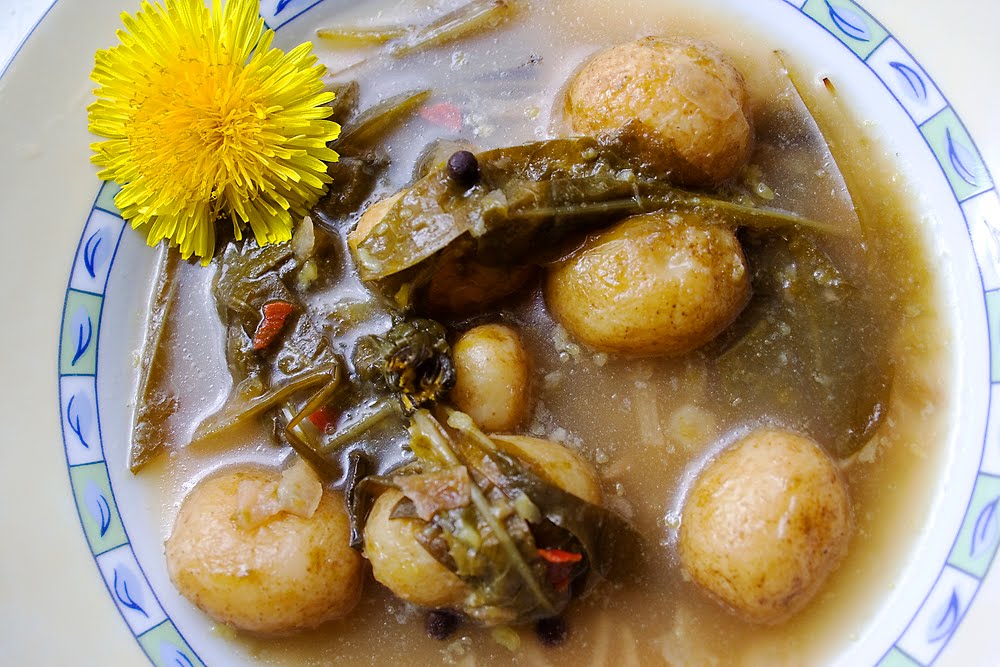
Dandelion Soup ‒ Voikukkakeitto

In case that supikas recipe yesterday sounded appetizing, here's a suggestion for the remaining broth. But if you want the soup only, dice a small rutabaga to cook with the potatoes.

Dandelion is among one of my favourite wild veggies because it's so multifunctional and grows just about everywhere. The leaves and buds for this soup I picked when returning along my jogging path, trying to find my breath that had got lost somewhere on the way.

- 20 unopened dandelion flower buds
- 2 dl young dandelion leaves
- 2 l rutabaga broth
- 5 dl new potatoes (or noodles)
- 0.5 dl seaweed
- 0.5 dl dried onion (or caramelized)
- 1 chili pepper
- whole black peppers or juniper berries

Wash the potatoes and remove the bad parts but don't bother to peel. Cook them in the rutabaga broth until soft. Add the rest of the ingredients and let the soup come to a boil. Eat right away.

In the present form the soup is more like a starter or an evening snack but if you want to turn it into a lunch you might want to add beans or such.

Nutritional values / 2 l:
energy 500 kcal
fat 3 g
protein 27 g
carbohydrates 96 g
fiber 11 g

13.5.10

Rye Waffles ‒ Ruisvohlut

It's hard to stay still. There are loads of stuff I should be doing but all I'd like to is wondering in the forest and traveling around like a tramp. It's bright and warm again, little green leaves have come out from all those brown piles, birds are trying to sing each other into swamp like Väinämöinen and Joukahainen. Nowadays I just can't wait getting to pick the first wild salad or harvest the little herbs on my window sill. The crispy waffles I made today were already accompanied by freshly picked dandelion, wood sorrel, lady's mantle and woodland strawberry leaves.

Root vegetables are nowadays an essential part of Finnish cuisine. That's why it's hard to believe that only a few hundred years ago Finns thought gardening as something that only Swedish-speaking upper class would do. Carrots and beets didn't become popular until 20th century. Previously common folk either ate very simply (and barren of nutrition) or gathered anything edible they found from the nature. Furthermore, after the second world war no one wanted to eat the same stuff they had learned to be just a substitute, used because of the shortage. You still can't find such wildly used ingredients like chicory or pine flour from stores today.

However, there are some week signs that foraging and growing things yourself are gaining more popularity again. Perhaps they will become trendy and then common in all classes? I sure hope so. One of the things I hope to see is my generation learning to appreciate their land and nature. After all, they have so much better chances for it than their parents did. I myself hope to play a squirrel this year and learn more about preservation for winter.

- 3 dl oat milk (or apple juice)
- 3 dl sparkling water (or tab water)
- 2 dl rye flour
- 1.5 dl dark wheat flour
- 2 dl rye flakes (or rolled oats)
- 3 tablespoons rape oil
- 1 tablespoon potato flour
- 1 tablepoon dark syrup (or maple syrup)
- 1 teaspoon apple wine vinegar
- 1 teaspoon baking powder
- salt

Mix the dry ingredients together and then add the liquid ones as well. Let the batter rest for at least half an hour. Bake a scoopful at a time according to the instructions of your waffle iron. I got six thick waffles out of this amount.

Rye waffles can be accompanied by many kinds of toppings both sweet and savory. This time I had them as the main dish with salad, well-spiced soy strips and garlicky yogurt sauce but for dessert I'd go with strawberry jam and oat cream, together with a cup of coffee. Some of the toppings you can use as a filling before closing the iron. And of course, they make a perfect picnic food when cold.

If you don't have a waffle iron just use more liquid and make pancakes or ropsu instead. When making ropsu you can also disregard the oil if you wish. With waffles you need to grease the iron between every waffle if there's no oil in the batter itself.

Nutritional values / 1 waffle (165 g):
energy 266 kcal
fat 8 g
protein 6 g
carbohydrates 41 g
fiber 6 g

7.5.10

White Sauce ‒ Valkokastike

When writing about the brown sauce I promised to tell you later about the other mother sauce my mum makes, the white sauce. Just like the brown one, this is really simple but can be used as a base for many other sauces. While I tend to associate the brown sauce with winter, the white one is much more summery. It crowns many of those seasonal delights of springtime: new potatoes, asparagus, fireweed and dandelion leaves or artichoke but can also be used for seitan steaks or in lasagna. French cuisine calls it béchamel.

- 3 tablespoons wheat flour
- 2 tablespoons margarine (of good quality!)
- 5 dl soy milk (I find this works better than oat milk but that's naturally only a matter of taste)
- white pepper
- herb salt

Melt the margarine in a sauce pot. Sift in the flour, stirring all the time so it won't get clumpy. Add the milk as a thin strip, stirring all the time. Spice up. The sauce is ready after it has thickened up.

For asparagus and dandelion I like to add some mayonnaise and a teaspoon of vinegar. Dill, garlic and blue-type soy cheese also fit here just perfectly.

Nutritional values / 5 dl:
energy 469 kcal
fat 32 g
protein 24 g
carbohydrates 25 g
fiber 1 g

11.6.09

Rhubarb and Mushroom Salad ‒ Raparperi-sienisalaatti

Hello! I'm leaving for a long trip tomorrow so I don't expect to be posting anything before the end of August. But don't worry, I will be back with new ideas!

Why do dandelions always grow by the roads where you shouldn't pick them from? Why do they only become visible after they grow a flower and thus turn bitter? These were the questions I pondered why hunting for the meal of the day.

Finally I managed to fill my bag with fresh and tender dandelion leaves. I decided to cook a re-edited version of an inventive rhubarb and shiitake salad that's apparently originally from Irina Somersalo's book Yllin kyllin (Multikustannus 2008).

- 0.5 l young dandelion leaves
- 300 g mushrooms (shiitake fits this one indeed but use what ever you find)
- 1 rhubarb stalk
- 1 red onion
- 1 tbsp sugar
- 1 tsp ginger
- 0.5 tsp salt
- oil for frying
- basil

Chop the veggies. Fry the mushrooms and the onion until they start to get some colour. Throw in the rhubarb and the spices. Continue frying so that the rhubarb turns into a mushy "sauce". Wash the dandelion leaves. Combine all. Eat while still warm.

Nutritional values / 670 g:
energy 354 kcal
fat 14 g
protein 12 g
carbohydrates 42 g
fiber 10 g
Osta neljä tuotetta ja maksat vain kolmesta - Luomutallin kampanjatuotteet näet täältä


Teekauppa.fi - laadukasta teetä netistä
Ostoskorin loppusummasta vähennetään viisi euroa ja toimitus tapahtuu ilman postikuluja.
Syötä ostoskoriin kuponkikoodi:

syysteet

Tilauksen on oltava vähintään 35 eur, mistä jää maksettavaksi 30 eur.
Related Posts Plugin for WordPress, Blogger...