26.2.14
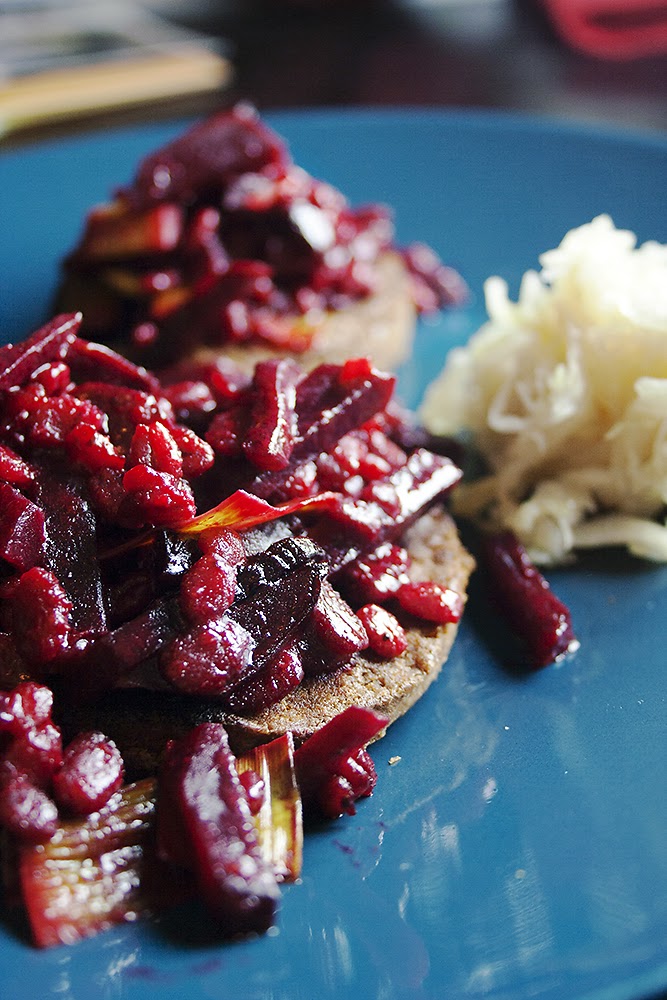
Salmiakki Sauce for Seitan and Beet ‒ Salmiakkikastike seitanille ja punajuurelle
When I dine at a restaurant I find it very pleasant if the menu clearly states what's in a given dish, for example "Chili rubbed seitan steak, raspberry vinegar marinated beets and salmiakki sauce". It gives me as a customer much better idea of what to order if the name isn't just some fancy French word I don't know how to pronounce. But when I see this elsewhere, peculiarly in recipes, for some reason I find it annoying and just trying to sound fancy, for example "engine oil rubbed Tavastian soap with small stones and slowly caramellized rubber". It's really a combination of the different ingredients or even separate dishes, and guess my logic goes that this means that any given part of that plate isn't really worth repeating or at least the recipe writer doesn't believe it is. Guess I'm only annoyed because this has becme some sort of a fad among Finnish celebrity chefs. Anyway, I try to avoid that happening in my recipes, although I realize I might just have an attitude problem. Sometimes the combination of tastes truly is the more important thing than any given part of it. Taste pairing might just be the single most important part of kitchen art.
This is the case of this recipe too. Although the part needing a recipe is really just for the sauce, I couldn't help but putting a suggestion of what comes under the sauce in the headline. These three tastes are just fine on their own, but they work especially well together, so I thought to highlight the combo. The idea came from a salmiakki marinated beet starter dish, created by a salmiakki making company, but I thought to turn it into an entrée. For the seitan, I used chili in the dough and fried them well in oil. For the beets, I sliced them thin, drizzled with oil and raspberry vinegar, as well as spiced with salt and thyme before roasting them in the oven long just long enough to still have them crunchy. The portion is crowned by the sauce which has a lot subtler aroma than you might think.
- 150 g salmiakki candy (hard ones are best in this, I used Turkinpippuri) + 1 dl water
- 4 dl strong vegetable bouillon
- 1 dl white wine
- 2 tbsp margarine
- 2 tbsp wheat flour
- black pepper
- salt
Prepare a salmiakki syrup by putting the candies in a small bowl and pouring water on them just enough to get them covered. Turn around with a spoon when you walk by. Dissolving only takes a few hours, so if you start in the previous evening, you can be sure they'll make it in time.
Melt the margarine in a sauce pan. Shift the flour on the melted stuff and stir. Pour in the stock before the roux start to turn brown (unlike in basic brown sauce). Let the sauce thicken on a low heat, stirring occasionally. Add the salmiakki syrup and the wine. Let the sauce reduce until the consistency is thick enough to stay on the seitan. Spice with salt and pepper according to your taste buds.
Nutritional values / 798 g:
energy 882 kcal
fat 22 g
protein 2 g
carbohydrates 144 g
fiber 1 g
22.2.14
Roasted Garlic Soup ‒ Paahdettu valkosipulikeitto
I recently noticed my whipped porridge in a Buzzfeed post about Finnish foods. It was an interesting listing altogether, featured many things you can find from this blog as well, like pea soup or cabbage casserole, and also reminded me of some dishes I'm yet to post, like korvapuusti or Karelian stew. But one item there didn't feel quite right. Garlic soup. Is that supposed to be some Finnish speciality? Yes, many Finns love garlic and there's even a garlic restaurant in Helsinki which serves garlic icecream, but I wouldn't call it any countryside stable. This soup I'd locate somewhere around Spain or perhaps even France.
Still, this is a perfect winter time soup to keep away flu, vampires and small-minded people. The modest outlooks don't really do justice to the wonderful complexity of the taste. Even if garlic isn't usually your cup of tea, you might still want to try this pleasantly smooth and sweet twist of it. Similarly to best of beers, the thing tastes like many things at once. You shouldn't start the cooking when your already hungry though, because it needs some time to develop all that symphony. Notice it's more of a starter than an entrée soup, though we enjoyed it paired with oven sandwiches consisting of rye bread, sun-dried tomatoes, smoked tofu, vegan sour cream and basil. The only important things in the soup are naturally the garlic roasting and onion caramelizing, but we based our version to a recipe which uses some beer as well, since hey, didn't someone just mention how good it tastes like?
- 7 whole garlics
- 4 onions
- 1 l vegetable broth
- 4 dl oat cream
- 2 dl strong tasting beer (or apple cider)
- 1 dl canola oil
- 2 tbsp farin sugar
- thyme
- black pepper
- salt
Cut the garlics in half breadth-wise. No need to remove the now halved cloves from their place, just put them in an oven casserole open side above and drizzle some oil on them. Roast in a 125°C oven for 1.5 hours. Now the cloves should be quite easy to peel.
Peel and chop the onions coarsely. Pour rest of the oil in a pan and heat up. Put the onions and garlics in the pan, turn down the heat to a mild temperature. This part takes a lot of patience as it may take up to 45 minutes. You shouldn't fry the onion but let it caramelize in time. Turn them occasionally and keep a low heat to prevent them from burning. They're ready when they look golden and taste sweet, just like the garlics when they came out of the oven.
Add the sugar and the beer with the onions. Let the mixture come in to a boil and then quickly add the broth. Put the lid on and let the soup simmer for half an hour or so. Add the rest of the ingredients. Cook for a few minutes more, smooth down with a hand blender and cure your flu.
Nutritional values / 2635 g:
energy 2136 kcal
fat 133 g
protein 44 g
carbohydrates 170 g
fiber 21 g
Tunnisteet:
garlic,
slow cooking,
soups,
winter
6.2.14
Black Trumpet Sausage ‒ Mustatorvisienimakkara
Mustamakkara, literally "black sausage" is very likely the most famous speciality of my home city Tampere. It's basically a groat sausage which gets its Gothic colour from blood and is usually served with lingonberry sauce. For years I've had this weird urge to make a vegan version out of it (Hey why not? Edinbourgh is full of pubs serving vegan haggis.) but had absolutely no idea what I could use in it.
As I've mentioned before, there are several traditional Finnish sausage types with no meat in them. I was especially delighted to find a recipe for a mushroom sausage that is otherwise vegetarian but uses real intestines as mold. I wouldn't know how to get those even if I wanted to, but this gave me an idea of using black trumpets when mushrooms are called for. They should naturally make a black sausage, so this might be an idea in line with the name. My version is a bit different though, containing gluten flour for added firmness and fillingness.
I've never actually tasted the blood version so I did some questioning among my friends who had. Apparently some versions do taste like blood while others don't. That sounded like a relief. While you could easily add an effervescent tablet to bring the iron taste into this, it doesn't sound like something I'd really like my sausage to taste like. Especially when black trumpets have such a discreet taste on their own.
- 300 g salt-pickled black trumpets
- 5 dl water
- 4 dl gluten flour
- 2 dl oat cream
- 1.5 dl whole barley grains
- 100 g fresh soy cheese
- 3 garlic cloves
- 1 tbsp canola oil
- white pepper
Cook the barley in salted water. Mince the garlic. Rinse and drain the mushrooms couple of times, then cut them into smaller pieces. Mix all the ingredients except the gluten flour. Start kneading the flour into the rest by your hand, a small amount at a time, to get it evenly mixed with the rest of the sausage. If there seems to be too much of the dry stuff, add a dollop of water, but carefully, since you don't them to become too soggy.
Take a fistful of the mass and roll into a bar. Wrap into folio and roll some more. Repeat for the rest of the mass. I got myself six large sausages from this amount. Bake in a 175°C oven for an hour. Enjoy as a snack or on the dinner, preferably with lingonberry or cranberry sauce.
Nutritional values / 1 sausage / 242 g:
energy 308,5 kcal
fat 11,5 g
protein 29,3 g
carbohydrates 22,5 g
fiber 4,5 g
Tunnisteet:
by the campfire,
main courses,
mushrooms,
seitan,
snacks,
Tavastian
26.1.14
Green Lasagna ‒ Vihreä lasagne
This is already the third lasagna recipe in this so-called Finnish-style food blog. None of my lasagnas have been exactly traditional though, and my personal twist is using more Finnish ingredients in the place of those typical to Italian kitchen. So before, I've replaced your average white wheat noodles with something as imaginary as finncrisps and zucchini. In the version at hand I used what I had at hand and ended up doing a green sauce instead of the tomato-based red one. Next time I thought to try making the white sauce too a bit differently, from nuts. That was even better but ended up too dry, especially on the surface, so this final recipe I'm posting now is the third incarnation in the development process. Feel free to substitute the dark green veggies according to availability and season.
- 12 spinach lasagna noodles (or regular full corn noodles)
- 3 dl lupin seeds or lentils
- 200 g cashew nuts
- 150 g frozen spinach
-1.5 dl dry and crunched nettle
- 1 broccoli or 150 g kale
- 1 onion
- 100 g pesto (or a bunch of fresh basil if you're growing a window garden, plus some extra oil and salt)
- 100 g melting soy cheese
- 3 garlic cloves
- 1 tbsp canola oil
- nutmeg
- black pepper
- white pepper
- salt
If possible, put the cashews in water during the previous night so they'll soften up. Soaked nuts are easier to blend with your average kitchen equipment. Use the water as well, so the consistency is on the runny side. Spice with garlic, white pepper, nutmeg and salt.
Chop the onion and sauté it lightly in oil. Add the broccoli and then the frozen spinach too. When the spinach has melted, add the lupins and half a litre of water. Crumble in the nettle, spoon in the pesto and sprinkle with black pepper. When the lupins are done, check the consistency of the sauce. You probably need to add water, but don't make it so runny it doesn't stick on the noodles.
Cover the bottom of an oven casserole with the lupin sauce. Layer with noodles. Cover the noodles with the cashew sauce. Repeat the process three to four times. See that the white layer is the top one. Sprinkle with soy cheese. Bake in the lowest shelve of a a 175°C oven for about 45 minutes. Let the lasagna rest for a moment before cutting so the layers hold together nicer.
Nutritional values / 1556 g:
energy 3263 kcal
fat 201 g
protein 151 g
carbohydrates 219 g
fiber 47 g
Tunnisteet:
broccoli,
Italian,
kale,
lentils,
lupin,
main courses,
nuts and seeds,
oven dishes,
spinach/nettle
27.12.13
Rutabaga Casserole ‒ Räätikkäloora
Somehow I've managed to forget posting one of the four classic casseroles of the Finnish Christmas table. The others are of course carrot casserole, potato casserole and liver or in my case, raisin casserole. As a replacement of some sort I have remembered rutabaga cubes in syrup though. Nothing wrong with that, but here's the true classic, too. While potato and carrot only became common relatively recently, rutabaga is something you might call original part of the standing table, after all.
- 1 kg rutabaga
- 2 dl oat cream
- 1 tbsp dark syrup
- cinnamon
- clove
- allspice
- breadcrumbs and margarine to top with
Peel and cube the rutabagas. Steam them soft. Mash smooth and mix together with the cream and the spices. Spread in a casserole and finalize by sprinkling breadcrumbs and margarine pieces. Bake for an hour in a 175°C oven.
Nutritional values / 1283 g:
energy 849 kcal
fat 45 g
protein 16 g
carbohydrates 96 g
fiber 21 g
- 1 kg rutabaga
- 2 dl oat cream
- 1 tbsp dark syrup
- cinnamon
- clove
- allspice
- breadcrumbs and margarine to top with
Peel and cube the rutabagas. Steam them soft. Mash smooth and mix together with the cream and the spices. Spread in a casserole and finalize by sprinkling breadcrumbs and margarine pieces. Bake for an hour in a 175°C oven.
Nutritional values / 1283 g:
energy 849 kcal
fat 45 g
protein 16 g
carbohydrates 96 g
fiber 21 g
Tunnisteet:
childhood,
oven dishes,
rutabaga,
Yule
25.12.13
Yule Stars ‒ Joulutortut
Yule stars or Christmas tarts are one of those things every Finn gets fed up during December. I tried to search the origin of them, but it turned out surprisingly difficult. Some writers say they originated in England which is funny because I haven't heard these would be known outside Finland. I assume we're talking about some tarts resembling them but not exactly like them. The first written recipe we know is by a Swedish cook Cajsa Warg in her book Hjelpreda i hushållningen för unga fruentimber, printed in 1755, but for my knowledge, Swedes of today don't know them either. Anyway, judging from the ingredients alone, these are probably one of those things that became popular in the 19th century among noblemen and which regular folk just couldn't even dream to afford.
This year there was a small public outrage when the public broadcasting company of Sweden (the country which Finns have a very complicated love-hate relationship with) claimed them swastikas. Nothing wrong with Sun symbols during the biggest Sun festive of course, but unfortunately it was more like Nazi symbols. This of course assured their popularity among younger Finns with a bad sense of humour like me. In our this years solstice bring-dish party there was little else than Yule starts to eat.
At least that gave me a change to compare self-made tarts and those with store-bought dough. The store-bought ones win in flakiness and fluffiness but of course, lose miserably in taste category. Making the dough yourself does take a little work though, so it's understandable why modern Finns most often cut corners here. The key words to success are coldness and layers. My personal secret ingredient is booze which boils away in the oven, leaving things crunchier than plain old water. It's not essential but if you don't want the extra taste, you can use good quality, odorless vodka.
- 1 l wheat flour
- 500 g margarine
- about 2 dl cold water
(- 2 tbsp brandy or vodka)
- 300 g plum jam (or apple marmalade)
Measure the flour into a large bowl. Place the margarine on it, cold. Start chopping the margarine with a knife until the pieces are about the size of a pea. Drizzle the brandy on the crumble as well as about 1 dl of cold water. Mix with a spatula. Keep adding water a spoonful at a time until you manage to get it mixed. Even quickly by hand and move the resulting clump into a cold place for half an hour.
Place the dough on parchment paper. Roll it flat and thin. Fold one third from the left on the centre and one third from the right on the centre. You should now have a three-layered dough. Turn it 45 degrees an roll again. Repeat this process a few times. Move into a cold place for half an hour.Now roll the dough one more time and cut into squares. If you're going for the traditional star shape, make cuts from all corners towards the middle. Portion a good spoonful of jam on the middle. Fold the left side of each corner in the middle. Press a little so they won't open up in the oven. If you're afraid your so-called friends will mistake you for a neonazi, try a flower shape instead. I got three baking shields or 27 stars from this amount.
Bake in 225 °C until the edges start to acquire some colour ‒ that's about ten minutes. For a "snowy" effect, dust with powdered sugar.
Nutritional values / 1 star / 50 g:
energy 203 kcal
fat 14 g
protein 3 g
carbohydrates 16 g
fiber 1 g
Tunnisteet:
childhood,
coffee table,
plum,
sweet,
Yule
17.12.13
Beet Temptation ‒ Punajuurikiusaus
I've talked before about the wonderful casserole type of dish called temptations.They usually involve potatoes cut into strips but it being December and all, this time I wanted to use beets. Their colour is so wonderfully dark and Christmassy, though this is still quite an everyday dish.This makes a creamy and fruity accompaniment for a more humble main course.
- 1 kg beetroot
- 4 dl oat cream
- 1 leek
- 1 dl barley
- 1 chili (I personally think habanero gives a nice fruity aroma. But if hotness isn't your thing, try a winter apple instead.)
- thyme
- green pepper
- bread crumbs and margarine to top with
Peel and julienne the beets. Cut the leek and chili too. Mix all the ingredients in a casserole. Bake for half an hour in a 175°C oven.
Mix things a bit with a spoon. Sprinkle bread crumbs on the casserole. Top with a few margarine pieces. Bake for another half an hour.
Nutritional values / 1765 g:
energy 1297 kcal
fat 54 g
protein 30 g
carbohydrates 169 g
fiber 45 g
Subscribe to:
Posts (Atom)
Osta neljä tuotetta ja maksat vain kolmesta - Luomutallin kampanjatuotteet näet täältä

Teekauppa.fi - laadukasta teetä netistä
Ostoskorin loppusummasta vähennetään viisi euroa ja toimitus tapahtuu ilman postikuluja.
Syötä ostoskoriin kuponkikoodi:
syysteet
Tilauksen on oltava vähintään 35 eur, mistä jää maksettavaksi 30 eur.
Teekauppa.fi - laadukasta teetä netistä
Ostoskorin loppusummasta vähennetään viisi euroa ja toimitus tapahtuu ilman postikuluja.
Syötä ostoskoriin kuponkikoodi:
syysteet
Tilauksen on oltava vähintään 35 eur, mistä jää maksettavaksi 30 eur.